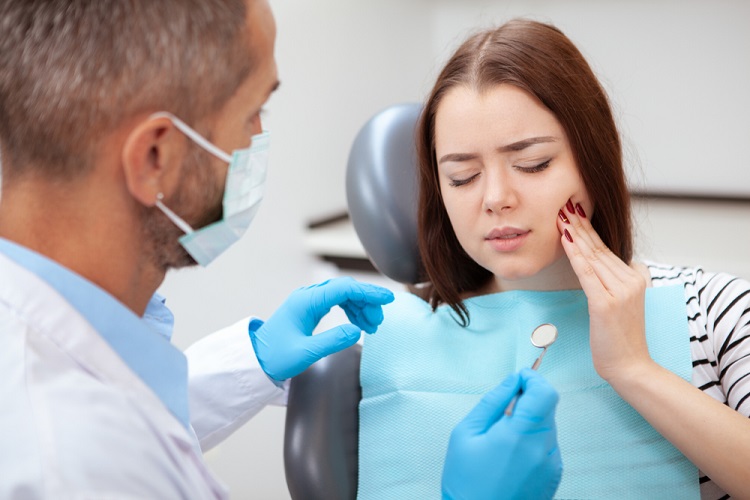
Like with other health issues, the best way to treat a dental emergency is to prevent it altogether. However, since people often restrict their oral hygiene to brushing alone, this usually results in dental problems, which can lead to dental emergencies if left untreated.
Sometimes the emergency would be severe and would require a dentist’s urgent intervention . Other times, however, it would be a mild ache, swelling, or bleeding.
Despite which situation you find yourself in, knowing how to act will not only help you tackle the problem—but it will also prevent further damage, and reduce the cost of treatment.
Trauma (and constant chewing and grinding) can cause parts of a tooth to break away. When this happens to you, the first thing to do is to rinse your mouth with warm water to prevent any imminent infection.
Next, rinse the broken pieces of tooth and store them in a clean cup of milk, saliva, or salt water. Then apply a cold compress to the affected area to reduce the pain and swelling, pending your next visit to the dental office.
If food or an object gets stuck between your teeth for too long, it can cause a gum infection, which can be excruciating. If you discover your gums are aching or acutely sensitive to touch, use a dental floss to gently remove the particles stuck between your teeth.
If you can’t remove them, then see a dentist as soon as possible. Never jab at the stuck particles with a sharp object, as this would only worsen matters.
If you have a tooth knocked out, pick it up by its crown—you mustn’t touch its root—and rinse it with water carefully. Then, if possible, gently reinsert the tooth into its socket.
If you try to do this and it proves difficult, place the tooth between your cheek and gum instead, while being careful not to swallow it. Or better yet place it in a cup of milk, saliva or salt water. After which, ensure that you contact a dentist immediately.
Depending on its severity, a toothache may be an indication of an abscessed or decaying tooth. While most toothaches will require medical attention, there are still some things you can do to ease the pain before seeing a dentist:
If you are lucky, the pain will subside after a while. However, if the pain persists two days, or is accompanied with a fever or pus discharge, contact a dentist as quickly as possible.
Here at KY Smile , we strive to ensure the overall satisfaction of our patients—you can book an appointment with us today.