A complete guide to shooting in NBA 2K27: what a green window is and how we measure it, rhythm shooting versus button shooting, the four jumpshot grades in the custom jump shot creator, the ratings and badges that widen your window, and the settings and practice tools that help you find your timing.
If you are struggling to shoot in 2K27, the size of the target is usually why. The run of milliseconds that goes in every time can be under 20 milliseconds wide, about a fiftieth of a second, so a jump shot that felt right as you let it go can still land outside it. None of that is random. It means your window is sitting somewhere you are not aiming yet, and finding it is what the rest of this guide is for.
Every jump shot has a green window. It is the span of time in which you can hold down the shoot button and it still counts as a make. We measure it in milliseconds because the timing is that precise: a typical pure window is only 15 to 20 milliseconds wide without any boosts.
The window is not a probability. It is a threshold. Release inside it and the ball goes in, every single time. There is no hidden roll waiting to take a perfectly timed shot away from you.
So a miss is information rather than bad luck. It tells you the release landed outside the window, and the only question worth asking is which side of it you were on.
We find it with modded controllers that hold the shoot button for an exact number of milliseconds. We test each millisecond twenty times until we get a green, then step forward one millisecond at a time until a millisecond fails all twenty attempts. That millisecond is the edge of the window. Once we know the edges, we take 200 shots every fifth millisecond across the window to chart the make rate.
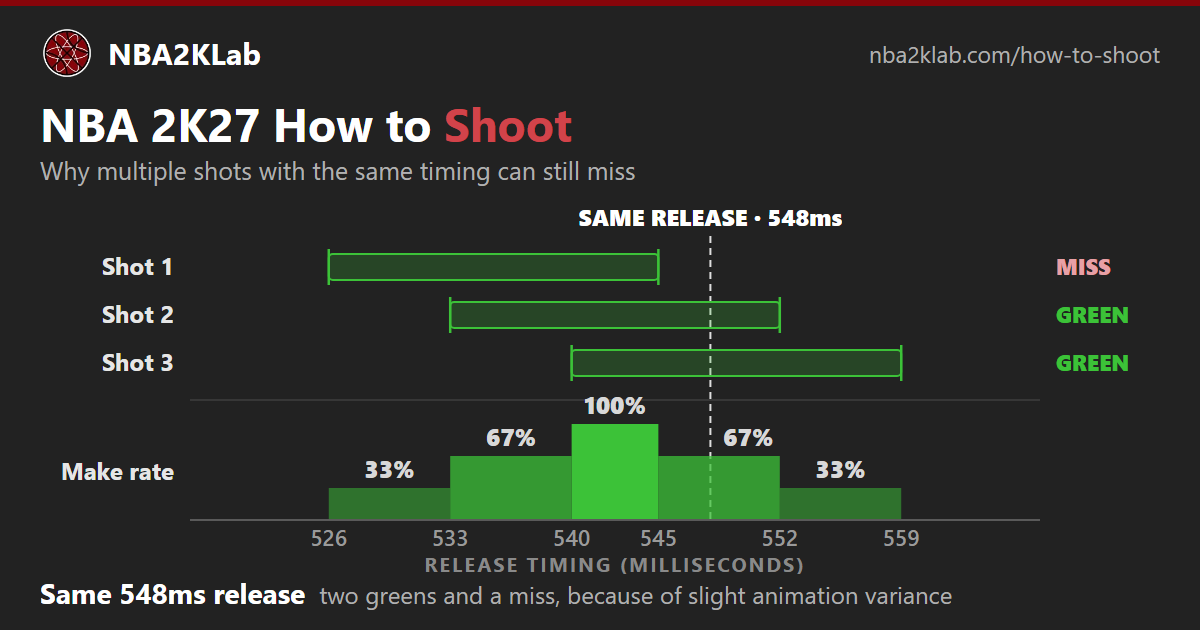
This is the obvious objection to everything above. If the window is pure, why does our own data show a curve that peaks in the middle and tapers toward the edges instead of a flat block of greens? The answer is not that the window leaks. It is that the window does not sit in quite the same place on every rep.
A jump shot is an animation, and no two attempts start from an identical position. Where the ball actually is when the gather begins, whether it swung up from your left hip or your right, which foot you planted on, what you were doing in the instant before you pressed shoot: each of those nudges the release point by a hair. The window is measured against the animation, so when the animation starts a fraction differently, the window travels with it.
That is why holding the button for exactly 520 milliseconds two hundred times is not the same as taking one shot two hundred times. It is two hundred near-identical shots whose windows sit a millisecond or two apart. Aim at the center and that drift is absorbed, because a couple of milliseconds in either direction is still comfortably inside. Aim at the edge and the same drift is enough to push some of those attempts out. The taper at the ends of our graphs is the shape of that drift, not the shape of a dice roll.
It is easier to see with three shots than with two hundred. Below, the same release is held on all three attempts, and the only thing that changes is where each shot's window happens to fall.
So aim for the middle, not the edge. Do not learn the earliest timing that greens. Learn the center, because the center is the only part of the window wide enough to survive a shot that starts slightly differently from the one before.
Two jumpers can have the same window width and still feel completely different, because the window also has a position. A shot that greens from 515ms to 570ms demands different timing from one that greens from 480ms to 535ms. Width is how forgiving the shot is. Position is what you have to learn.
The window is a fixed width for a given jumper, but it does not sit in the same place on every shot. Your shot speed is not fixed, and anything that changes it slides the window earlier or later without making it any bigger:
Your job is not to improve your odds. It is to work out where the window moved to.
Testing in progress Window width open, lightly contested and heavily contested, at full and drained adrenaline.
The headline question of the year, and the answer is more interesting than “one is better”. Both mechanics start from an identical base green window. What separates them is what happens next.
You get the base window, every time. No bonus, no penalty. It is the floor and the ceiling at once, which makes it the reliable choice while you are learning a new jumper.
Your tempo, meaning how fast you move the right stick from down to up, modifies the base window in both directions. Match the shot's tempo and the window grows. Rush it or drag it and the window shrinks to smaller than the button would have given you.
Rhythm asks more of you than the button does. The tempo match has to be genuinely close, and you have to green your timing to make the shot, exactly like the button. Rhythm applies at the free throw line too.
Worth saying clearly: the tempo bonus is not large. In his words, “it's not a massive boost”. Rhythm is a genuine skill bet with a higher ceiling and a higher floor to clear.
Testing in progress Button baseline vs rhythm at matched, rushed and dragged tempo, same jumper and same build.
Every jumper in the creator is graded on four attributes. Three of them describe how the shot behaves against a defender. The fourth describes how much timing room it gives you, and it is the one to read first.
How high the ball sits when it leaves your hands. A higher release is harder for a defender to reach, which is what makes it matter against contests rather than in an open gym.
How much of a shot contest the jumper shrugs off. This is the grade that decides whether a hand in your face is an inconvenience or the reason you missed.
How quickly the shot leaves. Not a free upgrade: the speed setting trades directly against the size of your green window. See the table below.
A direct multiplier on the size of your green window, and the single most important grade on the jumper for greening. Everything else being equal, this is the grade that decides how much room you have to work with.
Mike Wang has said the Release Window grade acts as a multiplier on your window, with A+ worth roughly a 10% boost, F roughly a 10% penalty, and the grades in between scaling across that range. We are treating that as reported rather than confirmed until we measure it ourselves.
Testing in progress Measured window width across the A+ to F ladder, to confirm the ±10% span and whether the grades really do lerp evenly.
The release speed setting on a custom jumper is not a free upgrade. It changes the size of your green window, and the quicker you set it, the less timing room you get.
Left column as stated by Mike Wang, 29 August 2026. Right column is our own test, 4,500 shots across the five settings. Both quick settings measured a little worse than he quoted and well inside our margin, so that half of the table checks out. The two slow settings came back about a point above Normal against a margin several times that, which is a boost we could not resolve rather than one we measured.
So the choice is a real one. A quicker release gets the shot off against a closeout and beats a contest that a slower shot would eat. A slower release gives you a bigger target to hit. Which is correct depends on whether you are getting blocked or getting slightly-earlys.
The bigger thing the test turned up is not about size at all. Every notch of release speed moves the hold that centers your window by about 15 ms, and 60 ms separates Very Quick from Very Slow, which is roughly twice the width of the window it is moving. Changing this setting is not a tweak to your odds, it is a new release point. See the release speed test .
We have now measured this, over 30,700 shots, and the answer is more specific than "higher rating, bigger window". The part of the window that greens on nearly every attempt barely moves: about ± 3.1 ms of room at a 65 against ± 3.6 ms at a 99 , which is 0.5 ms across the whole ladder.
What rating actually buys is the shoulder either side of it. The band where a shot still falls around 70% of the time goes from ± 5.8 ms to ± 13.9 ms over the same range, 2.4 times the room to be early or late. So rating is not what makes you green; timing is. Rating is what stops a slightly bad release from becoming a brick. See the full ratings test .
Takeover dwarfs both of those. We ran the same test with the Calibrated takeover up and down, and it is worth 2 times what the whole ladder above buys, plus something no rating produced at any level: a 20 ms stretch of hold times that greened 500 times out of 500 . See the takeover test .
The Jump Shots skill boost is the same lever bought for VC, and we measured that too. It is worth about 4.3 % more makes across the window, mostly on early releases, and the meter off boost below is 4.2 times bigger. See the shooting boost test .
Hot zones are the lever that costs reps instead. We shot the same corner with the zone cold, neutral, hot and lethal: a lethal zone is worth about 5.4 points across the window, mostly on late releases, and a cold one costs about 2.1 . That is about 2.3 shooting boosts for nothing but practice. See the hot zone test .
Your Three-Point Shot and Mid-Range Shot ratings also gate which jumpshot bases and releases you can equip at all, so they buy you access as well as forgiveness. Mike Wang has been clear that high shooting percentages are achievable in 2K27, but that most players will need real practice to get there, and that higher ratings and badges help you get there faster.
Plan your ratings in the MyPLAYER Builder · Animation requirements by rating
There are 9 shooting badges in 2K27, 5 of them new. The most useful way to read the list is as a two-by-two: whether you are set or moving, and whether you are shooting a three or a mid-range. Four of the five new badges fill exactly those four boxes.
That split is genuinely new, and it changes badge planning: a spot-up shooter and a shot creator now want different badges rather than different tiers of the same badge.
All 2K27 badge tests · Badge requirements · Badge tokens
Best 2K27 settings · Controls
Mike Wang's advice on getting better at shooting is two steps, and it is the same thing our testing has shown for years:
“Try out different jumpers to see which ones you naturally can match the tempo consistently with. Once you find that, just stick with it and get the reps in to perfect your timing.”
The second step is on you. The first one is where most players lose a season. The creator holds roughly 800 bases, roughly 800 options again in each of the two release slots, and a hundred blend steps between them. Multiply that out and it is billions of possible jump shots, and their pure windows are nowhere near the same size. Some hand you a target you can still hit with a defender closing. Plenty hand you almost nothing. Trial and error cannot search a space that size, and the gap between a forgiving jumper and an unforgiving one is far too fine to feel out a few shots at a time. Work through it by hand and you will spend thousands of attempts learning the timing of jumpers that were never going to fit you.
That first step is what we measure. NBA2KLab Premium carries the green window, shot speed and make rate for every 2K27 jumper we have run on the rig, so you can compare them on numbers instead of on feel. The Jumpshot Recommender goes further and reads ten shots off your own meter, then returns the jumpers that match the timing you already shoot. That turns Mike Wang's first step from a season of guessing into an afternoon.
Then put the reps in, because nobody can do that part for you. Pick one jumper off the shortlist and stay on it. Shoot at the middle of its window rather than the earliest millisecond that greens, since the middle is the only part wide enough to survive a shot that starts slightly differently. And practice the shots you actually take in games, off the catch and off the dribble, not just standing still in an empty gym, because those are different timings.
See what's on Premium
Straight from the source, newest first. These are the same posts that feed our 2K27 Dev Updates page.
Asked: Does losing adrenaline shrink your green window or only drops your shot ratings?
Asked: @Beluba are shot cues still in the game?
Asked: @Beluba Would you say similar to NBA2k25 rhythm shooting then?
Asked: @Beluba little follow up, but is there a percentage boost for shooting with pro stick again this year?
Asked: will off dribble shots be easier from the 3pt line this year? players like luka hit stepback 3s all the time but in the game is nearly impossible, makes it very hard to emulate that playstyle
Subscribe to our YouTube channel to see our badge tests the instant they are complete.