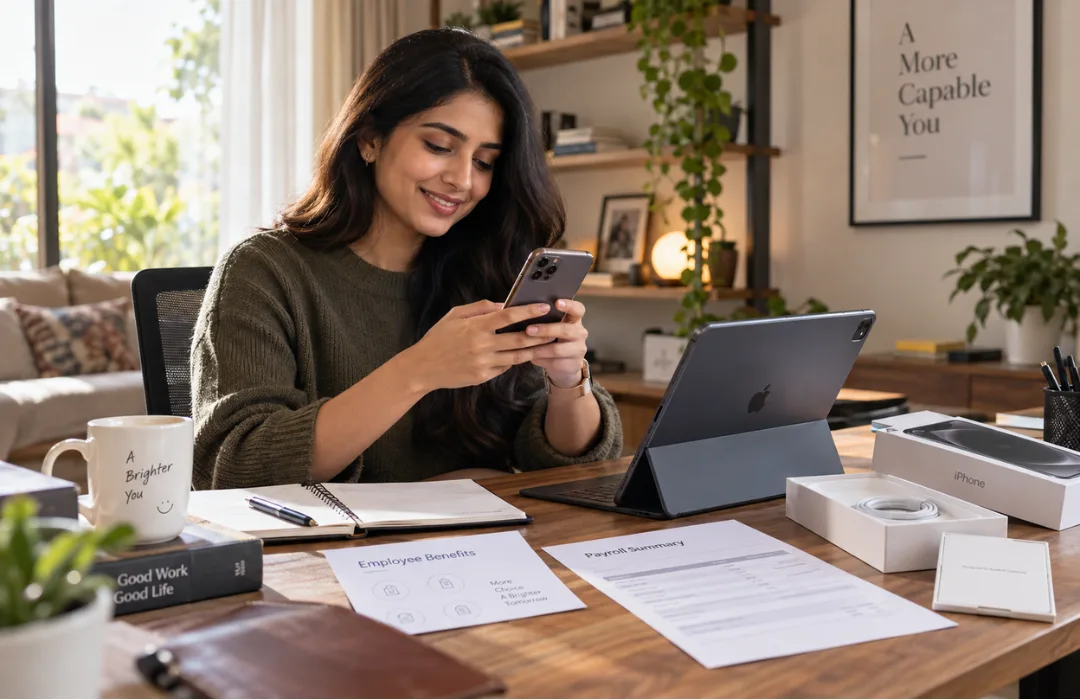
A well-structured Employee Purchase Program enables organizations to deliver premium devices as a meaningful employee benefit without affecting the balance sheet. This article explains how payroll-linked design, security controls, and partner ecosystems create protection, efficiency, and a seamless experience.
Employee benefits conversations in India have matured. Compensation alone no longer defines employee value. Access to reliable personal technology now plays a direct role in productivity, hybrid work readiness, and engagement. HR and finance leaders are increasingly expected to design employee purchase programs that feel modern while remaining financially prudent and operationally controlled.
This shift has elevated the Employee Purchase Program from a niche benefit to a strategic lever. When designed correctly, it allows employees to acquire premium devices through payroll deductions while ensuring the organization carries zero corporate cost, zero credit exposure, and minimal administrative burden.
The challenge lies in execution. Many programs fail not because the intent is flawed, but because they overlook protection, governance, and employee experience.
At first glance, offering employees access to premium smartphones appears straightforward. In practice, several hidden risks emerge. Finance teams worry about credit exposure if employees exit mid-tenure. HR teams worry about employee dissatisfaction if processes feel opaque or restrictive. IT teams fear data security on personally owned devices. Procurement teams worry about vendor complexity and compliance.
We have often observed that employee trust in benefits programs declines sharply when processes are unclear or inconsistent across employee cohorts. Benefits that create confusion ultimately erode engagement rather than improve it. A resilient Employee Benefit Purchase Program must be engineered with these concerns at its core, not treated as an afterthought.
This challenge is examined in greater detail in an earlier discussion on why employee benefits often fail to work in practice, even when they appear well designed on paper.
The most effective Employee Purchase Programs are anchored to payroll, not reimbursement or ad hoc financing.
Payroll-linked deductions eliminate upfront payments for employees and remove credit risk for employers.
Deductions are predictable, auditable, and aligned with tenure.
This structure also simplifies exit scenarios by enabling final settlement adjustments without manual intervention.
From an employee standpoint, payroll deductions remove the friction of personal financing.
From a finance standpoint, they preserve cash flow and ensure zero corporate liability.
This payroll-centric architecture enables employee purchase programs like Zaggle's to scale across mid- to large-sized enterprises without creating administrative drag.
A related viewpoint explains how payroll-aligned benefits can boost take-home pay without increasing fixed costs , a consideration increasingly relevant for finance leaders.
Premium devices introduce premium risks. Data breaches, misuse, and device loss can quickly turn a benefit into a liability. Enterprise-grade security must therefore be embedded into the program design. This includes controlled access to authorized devices, secure onboarding, and clearly defined ownership and compliance policies.
Employee-owned devices remain among the most under-governed endpoints in enterprise ecosystems. A structured Employee Purchase Program addresses this gap by combining personal ownership with enterprise-grade controls, like ISO 27001. Protection in this context is not about restricting employees. It is about creating confidence for all stakeholders involved.
Another critical determinant of success is partner ecosystem design. Device availability, pricing consistency, warranty handling, and service support all influence employee perception. Programs built on fragmented vendor networks often struggle with delays, inconsistent pricing, and service disputes. In contrast, structured partnerships with leading technology distributors ensure reliability and scale.
Zaggle’s collaboration with distributors and OEM partners (Redington, Apple, Samsung, Google) exemplifies how access to premium devices and structured leasing models can be delivered without operational friction. For employees, this translates into choice and transparency. For organizations, it translates into governance and predictability.
An Employee Purchase Program ultimately lives or dies by employee experience. Complicated approvals, unclear pricing, or delayed fulfillment undermine adoption. High-performing programs focus on simplicity. Employees understand eligibility upfront. They see savings clearly. They know precisely how deductions work and when ownership transfers. Benefits programs with high clarity and ease of use help enhance employee engagement than those with similar financial value but poor experience design.
This is where seamless onboarding, intuitive communication, and predictable fulfillment become strategic assets rather than operational details.
The link between choice and engagement is discussed more fully in a companion piece on how flexible benefit plans improve employee morale across diverse workforces.
Savings are an essential but sensitive element. When positioned poorly, they can make a premium benefit feel transactional. Well-designed programs quietly unlock value. Employees benefit from negotiated pricing, structured leasing, and potential tax efficiencies where applicable. Organizations benefit from scale economies without appearing to subsidize consumption.
Programs like Zaggle, which enable savings of up to 48% on MRP, while maintaining zero corporate cost, create a rare alignment between employee satisfaction and financial discipline. At this point, HR and finance leaders often explore how device-led benefits compare with other modern employee perks and benefits programs, especially in hybrid work environments.
Reimagine device benefits clearly. Protect cash flow consistently. Explore Smarter Benefits Now.
Governance does not need to be heavy-handed to be effective. The strongest Employee Purchase Programs embed compliance naturally through payroll systems, partner contracts, and policy alignment.
Clear policies around eligibility, repayment terms, device ownership, and employee exits help prevent disputes before they arise. Structured exit workflows and payroll-linked records create a reliable audit trail while minimizing administrative effort.
By building compliance into the program rather than managing it reactively, organizations can maintain control without creating friction. For CFOs and CHROs, this balance between flexibility and accountability is what separates scalable programs from short-term experiments.
Many enterprises treat Employee Purchase Programs as tactical benefits rather than strategic platforms. As a result, they fail to integrate them with broader employee engagement and financial wellness initiatives. When aligned with engagement goals, such programs reinforce employer brand, support productivity, and signal long-term investment in employees. They become part of the organization’s value narrative rather than a standalone perk.
A short example highlights the difference. In one rollout for a large enterprise, integrating the Employee Purchase Program with the organization's broader engagement and financial wellness initiatives increased adoption from 35% to 60%. The program was positioned not as a standalone device benefit, but as part of a larger employee value proposition, making it more visible, relevant, and easier for employees to understand.
This is also where benchmark-driven approaches matter. Platforms that have institutionalized payroll integration, partner management, and security controls set the standard that others attempt to replicate.
Design benefits strategically Eliminate operational risk Explore Now
A modern Employee Purchase Program is not about selling devices. It is about designing a protected, seamless, and financially neutral experience that employees trust and organizations can scale.
Zaggle’s approach positions the Employee Purchase Program as an enterprise-grade benefit framework rather than a transactional offering. The emphasis remains on protection, simplicity, and long-term sustainability. For leaders evaluating how employee engagement, employee perks and benefits, and financial discipline can coexist, this model provides a practical reference point rather than a sales pitch.
The future of employee benefits in India will be defined by programs that combine relevance with responsibility. Employee Purchase Programs that integrate payroll discipline, premium protection, and seamless experience meet this standard. When executed thoughtfully, they enhance engagement without compromising governance and deliver value without increasing financial burden.
A well-designed Employee Purchase Program helps organizations strengthen employee engagement while maintaining operational simplicity.
Assess your benefits strategy.
Simplify payroll-led programs. Talk to an Expert Now.
An Employee Purchase Program is a corporate benefit that allows employees to purchase products such as smartphones, laptops, and other devices at preferential pricing through payroll deductions or structured payment plans. It helps employees access premium technology while enabling organizations to offer a valuable benefit without significant administrative effort or corporate liability.
Premium protection is typically built through a combination of authorized device sourcing, clearly defined ownership policies, payroll-linked payment structures, and enterprise-grade security practices. These measures help protect both employees and organizations while ensuring a smooth and compliant experience.
A robust Employee Purchase Program should incorporate secure data handling practices, employee consent management, controlled access to personal information, audit-ready documentation, and partnerships with trusted technology providers. Organizations may also align program governance with their broader IT, HR, and information security policies.
Implementation timelines vary depending on organizational size, policy requirements, and payroll integration needs. However, many programs can be deployed within a few weeks when supported by established technology platforms, predefined workflows, and experienced implementation partners.
Most Employee Purchase Programs offer employees a choice of devices from approved brands and models. The available options depend on the program structure, partner ecosystem, and organizational policies, allowing employees to select a device that best meets their personal and professional needs.
What happens to the device if an employee leaves?
The outcome depends on the program terms and the stage of repayment. In many cases, clearly defined exit management processes determine how any outstanding obligations are settled and when full ownership transfers to the employee. These policies are typically communicated upfront to ensure transparency and avoid disputes.
Expert contributor and editor at the Zaggle Knowledge Hub, specializing in corporate spend management, expense compliance, and B2B fintech solutions.
Posted on : Sep 22, 2026
Posted on : Aug 5, 2026
Posted on : Jul 28, 2026