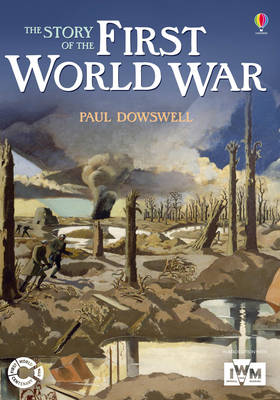
By Paul Dowswell (author) , Ian McNee (illustrator) Part of the Narrative Non Fiction series
Paperback Not Available
View All Editions (1)
An excellent introductory history of the First World War told in short, accessible chapters, this describes some of the key moments of the conflict and some of the reasons why it was so much more devastating than had been anticipated. Opening with the then widespread belief at the time that it would be ‘over by Christmas’ key military moments such as the zeppelin campaign, the Battle of Jutland and the devastating battle of the Somme are described as well as the unlikely but true events including the famous football match on Christmas Day 1914.
It looks at the causes of the war, its great battles and catastrophes, as well as how the war affected nations and people all over the world. It features pages that are brought to life through vivid illustrations and original photographs, as well as timelines, maps and fact boxes.
Read the full description
This is a fascinating account of one the most destructive conflicts the world has ever known, published in association with the Imperial War Museums.
Paul Dowswell cemented his position as one-to-watch in the world of children’s historical fiction with his much-acclaimed WWII novel, Ausländer . Throughout all of his fiction, Paul weaves meticulous research into thrilling narrative that will engage young readers.
A former senior editor with Usborne Publishing, Paul Dowswell is now a full-time author. He has written many non-fiction titles, two of which were shortlisted for the Blue Peter Book Award. Powder Monkey, his first novel, was published to huge critical acclaim. Ausländer was shortlisted for the Booktrust Teenage Prize and the Red House Children’s Book Award. He currently lives in Wolverhampton with his family.
The Cabinet of Curiosities is set in 16th Century Prague, during the reign of Rudolph II. Lukas Declercq, fleeing the Inquisition in his native Ghent, arrives in the city in 1598 to be apprentice to his Uncle, court physician Anselmus Declercq.
Seeking company away from the staid confines of the castle, Lukas is drawn to the excitement of the city’s darker side. He becomes an unwitting pawn in the battle to control what people are permitted to say and think. (Here the story shares some ground with my previous book Ausländer about a teenager in Berlin during the Second World War.) Ultimately, Lukas learns how to make his own choices between right and wrong, and that the answer is rarely clear-cut.
The idea behind the story was inspired by Giuseppe Arcimboldo’s fruit ’n’ veg portrait Vertumnus, of Rudolph II. A culture which produced something so magnificently strange and original sparked further investigation.
I visited Prague and the Castle whilst researching the book. Woodcuts and engravings from the era show that much of the city remains from Rudolph’s time. The contents of his Cabinet of Curiosities – an extraordinary collection of mechanical and scientific instruments, specimens, paintings, and relics – are well documented. Four huge rooms contained everything from astrolabes and orrerys to Dürer’s famous watercolour of a young hare, and, supposedly, nails from Noah’s Ark and feathers from a phoenix. Much of the Cabinet was scattered to the four corners of Europe when the Castle was looted by Swedish Troops in 1648 during the 30 Years War. A fraction remains in Prague. The rest can be found in museums and art galleries around the world.
Rudolph was plagued throughout his life by severe depression – all the more reason to admire his open mindedness, tolerance, and passion for art and science. In a Europe haunted by the Inquisition, his Prague was an oasis of free-thinking where Catholics, Protestants and Jews lived side by side. Here, natural philosophers could investigate and share their knowledge of the newly-emerging sciences without fear of being executed as heretics. This was an age, after all, where an astronomer could be burned at the stake for stating that the Sun was at the centre of the Solar System rather than the Earth. In his patronage of alchemy and fascination with the world, Rudolph was an early champion of the Scientific Revolution of the 17th Century.
Photo credit David Rann
the best books for 9-12 year olds · the best books for teenagers
On the Move: Poems About Migration
The Lost Child of Chernobyl; A Graphic Novel
The LoveReading4Kids Editorial Team have read and reviewed The Story of the First World War and determined it is suitable for children aged 9-12 years old
The Story of the First World War features in the following genres: Featured Books for 11+ readers, Recommendations, Warfare & Battles, Children’s / Teenage: General interest, Children’s, Teenage and Educational, History, Featured Books for 9+ readers
Paperback. Not Available.
The Story of the First World War was written by Paul Dowswell and published by Usborne Publishing Ltd
The Story of the First World War has 95 pages
Yes it is part of Narrative Non Fiction series
©PTC International Ltd T/A LoveReading is registered in England. Company number: 10193437. VAT number: 270 4538 09. Registered address: 157 Shooters Hill, London, SE18 3HP. Terms & Conditions | Privacy Policy | Disclaimer
The National Year of Reading starts here. Join thousands of families and schools supporting reading for pleasure across the UK.