MONTHLY REPORT - VETERINARY CLINICAL INTERVENTIONS FOR THE SOUTHERN CONSERVATION AREA (MVU) – JULY 2016
SCA-mvu during this month was faced with an increased number of cases within the ecosystem. The gradual increase in the number of cases is probably due to the dry spell that is setting in. Cases ranged from human wildlife conflict to poaching.
CASE#1 ELEPHANT RESCUE
A young elephant was reported abandoned in Amboseli ecosystem within community land in Rombo area by Big Life rangers. The mother could not be traced hence reunion was impossible. A decision was made to relocate him the DSWT stockade at Nairobi National park for care and nurturing.
Physical restraint was used due to the age of the baby elephant. Using a land cruiser the young elephant was relocated to Amboseli National park awaiting relocation to Nairobi. The DSWT arranged for a chartered aircraft to relocate the elephant to the Nairobi stockade.
The elephant was immediately airlifted to Nairobi for care and nurturing.
The elephant is in good health and chances of survival high.
CASE#2.TREATMENT OF AN ELEPHANT WITH AN ARROW INJURY
Location; Tsavo East
The elephant was spotted by the DSWT rangers while on routine patrol. Plans were made to airlift the vet from Amboseli to Ithumba immediately. The veterinary team from Amboseli attended to the case for assessment and treatment.
Immobilization, examination and treatment
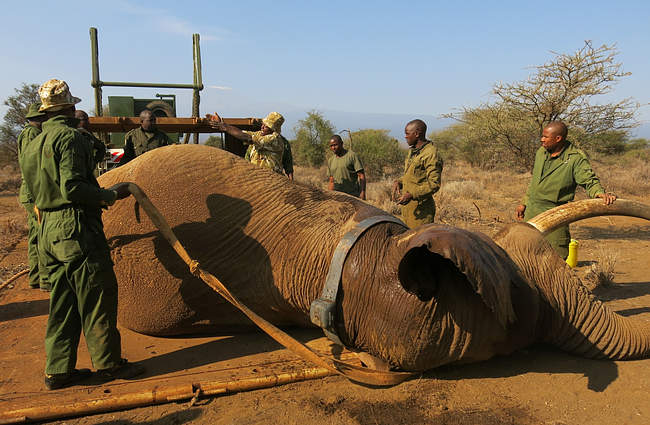
The elephant was immobilized using 17 mgs Etorphine Hydrochloride in a 3cc dart using the Dan Inject system from a vehicle. The elephant went down in a dog sitting position after 8 minutes and therefore had to be flipped to access the wound and for safety of the elephant. The trunk was maintained patent using a piece of stick placed across the nostril entrances. The temperature was high hence plenty of water was doused on the elephant to keep the body temperatures low. The ears were used as blindfold.
On physical examination the elephant had a wound (approx. 2 months old) to the right flank region. The wound was septic with necrotic tissue and had been caused by an arrow head. The wound was thoroughly cleaned using water and Hydrogen Peroxide then lavaged using tincture of Iodine. Topical antibiotic cream and green clay was then applied into the wound to facilitate healing and avoid infection. The elephant was then injected with 100 ml Betamox L.A and 50 ml Dexamethasone at different sites intramuscularly. The entire operation lasted about 30 minutes.
Diprenorphine Hydrochloride (48mgs) into the ear vein was used. It took about 5 minutes to be fully awake from anaesthesia.
CASE #3 POSTMORTEM OF A POISONED LION
Age: Adult (6-8 yrs)
The female lion was found dead in a ridge and was heavily swollen. Adjacent to the carcass was a dead black backed jackal also presumably died on the same day. Within 100 meters there were also remnants of bovine offals. The post-mortem was performed 5-7 days after death.
Pathological changes in the carcass included;
The pathological changes indicated the cause of death to have been poisoning. The changes are characteristic of Amitraz. This is a very common poison available in all agrovet shops and is suspected to have been used in this case. The fact that a black backed jackal with similar pathological changes died at the same time and within a radius of about 100meters indicates that the two animals must have fed on the same poisoned bait.
The presence of offals within the same area indicates that the culprits may have used the offals for poisoning the animals.
CASE #4 POSTMORTEM OF A POISONED BLACK BACKED JACKAL
Species; Black Backed Jackal
The jackal was found dead in a thicket adjacent to a lion carcass that presumably died on the same day. Within 50 meters there were also remnants of bovine offals. The post-mortem was performed 5-7 days after death.
The pathological changes indicated the cause of death to have been poisoning. The changes are characteristic of Amitraz. This is a very common poison available in all agrovet shops and is suspected to have been used in this case. The fact that a lion with similar pathological changes died at the same time and within a radius of about 100meters, indicates that the two animals must have fed on the same poisoned bait.
CASE#5 AN ELEPHANT INJURED DURING HUMAN WILDLIFE CONFLICT
Date: 12th July 2016
Age: Adult (25-30 yrs)
Location: Amboseli ecosystem-Selengei
The elephant was spotted by Big Life Rangers. It had a fairly large swelling on the left hind limb. He also had a clearly visible wound on the left hind quarters and was severely limping.
This elephant was immobilised using 17mg Etorphine Hcl in a 3 ml Dan - inject dart using the Dan-Inject system from a vehicle. After 8 minutes, the bull went on lateral recumbence. The trunk was maintained patent using a piece of stick placed across the nostril entrances. Plenty of water was doused on the elephant to keep the body temperatures low. The ears were used as blindfold.
On physical examination the elephant had swelling of the left hind limb. A clearly visible wound was also seen on the hind quarters. The wound was 15 cm deep and had been caused by a spear in a human wildlife conflict situation about 4 days earlier. The wound to the hip was most likely inflicted by a fall or fight. It was suspected that the swelling could have been caused by trauma. The elephant was injected with 200 ml Betamox L.A and 100 ml Flunixine meglumine at different sites intramuscularly. The entire operation lasted about 30 minutes.
Diprenorphine Hydrochloride (54 mgs) into the ear vein was used. It took 10minutes to get up and walk away from the site. However, he had to be assisted by a land cruiser to get up. A follow up after 3 to 4 weeks will determine the fate of the elephant.
CASE #6 POSTMORTEM OF A SPEARED ELEPHANT
Date: 13th July 2016
Age: Adult (45-50 years)
The carcass was relatively fresh (3-4 days old) and the head region had been scavenged on presumably by scavengers.
The wound was relatively fresh and had not punctured any vital organs indicating the death was quite fast. The wound was too big for a bullet or an arrow head therefore the poachers must have used a spear laced with some lethal poison targeting the huge tusks.
Skin and soft tissue with the powder on it were collected and delivered to the veterinary headquarters for further investigation
CASE#7.TREATMENT OF A SICK LION
Date: 27th July 2016
A lioness was spotted by rangers at Amboseli National park and reported to have been lame and emaciated. The veterinary team immediately attended to the case and made a decision to immobilize and examine the lion.
The lion was immobilized using 4.0 mgs Medetomidine and 295 mg Ketamine in a 3cc dart from a vehicle using Dan-inject system. Full immobilization took place after 6 minutes and he fell on lateral recumbence. The lion was blind folded and opticlox applied to the eyes.
On physical examination the lion had no injuries but was highly emaciated and anemic.
The lion was injected with 40 ml Betamox and 30 ml Dexamethasone at different sites intramuscularly. 10ml Catasol and Ivomec was also administered to take care of the external and internal parasites. The operation lasted 1 hour and 30 minutes.
The lion was then revived using 12 mg Atipamizole and was fully recovered after 30 min. The young lion was fed on an impala carcass that had been hunted down by other carnivores and abandoned.
A follow up indicated a healthy looking lioness on her footpath to recovery.
CASE#8 ELEPHANT RELOCATION FROM MARBA-AMBOSELI ECOSYSTEM
Date: 31st July 2016
Species: African Elephant
Location: Marba-Amboseli
This elephant has been invading farms and destroying valuable crops including maize, beans, watermelons, tomatoes among others as well as water storage facilities, a property of the community members. The animal has posed a major security threat to people, on daily basis as they invade various facilities and farms. This elephant bull with no family was roaming freely in farmlands daily causing public panic and crop destruction. Kenya Wildlife Service management requested us to move this problematic animal to Tsavo East National Park.
The elephant was immobilised using 18mg Etorphine in a 3 ml Dan - inject dart Using a Dan inject dart rifle from a helicopter. The elephant was darted at 7.14 am and he was immobilized after 25 minutes. He went down in a dog sitting position and was flipped onto lateral recumbence using the land cruiser. It took about two and a half hours to load the animal into a truck. To keep the elephant under anesthesia total of 3mg of Etorphine Hcl was used as a to top up at a dose rate of 1mg of Etorphine given I.V at 08.14am, 8.50am and at 9.37 am.
The elephant was also injected with the following, Oxytetracycline 30000mg I.M and Dexamethasone 50mg I.M
The anaesthetic was reversed using 72mg of Diprenorphine IV in the ear vein at about 10.25 am. Due to complications of anaesthesia considering the age, the elephant could not get up. He succumbed to the complications and died despite efforts applied; 20ml Dexamethasone iv, and Naltrexon.
The Southern Conservation Area Mobile Veterinary Unit is grateful to all individuals and organisations that played a role in assisting us towards achieving our goal. Many thanks to The David Sheldrick Wildlife Trust, The Samuel J and Ethel Lefrak charitable trust and The Kenya Wildlife Service for their continued support to this unit which aims at immediate response to clinical intervention, wildlife rescues and alleviating wildlife suffering.