MONTHLY FIELD VETERINARY REPORT FOR MASAI MARA – APRIL 2017
By Dr. Campaign Limo
This month the Masai Mara area has received sporadic rain fall and water and forage is relatively available for wildlife. Possibly due to the onset of the rains the area has been relatively calm and few cases have been reported. The Vet Unit investigated an incident involving the mysterious loss of two young elephant bulls at Nguruman and conducted a post mortem. Samples were collected to help identify the cause of their deaths and the results of the analysis are being awaited.
The following are cases attended during the month;
CASE#1 TREATMENT OF AN INJURED LIONESS
Date: 8th April 2017
Species: African lion
Location: Masai Mara National Reserve (Musiara area)
This lioness was seen with an injury to her right hind limb by Masai Mara National Reserve Rangers on patrol and the Governors Camp Guides who sought our help treat her. This lioness was found relaxing under tree with her two one year old female cubs. The injury was evident from a distance as she displayed a slight limp while moving. They all appeared hungry.
Immobilization, examination and treatment
Restraint was achieved chemically by use of a combination of 4.8mgs Medetomidine and 200mgs Ketamine in a 3ml dan-inject dart. The vet approached the lion in a vehicle to dart her and it took ten minutes for her to be completely anaesthetized with the cubs moving a short distance away.
Examination revealed a moderately deep injury most likely inflicted by a sharp object. Part of the muscle tissue was severed but luckily the wound was not infected. The wound edges were debrided and deeper layers stitched together with absorbable suture whilst the skin layers were closed with nylon. Tincture of iodine and Cloxacillin ointment were infused into the wound to prevent infection and hasten healing.
Additional treatments included parenteral administration of 3000mgs amoxicillin antibiotic and 80mgs Ivermectin parasiticide.
Reversal and Prognosis
Reversal of the anaesthetic was achieved by intramuscular administration of 20mg Atepamezole hydrochloride one hour after immobilization. She got up after eight minutes to join her cubs.
CASE#2 MYSTERIOUS ELEPHANT DEATHS IN NGURUMAN
Date: 9th April 2017
Species: Elephant X 2
On Sunday 9th April 2017, Mara Mobile Veterinary Unit got a call from KWS officer in-charge Nguruman station requesting a post mortem of two young elephants found dead by a water pool on the morning of this date at GPS S 01.98168 E036.0824. The two elephants were reported to have been in a big herd and none of them had been seen with visible problems the previous day. They died hardly 5 meters from each other and under similar circumstances, immediately after drinking water.
It was reported there were new rains in the area with plenty of pasture sprouting.
General examination of the carcasses
Both carcasses were intact with no visible injuries noted externally. They had been pulled some distance away from the pool to avoid pollution of the water as they deteriorated. From the appearance, they died under similar circumstances possibly soon after drinking water and were in good body condition just before death. Brief interview with first witnesses and the locals indicated there were no recent reported deaths in both domestic and wild species and these elephants were seen the previous day in good body condition. They could have died overnight since the carcasses appeared relatively fresh, less than eight hours old. An aerial and ground check on the other herd members nearby indicated they were fine.
Post mortem was conducted on both carcasses in turns with the following picture.
On opening this carcass, the following picture was noted;
Samples collected from this carcass include-
This was the smaller bull 4-5 years on estimation. He died under similar circumstances as the bigger male with all described findings noted on opening. He was in good body condition, but more bloated than his counterpart.
Opening of the carcass revealed the following additional findings;
Samples collected from the carcass include;
These elephants died mysteriously under similar circumstances. Drinking of water exacerbated the situation either dissolving the pre-ingested harmful substance for quick systemic availability or worsened a simple bloat by increasing intraabdominal pressure impacting negatively on lung expansion with resultant dyspnea, hypoxia.
The collected samples were submitted to the Government Chemist for analysis.
CASE#3 TREATMENT OF A GIRAFFE IN RUMA NATIONAL PARK
Date: 21st April 2017
Species: Masai Giraffe
Location: Ruma National Park
There were reports of giraffes displaying signs of chronic emaciation over the last two weeks within the park. Three days prior to this intervention, one sub adult was reported to have died and there was urgent need to investigate and identify possible cause of this problem.
Several herds of giraffes were observed in an attempt to identify one with similar signs for sampling and treatment but all appeared to be in good condition. One adult female was seen in a herd of about 30 giraffes with slight loss in condition and the team agreed she be treated and sampled.
Immobilization was achieved by use of a combination of 12mgs Etorphine hydrochloride and 50mgs Azaperone delivered in a 3ml dan-inject dart from a vehicle. It took seven minutes for the drugs to take full effect with the giraffe going down on right lateral recumbence. The sedative was immediately reversed with 150mgs Naltrexone and the giraffe restrained manually for examination.
All the parameters were within range except slight anaemia was noted. Given that there has been an upsurge of tsetse population in this park from the latest investigation and documentation, Trypanosomosis was not ruled out and featured as a differential. This is especially considering the long drought experienced over the country for the last few months which could have caused stress and increased susceptibility influencing resistance. Thick and thin blood smears were prepared for microscopy and whole blood collected for DNA.
Diminazene acetuate was given intramuscularly for trypanosomosis along with Oxytetracycline as anti-biotic as well as Anti-ricketsial. Additionally she received an injection of a tonic and blood boosting drug.
The anaesthetic was reversed before examination and treatment and the giraffe remained restrained manually to avoid anaesthetic complications. Her prognosis is favourable.
CASE#4 LION TREATMENT AND COLLARING
Location: Mara north Conservancy
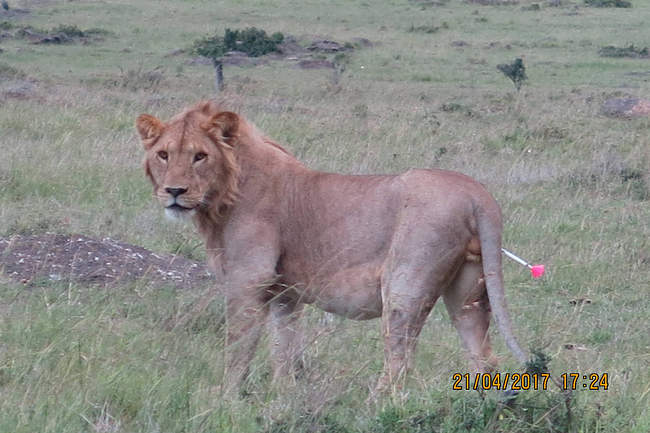
This lion in a coalition of three males was limping slightly on his front left leg. He was also a candidate earmarked for collaring by KWS and other partners for monitoring purposes.
This lion was lying under a tree a few meters from the other males. He had recently fed and was in good condition.
Restraint was achieved chemically by use of 4.8mgs Medetomidine and 200mgs Ketamine in a 3ml dan-inject dart. The vet approached the lion with a vehicle for darting. It took twelve minutes for him to be fully anaesthetized upon which a blindfold was put in place and Cloxacillin ointment applied to both eyes.
Examination revealed a small wound to one of his left paws, which could have been caused whilst hunting, otherwise he was in perfect condition. This wound was cleaned and topical oxytetracycline spray applied. Additionally, he received parenteral injection of Penicillin and Streptomycin combination antibiotic. When treatment was complete, a Satellite and GSM collar was deployed for monitoring.
Reversal of the anaesthetic was achieved by intramuscular administration of 20mgs Atepamezole hydrochloride one hour after immobilization. He will make a full recovery as he is a very healthy male.
The Mara Mobile Veterinary Unit would like to extend their gratitude to all stakeholders who helped report cases that required intervention. Thanks to Minara foundation through DSWT for their continuous facilitation. Thanks to KWS management for their technical advice.