FIELD VETERINARY REPORT FROM MASAI MARA-MARCH 2018
The period under review was characterised by increased precipitation leading to severe flooding of most seasonal rivers. This hampered mobility and drastically reduced number of cases reported and attended to. This also came as a blessing for wildlife as this led to availability of plenty of water and forage.
Cases attended to included a week old baby hippo which was swept away by floods but was eventually rescued and re-united with the mother. The month also witnessed an increase in domestic animal predation by lions with the community retaliating by spearing a young lioness after killing several sheep in an enclosure at night. KWS officers took over investigations and offered assurance to the affected families. This happened only a week after another pride killed several cows in a nearby village. The owners were convinced to give wildlife authorities a chance for investigation and possible compensation.
The following cases were handled during the month;
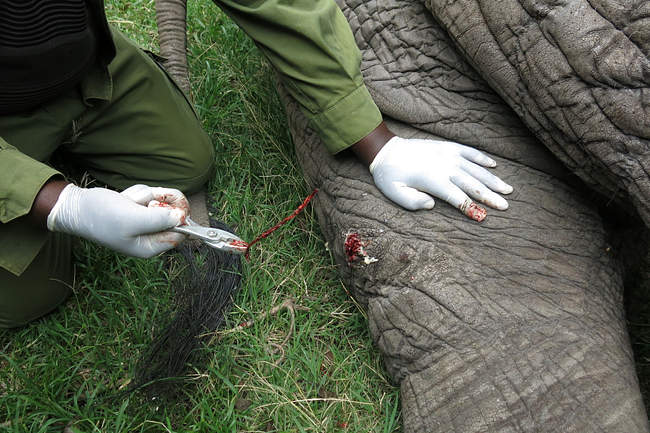
CASE#1 INJURED ELEPHANT
Species: African elephant
Location: Musiara area (Near Main Governor’s Camp)
This old bull nicknamed `Blossom’ is a regular visitor to Governor’s camp.
He was spotted with an arrowhead at the base of his trunk and a suppurating wound on his right hind leg by Masai Mara Reserve Rangers and Governor’s camp guides. They called the mobile veterinary unit for help. This old bull was seen near the camp in company of a very protective young bull. He appeared calm with the arrowhead clearly visible from a distance.
Immobilization, examination and treatment
Restraint was achieved chemically by use of 15mgs Etorphine hydrochloride delivered through a 1.5ml dan-inject dart from foot. All along, the young bull was very protective of him and made several mock charges before eventually moving away. The big bull followed him before being overwhelmed by the anaesthetic ten minutes later after covering close to 500meters. After stabilizing him, a thorough examination was conducted. The barbed arrowhead was retrieved from the base of the trunk and another one was found and removed from the injured left thigh after deep probing. Both arrowheads were considered not poisoned. The wounds were thoroughly cleaned with copious amount of water and hydrogen peroxide. Tincture of Iodine was used for disinfection and Cloxacillin ointment infused.
Other treatments include parenteral administration of 30000mgs amoxicillin antibiotic and 5000mgs flunixin meglumine anti-inflammatory.
Reversal of the anaesthetic was achieved by administration of 36mgs Diprenorphine hydrochloride through a prominent ear vein. He woke up in three minutes to join his colleague.
CASE#2 DE-SNARING OF A ZEBRA
Date: 24th March 2018
Species: Common zebra
Location: Kawaii area (Trans-Mara)
This male zebra was seen dragging a braided wire snare on his right hind leg by Ann K Taylor de-snaring team together with Mara Triangle Rangers. They called the mobile veterinary unit for intervention. The Vet Team found him grazing with other zebras in a community area in good body condition. He was dragging a long braided wire snare on his right hind leg loosely attached to his fetlock joint.
Immobilization, examination and de-snaring
Immobilization was achieved by use of a combination of 6mgs Etorphine hydrochloride and 50mgs Azaperone delivered through a 1.5ml dan-inject dart from a vehicle. It took seven minutes for the drugs to take full effect with this zebra assuming left lateral recumbency. Since the snare was loose, it was removed without any complications and no injury on the leg was noted.
Reversal of the anaesthetic was achieved by use of 12mgs Diprenorphine hydrochloride administered intravenously through the jugular vein. He rose up in two minutes to join the rest of the herd.
CASE#3 EXAMINATION OF A DEAD ELEPHANT COW
Date: 26th March 2018
Age: Adult (45-50years)
Location: Masai Mara National Reserve
This old female was found dead the morning of the 26th March by the Reserve security patrol team. They called the mobile veterinary unit to ascertain the cause of her death.
The following was noted on general assessment;
On opening the carcass the following findings were noted,
This elephant cow could have died from intestinal torsion as the picture and post mortem lesions pointed to this.
Spirited attempts to locate and age the calf for possible rescue were made in vain. The family could not be traced and all the teams were advised to be on the lookout and report as soon as it is spotted for assessment.
The Mara Mobile Veterinary Unit would like to thank all the partners who helped in reporting and assisting in intervention of cases during the month. Thanks to Minara foundation through The DSWT and KWS for their continued partnership which has resulted to several wildlife case interventions within the ecosystem.