FIELD VETERINARY REPORT FOR MARA CONSERVATION AREA FOR THE MONTH OF OCTOBER 2016
By Dr. Campaign Limo
The month we received near nil precipitation with most of the wildlife out of the reserve and to be found in the surrounding conservancies. Though diminishing, forage is still available for most herbivores within the ecosystem.
Cases requiring veterinary intervention were uncharesterically low with all those attended showing good prognosis.
The following cases were handled during the period.
Case#1 Post Mortem of a Lioness
Date: 7th October 2016
Species: African lion
Location: Naboisho – Ndonyo Rinka border
The carcass of this lioness was seen by the KWS and Naboisho conservancy rangers on their normal patrols. They had received a report about a pride of lions that broke into a boma killing several sheep and afterwards two carcasses belonging to a male and female lions were seen not far from the killed sheep. They suspected poisoning and requested our services to carry out an autopsy.
We responded immediately but were only able to find one carcass belonging to the lioness. The male lion carcass had completely been eaten by hyenas overnight and no remains were found.
On opening the carcass, the following observations were made:
Liver, kidney and stomach contents (with the pinkish content) were collected as samples for further analysis at competent laboratories. The same was handed over to KWS crime scene investigation officer for onward transmission and follow up.
From the pattern of deaths and post-mortem picture, poisoning is suspected to have caused the deathof this lioness.
Case#2 Giraffe with an Arrow
Date: 11th October 2016
Species: Masai giraffe
Location: Siana/Olarro conservancy
This giraffe had an arrow sticking out of the right side of its neck and was reported to us by Olarro/Siana conservancy rangers while on their normal patrols.
He was in a group of about twenty giraffes, all browsing and in good health. The arrow could be seen sticking on the right side of his neck giving him some degree of discomfort.
Immobilization, examination and treatment.
Restraint was achieved chemically by use of a combination of 12mgs etorphine hydrochloride and 60mgs azaperone delivered in a 3ml daninject dart.Darting was carried out from a vehicle.
It took ten minutes for the drugs to take full effect with the giraffe wandering and falling into a shallow dry Lugga. Quick action made sure his head was kept up and whilst the treatment was going on. The resultant wound was debrided with hydrogen peroxide, rinsed with clean water and disinfected with tincture of iodine.Cloxacillin ointment was infused and oxytetracycline wound spray was applied topically. Additional treatments include parenteral administration of 6000mgs amoxicillin antibiotic and 1500mgs flunixin meglumine anti-inflammatory.
Achieved by intravenous administration of 30mgs diprenorphine hydrochloride through the jugular vein. He rose up immediately to join his freinds.
Case #3 Treatment of a Bull Buffalo With an Arrow
Date: 23rd October 2016
Species: Cape buffalo
Location: Musiara area of Masai Mara Reserve
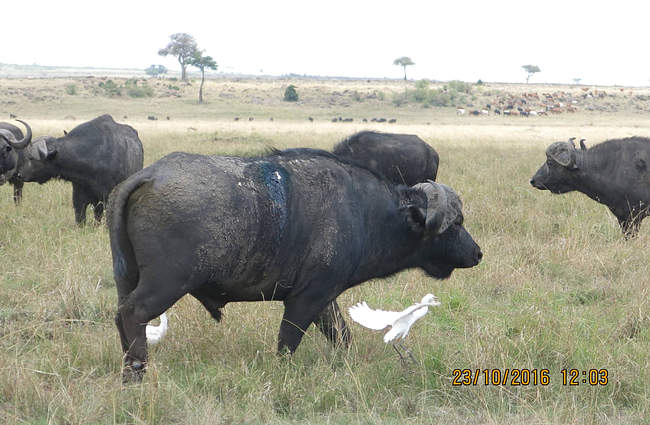
This buffalo in a herd of about 200 was seen with an arrow and reported to us by the warden of Musiara sector, Masai Mara Reserve.
This buffalo in a big herd had an arrow sticking from the right side of his flank. His body condition was still good, though there was evidence of pain as he walked around.
Immobilization, examination and treatment
Restraint was achieved chemically by use of a combination of 7mgs etorphine hydrochloride and 60mgs azaperone in a 3ml daninject dart.Darting was achieved from a vehicle. Drugs took full effect after seven minutes with this buffalo assuming sternal recumbency.
Examination revealed that the arrow was barbed and had lodged itself deep into the flank muscles. This arrow was carefully removed and resultant wound debrided with hydrogen peroxide and rinsed with clean water. Tincture of iodine was used to disinfect before cloxacillin ointment being infused. Additional treatments included parenteral administration of 6000mgs amoxicillin antibiotic and 1000mgs flunixin meglumine anti-inflammatory.
Achieved by administration of 18mgs diprenorphine hydrochloride intravenously through a prominent ear vein.
He woke up in three minutes to join other buffaloes.
The Mara Mobile Veterinary unit would like to thank many stakeholders who in one way or another help bring attention to wildlife requiring veterinary intervention. Much appreciation to Minara Foundation through The DSWT for their continuous facilitation to the unit. Thanks to KWS management for their technical assistance and advice provided to theunit. All yourcontributions have been very helpful to the functioning of this unit.