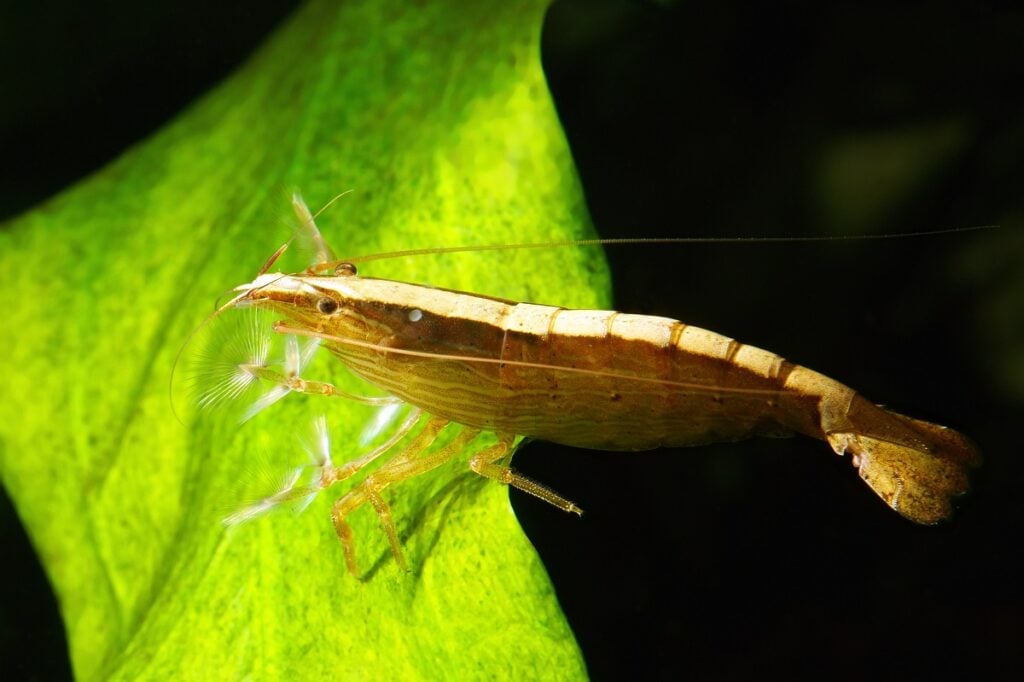
Looking for an unusual invertebrate addition to your aquarium? Something a little more creative than the good old cherry shrimp? No worries, there's plenty of love for oddball shrimp here at The Shrimp Farm! Today, let us introduce you to bamboo shrimp, two unusual Asian natives with fascinating feeding habits.
Keep reading for everything you need to know about bamboo shrimp care and how to keep these funky filter shrimp in your aquarium.
When aquarists and aquarium stores are talking about bamboo shrimp, there are two species they might be referring to. These are scientifically known as Atyopsis moluccensis and Atyopsis spinipes, and they're almost impossible to tell apart unless you've got a very strong magnifying glass on hand. Even professionals mix them up all the time — no problem, because their care requirements are the same.
When it comes to shrimp for a freshwater aquarium, oddballs like bamboo shrimp usually aren't the first thing that comes to mind! They truly are very different from other species in the trade, not to mention instantly recognizable. Their size is the first thing you'll notice: at 3–", they're a lot larger than popular dwarf species like Neos and bee shrimp . Spinipes shrimp usually stay a little smaller than moluccensis, but they're still very chunky.
The second thing you'll notice about bamboo shrimp is, of course, their fan hands! These are filter shrimp (also sometimes called flower shrimp due to the shape of the fans). In their natural habitat, they use these modified front legs to extract food from fast-moving waters.
These shrimp prefer sitting still with their fans extended to moving around in search of food. They've developed excellent camouflage to make sure no one bothers them as they do so, blending in perfectly with the surrounding leaf litter thanks to their orange-brown color and the light stripe running across the top of their backs.
Tip: It's possible to visually tell the difference between a male and female bamboo shrimp. The main giveaway when the females aren't carrying eggs (gravid) is size: unlike in most shrimp, the males are larger the than females. Their forelegs are also much chunkier than those of the girls.
Both species of bamboo shrimp are naturally found in Asia. The Moluccas bamboo shrimp, A. moluccensis, has a pretty narrow range in Southeast Asia: Thailand, Malaysia, some parts of Indonesia, and possibly the Philippines. Its doppelgänger A. spinipes is found throughout much more of the Pacific, from Taiwan and the southernmost islands of Japan to further east in Fiji, Samoa, and other small island groups.
Both bamboo shrimp live in streams and rivers in hilly areas where the fast water flow ensures plenty of passing edible particles for them to catch with their fans. These streams are usually shallow, with a mix of sand and larger rocks on the bottom. The shrimp have been found clinging to (the underside of) smooth boulders right in the harshest currents of torrential streams, rivers, and even small waterfalls!
The IUCN Red List considers bamboo shrimp to be species of Least Concern , but notes a lack of information about their populations and whether they're stable. The Moluccas bamboo shrimp is probably at risk: there's a lot of human activity in its smaller natural range. In some rivers, like the Gombak in Malaysia, it seems pollution has already caused a decrease in its numbers.
Did you know? As a result of shrimp escaping or being released from the aquarium trade, bamboo shrimp considered an invasive species risk. Even in countries like Hungary, which are normally much too chilly for this tropical species in winter, it has been found thriving in thermal waters .
If you're interested in keeping bamboo shrimp, it's important to know that this isn't a species that you can just pop into any old community tank and be done with it. Their specialized feeding habits mean they can starve in the wrong environment, plus their large size means they don't do well in nano set-ups. You'll need an aquarium of at least around 20 gallons to keep a group.
It's important for at least a few spots in the aquarium to feature moderate to heavy flow levels to help food reach your shrimp's fans. On top of that, it doesn't just need to be fully cycled (as it should be for any shrimp or fish) but should also be as mature as possible. New tanks are usually just too clean for detrivores like these, putting them at risk of starvation. It's best to wait at least three months before adding these shrimp.
Be sure to provide plenty of hiding places, as well as live plants and rock or wood formations close to the water flow. The shrimp will appreciate the decor for perching and doing their filter magic, which is really quite fascinating to watch! They can sit in one spot fishing for particles and barely moving for hours.
We also recommend adding some leaf litter for a more natural look.
Your bamboo shrimp starter pack:
The water quality should always be high in order for these sensitive creatures to thrive. This can be difficult, as you will likely have to supply powdered food which can blow all over the tank and end up fouling the water. This paradox is another reason the tank should be nice and mature mature: it'll have a solid nitrogen cycle that is more likely to be able to handle the high bioload.
Ammonia and nitrites should always be 0, while nitrates should be kept low (<10). Weekly small water chages are a must!
Temperature : 71-82 °F
Total Dissolved Solids : 150-300
If you'd like to keep your bamboo shrimp with fish, it's important to choose their tankmates very carefully. These gentle giants are lovers, not fighters: they're slow, a little bumbling, and rely on their fragile fans to survive. You'll want to avoid any species that may bother the shrimp or try to pick at them.
Luckily, there are still plenty of 100% docile fish to choose from:
You should also keep the need for high flow levels in mind. Critters that live on the bottom won't really notice the hillstream effect, but most small schooling fish come from stagnant waters and won't like being blown all over the tank. If you want to keep your shrimp with these, you might need to experiment with creating high and low flow zones to make sure everyone stays happy.
Most invertebrates also make great choices for a bamboo shrimp tank. Both Caridina and Neocaridina shrimp should work well, as will aquarium snails . Just keep everything nice and Zen for the best results.
Tip : It sounds a little harsh, but Amano shrimp make a particularly good tankmate choice because the females regularly release tiny larvae. These aren't able to survive in freshwater, but they make for an excellent bamboo shrimp meal. Circle of life and all that!
Getting their diet right is the most crucial factor in having your bamboo shrimp thrive in the long run, but it can be challenging. As mentioned earlier, the aquarium can't be too "clean", because these shrimp feed on pieces of detritus floating through the water column. Plenty of live plants and leaf litter can help with this.
Of course, debris being present isn't enough: it also needs to be moved around. Your tank will need a healthy flow level to recirculate particles and allow them to be blown into the shrimp's filter hands. That may means having to install an extra powerhead, or at least an extra-strong filter rated for a larger aquarium than you actually have.
As for maintenance, larger pieces of debris will have to be removed so they don't foul the water. You should resist the urge to vacuum the substrate every time you see some dirt on it, though. In fact, it's a good idea to give that layer a good whirl every now and then to stir up any bits of food, decayed plants, and fish waste that may be present. It will cloud the water for a bit, but it's a bamboo shrimp's absolute dream dinner! The excess will be sucked into the filter, allowing you to remove it when you next clean the sponge.
Even with proper flow and a good amount of detritus, you will most likely need to provide supplemental meals. Anything very small works: powdered baby shrimp food , crushed fish flakes, spirulina powder and the like are great for bamboo shrimp. You can release it into the flow or near their fans to make sure they catch it; try turning off the filter so the particles aren't immediately removed.
Tip : If you see your bamboo shrimp using their fans to scrape the aquarium floor, they're not getting enough food and have gone hungry. Adjust accordingly before they damage their delicate filters, because if this happens, they won't recover until the shrimp molts.
Like Amano shrimp , bamboo shrimp are a lower-order amphidromous species. Unlike the dwarf shrimp most of us are so used to, they don't produce miniature versions of the adults. Instead, their fry pass through a highly delicate larval phase — and to make things worse, they need to be kept in brackish water temporarily or they will die before they can metamorphose.
Although it can be done, we recommend not bothering unless you're a particularly dedicated bamboo shrimp enthusiast!
Most specialized aquarium stores should carry bamboo shrimp, so they usually won't too hard to find. We're proud to offer you our Spinipes bamboo shrimp here at The Shrimp Farm. We ship them right to your doorstep with our live arrival guarantee, so you don't even have to leave your home to get your shrimp!
Tip: If you love bamboo shrimp, be sure to keep an eye out for their African cousin as well. It's called the vampire shrimp (Atya gabonensis) and it's huge . If you want something smaller, on the other hand, maybe you'll like the green lace shrimp better.
Yes, the two species can coexist fine.
Bamboo shrimp will eat floating green algae, which isn't the most common type in the aquarium. They're unlikely to scrape algae off aquarium walls or décor, so don't count on them keeping your tank clean.
Unfortunately, these shrimp don't have long lifespans. With good care, they can make it to 2-3 years of age.
Bláha, M., Weiperth, A., Patoka, J., Szajbert, B., Balogh, E. R., Staszny, Á., ... & Kouba, A. (2022). The pet trade as a source of non-native decapods: the case of crayfish and shrimps in a thermal waterbody in Hungary. Environmental Monitoring and Assessment , 194 (11), 795.
Chace Jr, F. A. (1983). The Atya-like shrimps of the Indo-Pacific Region (Decapoda: Atyidae).
Iwata, T., Inoue, M., Nakano, S., Miyasaka, H., Doi, A., & Covich, A. P. (2003). Shrimp abundance and habitat relationships in tropical rain-forest streams, Sarawak, Borneo. Journal of Tropical Ecology , 19 (4), 387-395.
de Mazancourt, V., Marquet, G., & Keith, P. (2024). An integrative taxonomic revision of the freshwater atyid shrimps (Crustacea: Decapoda: Caridea) of Micronesia. Diversity , 16 (4), 200.
Wowor, D., Cai, Y., & Ng, P. K. (2004). Crustacea: Decapoda, Caridea. Freshwater Invertebrates of the Malaysian Region. Malaysian Academy of Sciences , 337-357.