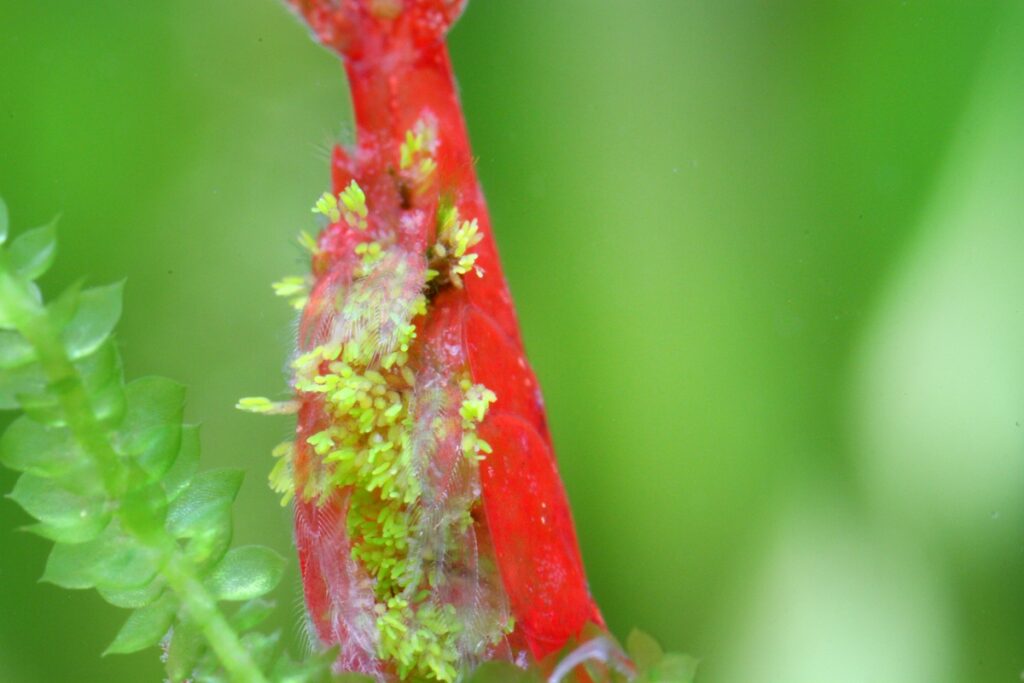
It’s one of the worst possible moments in shrimp keeping: thinking your favorite crustacean is berried (yay, baby shrimp!), only to discover the green bits between its swimming legs aren’t eggs, but a potentially deadly parasite known as "green fungus" or "Ellobiopsidae" .
A lot of confusion still surrounds this lethal shrimp ailment. Today, let's get to know our enemy — and find out if we can cure infected shrimp.
We'd like to take a moment to clarify a few things about the "green fungus" that can pop up on ornamental shrimp. You don't have to read this if you're in a rush, but we do think it's useful to know what you're dealing with before you start attempting to medicate your shrimp.
First off, although this ailment looks like a fungus, that's not at all what it is — but the misinformation doesn't end there. Annoyingly, the more scientific-sounding "Ellobiopsidae" is also a misdiagnosis. Researchers note that real Ellobiopsidae occur exclusively in marine crustaceans — mostly zooplankton like copepods and krill. It has never been found to infect freshwater shrimp.
True Ellobiopsidae don't even belong to the right "tree of life": they're alveolate protists (which puts them in the same group as the microscopic parasites that cause Malaria disease). The parasite that affects our freshwater shrimp, on the other hand, is a green alga. This makes the two even less closely related than you are to your shrimp (really!).
So: "green fungus" on shrimp is not a fungus. It's also not Ellobiopsidae, but rather a green alga belonging to the genus Cladogonium — almost like a Marimo ball decided to go parasitic. Its identity has been known in scientific circles since a Japanese study identified Cladogonium in freshwater shrimp in 1970. The shrimp hobby, which took off in the '90s, never got the memo and went with Ellobiopsidae instead.
The initial 1970 study pinpointed the culprit as Cladogonium oshimae . This was extended to " possibly multiple species " in 2014. The matter was finally cleared up in 2023 by inspecting a whopping nine hundred cherry shrimp. Conclusion: if your shrimp's swimming legs look moldy and green, it almost certainly has Cladogonium kumaki . It took a long time, but we can finally put a name to the face.
Cladogonium (whether kumaki or oshimae ) consists of three parts:
Like most of the unwelcome guests we find on our dwarf shrimp — Vorticella , Scutariella , etc. —, Cladogonium infections are strongly associated with imported shrimp. That's not because people in other countries are worse at caring for shrimp, but because:
If you're buying from a seller who imports their shrimp (which is the vast majority, unless you're buying from a fellow hobbyist), it's a good idea to ask about their quarantine policy. If they quarantine their shrimp for thirty days, they're much more likely to be able to catch Cladogonium infections and refrain from selling them to you. Still, you should quarantine any new additions for another month in order to further minimize the chances of introducing green fungus in your display tank (and more easily treat it if it does pop up).
If you're an experienced shrimper, you'll have no problem telling the difference between a berried ("pregnant") shrimp and one that's infected with Cladogonium algae. It's a different story for beginners who haven't had the pleasure of seeing berried shrimp in their tanks yet (and are more likely to spot this ailment in the first place, because they've bought their shrimp more recently).
So how do you tell the difference when you find a shrimp carrying a mass between its swimming legs (pleopods)? We've come up with a few simple questions that will help you diagnose berried vs. Cladogonium . If you own a loupe or your phone has a solid zoom function, that helps a lot.
Diagnose your shrimp:
If the Cladogonium mass is green, it's likely still in an early stage. A more yellow, textured mass means the algae are mature and actively spreading mobile spores — you can consider all your shrimp infected at this point.
*Unfortunately, we haven't been able to establish whether "Ellobiopsidae" also occur in other Neocaridina species, like the snowball shrimp ( N. zhangjiajiensis ). We haven't observed it ourselves, but that doesn't mean it's not possible. There are definitely no reports about infected Caridina species (bees, Amanos), so those should be in the clear.
Support shrimp health:
The quick answer: it's up to you whether you want to try.
Many of the "parasites" that appear on our dwarf shrimp are technically epibionts: they live on their host, but don't cause trouble unless they overgrow. Green fungus is sometimes labeled as an epibiont, too, but many experts lean more towards it being truly parasitic. It penetrates the shrimp's exoskeleton and seems to feed on its tissue. Although the shrimp can take a long time to die, this is usually fatal.
A 2021 study found Cladogonium , bacterial infection, and fungal infection in the same recently imported (stress, low water quality) shrimp; the Clado probably helped open the door for this multifactorial outbreak by damaging the exoskeleton.
Unfortunately there's no single quick cure for Cladogonium in dwarf shrimp. Invertebrate medicine in general isn't exactly a well-researched field, and most shrimpers opt to cull any shrimp infected with Clado right away. This being said, hobbyist shrimpers have experimented pretty extensively with different substances, with some anecdotal evidence of success. We think treatment is worth a try if you've got the patience for it, but it's very much a "glass half empty" situation.
As we've mentioned, Cladogonium algae can spread from one shrimp to the next. This is one of the reasons we highly recommend quarantining any new additions. If they're already in the display tank, note the color of the "fungus". Yellow — rather than green — filaments are a sure sign the spores are spreading, at which point the entire tank is radioactive and separation won't do much.
If the filaments on your infected shrimp are still green, popping them into a quarantine container may help in preventing the Clado from spreading to the rest of the colony. It's probably best to forego both the substrate and the filter (instead performing daily drip water changes) so the spores have nowhere to hide.
Whether they're in a display or quarantine tank, ensure the water quality is pristine and there are no external sources of stress affecting your shrimp. Perform daily small water changes, vacuuming well and adding the new water back in using a drip system. With some (okay, a lot of) luck, this helps your shrimp avoid secondary illnesses and hopefully clear the Clado themselves.
Water quality high? Great. Next, add a good amount of blanched Indian almond leaves or alder cones. We start with around 0.5 leaf or 1 cone per gallon, but if your shrimp are dying off, increase the dosage. It's unlikely to make the situation worse.
These botanicals don't cure Ellobiopsidae, but they:
Because Cladogonium appears resistant to brackish water, adding a small amount of salt to the tank itself doesn't seem to help. Instead, most shrimpers treat with a combination of hydrogen peroxide and salt dips. Success rates vary widely, so it's up to you whether you can be bothered.
For the peroxide (H2O2):
Salt dips work best if your shrimp are in quarantine, because it's difficult to catch them in a display tank. Combine this with tank-wide hydrogen peroxide, or the shrimp will just get reinfected by latent spores:
Some shrimpers report success with a fish medication known as malachite green. This is highly anecdotal, and if you're reading this from the EU you won't be able to buy this substance anyway — it's banned due to being highly toxic and carcinogenic. Additionally, there's no solid proof it's safe for shrimp, so this really is the nuclear option.
In the USA, if you do want to try, you can buy it as Rid Ich Plus (which also contains formalin) or Kordon Malachite Green. Other brands exist (API Super Ick Cure, SeaChem Paraguard), but the concentration is lower.
The "protocol" (if you can call a completely experimental treatment shared by shrimpers on social media a protocol) is to administer the malachite green orally or tank-wide. We think orally makes more sense, but only if combined with hydrogen peroxide treatment (see above) to kill spores around the tank. You can make the medicated food by soaking a dry, absorbent shrimp food in malachite green until it swells, then letting it dry and feeding it to your shrimp for at least a week.
Note: Used any of the treatments discussed here? Sharing a detailed comment with method and results in the comments below might be helpful to other shrimpers looking for help with Ellobiopsidae. Thank you!
Bauer, J., Jung-Schroers, V., Teitge, F., Adamek, M., & Steinhagen, D. (2021). Association of the alga Cladogonium sp. with a multifactorial disease outbreak in dwarf shrimp (Neocaridina davidi). Diseases of aquatic organisms , 146 , 107-115.
Gómez, F., López-García, P., Nowaczyk, A., & Moreira, D. (2009). The crustacean parasites Ellobiopsis Caullery, 1910 and Thalassomyces Niezabitowski, 1913 form a monophyletic divergent clade within the Alveolata. Systematic parasitology , 74 (1), 65-74.
HIROSE, H., & AKIYAMA, M. (1971). A colorless, filamentous chlorophyceous alga, Cladogonium ogishimae gen. et sp. nov., parasitic on fresh-water shrimps. Shokubutsugaku Zasshi , 84 (993), 137-140.
Maciaszek, R., Świderek, W., Prati, S., Huang, C. Y., Karaban, K., Kaliszewicz, A., & Jabłońska, A. (2023). Epibiont Cohabitation in Freshwater Shrimp Neocaridina davidi with the Description of Two Species New to Science, Cladogonium kumaki sp. nov. and Monodiscus kumaki sp. nov., and Redescription of Scutariella japonica and Holtodrilus truncatus. Animals , 13 (10), 1616.
Serizawa, K. (Matsuyama), Imai, M., Nakaso, M., & Serizawa, K. (Serisawa). (2014). Freshwater shrimp ectoparasitic Cladogonium (Chlorophyta, Cladophoraceae) reconfirmation. The Japanese Journal of Phycology, 62 (1), 1-6.