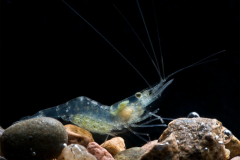
Got some ghost shrimp for your aquarium and wondering if you can breed them? The answer is yes! Although it's slightly more complicated than raising your basic (Neo)caridina dwarf shrimp, ghost shrimp breeding is not that difficult. It makes a great first "real" breeding project for new aquarists and veterans alike.
Below, find out everything you need to know about ghost shrimp breeding and how to successfully raise the finicky larvae to adulthood.
One important point we'd like to get out of the way before we start: ghost shrimp don't require brackish (half fresh, half marine) water to reproduce. It's easy to see where the "brackish myth" came from, as there's a shrimp species that looks quite similar to ghost shrimp whose babies do need brackish water to survive. The shrimp in question is called the Amano shrimp , and breeding it is a real challenge due to (among other factors) the salt requirements of the larvae.
There are also members of the genus Palaemon that live and reproduce in brackish or even full marine water. These are sometimes sold as cheap feeder "ghost shrimp" at aquarium stores. Luckily, true ghost shrimp ( Palaemon paludosus ) make make for an easier breeding project because they can stay in freshwater both as larvae and as adults.
Now that we've got that out of the way...
Ready to start breeding shrimp? You don't need much to get started. In fact, if your tank is heavily planted and doesn't contain larger fish that would like to eat a baby ghost shrimp, you might find the population slowly increasing without any intervention on your part. Raising the babies separately is ideal, however. It should result in a significantly higher survival rate, as there's no risk of the larvae being eaten by their parents or tankmates.
So, for the purposes of breeding, we recommend two containers. One can be a normal community aquarium or a ghost shrimp-only set-up, and you can do whatever you want with it. The other one, the rearing tank, can be as simple as a food-safe plastic tub. It doesn't have to be fancy (although it can be if you want!). In fact, since the larvae have such a low bioload, you probably won't even need a filter — you'll be adding lots of plants anyway.
All you need for the rearing tank is:
That's it! Unless the room you keep the rearing tank in is prone to temperature swings (garage, attic), you probably won't need a heater. As long as it's stable, ghost shrimp larvae do just fine at room temperature.
Your biggest enemy when trying to breed ghost shrimp — or anything aquarium-related, really — is impatience. It's best to give the rearing tank plenty of time to mature. The water parameters will be more stable this way, and plenty of biofilm will grow for the larvae to eat. Don't worry if it gets algae, as that just means more food for the babies!
Your ghost shrimp breeding starter pack:
In addition to the equipment, you'll need a few ghost shrimp to start your colony. If you get 5-10 shrimp, you can be pretty sure there are both males and females in the batch. It can be difficult to tell the difference between them at first, especially because they're often sold as juveniles. Once they reach maturity and the females start becoming berried ("pregnant"), it'll be very easy to tell who's who.
Adult female ghost shrimp are significantly chunkier than the males. They will have a colored fleck behind the head, called a saddle, which are eggs developing in the ovaries. Alternatively, as mentioned, they carry fertilized eggs between their back legs (pleopods) after mating.
Most shrimp breed in a similar manner, and ghosts are no exception. Adult females are ready to mate after molting, which they do every month or so. They'll shed their old skin and release pheromones that attract the males. You'll usually know this is happening because the entire tank seems to go a little crazy, with the shrimp zooming all over the place for a few hours.
After mating, the female moves the fertilized eggs from her "saddle" (the colored patch behind the head, usually yellowish or greenish) to her pleopods. She is now "berried". She'll keep the eggs in her pleopods, gently waving them for oxygenation and regularly cleaning her brood, for up to 2 weeks.
If you set up a separate rearing tank as we recommended, you can transfer the female at around the 1-week mark. Don't do it after hatching, as the larvae are very difficult to catch! You can move the mother back once she's dropped the eggs, as ghost shrimp exhibit no parental care. They're more likely to eat their larvae than anything else.
Ghost shrimp eggs are carried in the female's pleopods until they hatch. They're small, oval, and greenish to yellowish in color. When they're almost ready to hatch, you'll actually be able to see the tiny eyes of the larvae. If this is the case and you haven't moved the female to the rearing tank yet, it's definitely time to do so now!
If you're trying your hand at ghost shrimp breeding in your main (display) tank, then there really isn't much you need to do. The only thing we do really recommend, if you don't use a sponge filter, is to put a prefilter sponge on the filter intake to prevent the larvae from getting sucked in.
The survival rate will be lower in a community aquarium, but the larvae will feed on infusoria and biofilm, eventually metamorphizing and growing into adult ghost shrimp without intervention on your part. Keep in mind you probably won't see them much or at all for the first 1–2 months.
There's not that much work to do if you keep the larvae in a separate rearing tank either, luckily. It's mostly just basic feeding and cleaning. If the rearing tank is mature and heavily planted, the baby ghosts may be able to find food themselves, although we do still recommend supplementing a little just in case.
To feed the ghost shrimp larvae, you can mix some spirulina, powdered baby shrimp food , or infusoria (if you have a culture going) with a few teaspoons of water. If you can find them, which can be difficult in a planted container, you can deposit the mixture near the larvae using a syringe or turkey baster. Remove uneaten foods and other waste daily using the same syringe/baster or some airline tubing. Just be careful not to suck up any of the larvae!
It'll take up to 10 days for the larvae to metamorphose into "real" miniature ghost shrimp. You'll know it's done when they start to swim in a more controlled manner — they just kind of zoom all over at random during the larval stage. You'll be able to see their eyes more clearly at this point, and they'll develop that typical ghost shrimp back hump.
Once metamorphosis has happened, you can switch the baby ghosts to regular shrimp foods. They're ready to go into the display tank with the adults once they're about fingernail-sized. If you also keep fish and are worried they might eat the babies, you can leave the little ones to grow for a few more weeks. Move them once you're sure they're too large to fit into their tankmates' mouths.
It wasn't easy, but we managed to take a picture for you! According to research , the larvae (referred to as zoea) pass through three different stages of life, although the differences are subtle. Even in the third and last larval stage, the zoea don't surpass 0.15" (4 mm) in length.
The females are ready to breed at around 4 months of age. They'll be just under an inch in size at this point. The breeding process is initiated when they molt.
They're not as easy as something like cherry shrimp , which don't pass through a larval stage and are therefore less fragile after hatching. But still, we'd consider ghost shrimp breeding pretty easy, yes.
Dobkin, S. (1963). The Larval Development of Palaemon Paludosus (Gibbes, 1850)(Decapoda, Palaemonidae), Reared in the Laboratory 1. Crustaceana , 6 (1), 41-61.