Looking for a peaceful bottom dweller to add to your tank? Catfishes of the genus Corydoras should be right up your alley. One of our personal favorites is the medium-sized and polka-dotted julii Corydoras, which makes a great addition to community aquariums.
Sound good? Below, you can find everything you need to know about this Cory catfish, including where it's from, how to care for it, and what it eats.
The julii Corydoras is a species of armored catfish, a name that refers to their protective bony body plates. These bottom dwellers can be recognized by their flat bellies and mouth barbels.
As far as Cories go, this one can be considered medium-sized at a length of around 2". Its body base color is beige, with a leopard pattern of black spots and a faint horizontal line running across the side. The tail has vertical stripes and the fish sport a black dorsal fin spot.
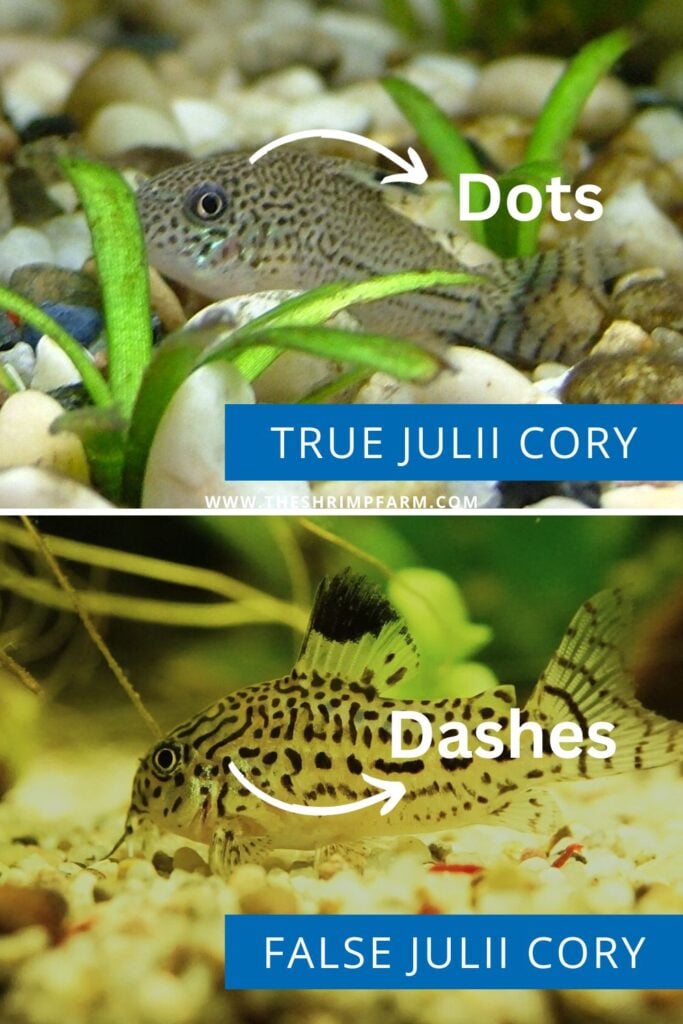
Did you know that the majority of julii Cories for sale are actually a different species? Corydoras trilineatus, which looks extremely similar, is more common in the aquarium trade and is often sold under the wrong name. This kind of confusion happens often in the aquarium hobby, and we'll admit these two really are indeed difficult to tell apart if you don't know what you're looking for.
True julii Cories have a polka-dotted pattern on their heads. The horizontal body stripe starts a considerable distance behind the gills. False julii Cories sport a reticulated head pattern of squiggly dashes.
If reading this you just realized you've got the "wrong" fish, don't worry. These two occur near each other in the wild, and luckily, their care is pretty much identical. They even school together.
This catfish is naturally found in northeastern Brazil. Specifically, it inhabits the lower Amazon river and a bunch of coastal river systems, such as Parnaíba. Scientists have spotted it in the states of Ceará, Piauí, and Maranhão. Their favorite spots are characterized by their calm waters and sandy or muddy substrates.
There's also a study that states Corydoras julii occurs in Perú, but this seems unlikely.
The IUCN Red List considers Corydoras julii to be a species of Least Concern in the wild. It does note that the species is heavily traded for the aquarium hobby.
Corydoras catfish, including this one, aren't too picky about their surroundings. There is, however, one thing you can do to greatly improve their quality of life: using a sandy substrate. Their instinct is to spend their days scouring the sand for tasty morsels, sometimes sticking their faces in right up to their eyes with great gusto, and this isn't possible with gravel. In fact, sharp gravel can damage their barrels.
You can keep a group of julii Corydoras in aquariums of 20 gallons (long) and up. Don't keep these fish in very deep tanks or set-ups that don't allow access to air, as ironically, they can drown! Unlike other fish species, Cories regularly dart to the surface to take gulps of air, absorbing the oxygen through their intestinal walls.
Add some cover in the form of live plants, driftwood, and rocks to ensure your fish feel safe.
Your Julii cory starter pack:
Although julii Cories aren't particularly fragile, it's still important to keep the water quality high. You should only introduce them into fully cycled tanks, and it's important to keep up with weekly water changes and other regular maintenance.
The waters these fish naturally occur in are usually soft and acidic. This being said, they're not too fussy and will do well at a pH of up to around 7.5. The water temperature in their natural habitat can vary; the most important thing is to keep it stable with the use of a thermostat heater.
Temperature: 68-79 °F
As mentioned in the introduction, Corydoras catfish in general are known for their peaceful nature. The nice thing, though, is that they're no pushovers. Their bony body plates offer them protection, as does a venomous pectoral fin spine (so when introducing your new julii Corydoras in your aquarium, don't touch them with your hands, as they can sting you!).
Thanks to this golden combo, plus the fact that they mostly stick to the bottom water layer and don't really bother anyone, julii Corydoras can be kept with a wide range of tankmates.
Our personal favorite option is always to keep them with fish from similar waters, such as:
If you don't mind where the fish are from, you can also consider Asian species like rasboras, dwarf puffers , and much more. Small shrimp will be eaten (bugs are this Cory's favorite food!), but large species such as Amano shrimp should do well.
Don't forget to buy multiple specimens of Corydoras julii. They're quite gregarious and don't like being alone, so a group of 5+ works best.
Tip : Avoid introducing water from the purchase bag into the tank, as Corydoras catfish can release a skin toxin when stressed that may affect your other livestock.
One scientific study described Corydoras, like C. julii, as "grubbers". We think that's pretty accurate:
Fishes of this group (representatives of the Callichthyidae) showed chiefly nocturnal habits and swim close to the stream bottom, moving the barbels through sediment particles of uppermost substrate layer; when a prey is localized, the fish quickly invests by immersing the snout into the substrate to grab it. (...) Corydoras aff. acutus and C. julii were observed probing the sandy substrate for preys, with little or [no] organic sediment deposits.
So, unlike what many aquarists still tend to think, Corydoras are not algae eaters. Unlike many bottom dwellers, they're not even detrivores. These are full-blown little predators! In the wild, they use their barbels to feel for small bugs. What you feed yours in captivity should reflect this. You shouldn't treat them like cleaners that can survive off leftovers.
The ideal food for your juliis would be live bugs like bloodworms, blackworms, tubifex, and more. However, frozen worms also work well, as do sinking flakes and pellets. Keep their diet varied for a long and healthy life.
Cory catfish are easy to breed and make a great choice if you have never bred fish before. Here's how it works:
As we've mentioned, Corydoras julii is one of the most popular Cory species available in the aquarium hobby. However, because it's so easily confused with Corydoras trilineatus, it can actually be difficult to find true juliis. Make sure you're buying the right fish!
The Shrimp Farm sells julii Corydoras and ships them right to your doorstep with live arrival guarantee.
Corydoras julii image credit : Merlin Senger, CC BY-SA 3.0 , via Wikimedia Commons
Brejão, G. L., Gerhard, P., & Zuanon, J. (2013). Functional trophic composition of the ichthyofauna of forest streams in eastern Brazilian Amazon. Neotropical Ichthyology , 11 , 361-373.
Kiehl, E., Rieger, C., & Greven, H. (2006). Axillary gland secretions contribute to the stress-induced discharge of a bactericidal substance in Corydoras sterbai (Callichthyidae, Siluriformes). Verhandlungen der Gesellschaft für Ichthyologie , 5 , 111-115.
Ortiz, N., & Iannacone, J. (2008). Current status of Amazonian ornamental fish from Peru with higher demand of exportation. Biologist , 6 , 54-67.