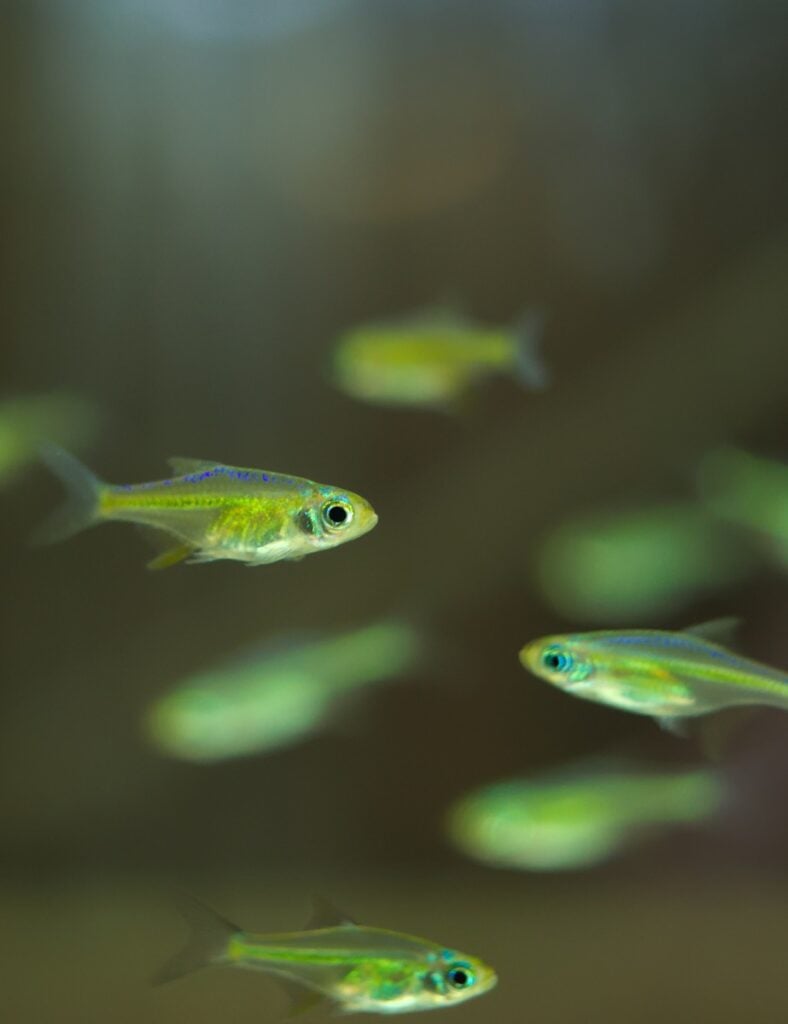
Looking for a colorful addition to your peaceful community aquarium, or the perfect eye-catcher to complete a beautiful aquascape? What about green? The tiny kubotai rasbora ( Microdevario kubotai ) is one of the only green aquarium fish out there, and its shimmering colors make it a real stunner.
Keep reading to find out everything you need to know about kubotai rasboras, including where they're from, how to care for them, and how to breed them!
Talk about tiny! Microrasbora kubotai, better known as the kubotai rasbora, stays under an inch (max. 0.75") in length. That's about the same size as a peanut.
What this diminutive fish lacks in size it makes up for in color, sporting shimmering yellows and greens on a transparent body. A school of these rasboras looks almost like sparkling sequins, especially if you keep them in a planted tank with a dark substrate and background.
Male kubotai rasboras can be told apart from the females by their brighter colors and slightly smaller size. Females will become visibly rounded during breeding time.
Did you know? This species was first scientifically described quite recently: 1993. It was initially called Microrasbora kubotai, but a later study revealed that it should be placed in a new genus along with two other fish. It was decided to name them Microdevario.
This charming little rasbora is naturally found in Thailand and Myanmar. Here, it inhabits calm to moderate-flowing streams, usually with clear water. The species' habitat is characterized by the presence of plenty of aquatic plants, shore plants, driftwood, and leaf litter.
The IUCN Red List considers Microdevario kubotai to be a species of Least Concern, although it notes the population is likely decreasing due to habitat destruction for agricultural purposes. It notes that collection for the aquarium trade isn't as intense as it used to be, and is likely sustainable.
Despite their size, these rasboras aren't suitable for the absolute smallest tanks. They're schooling fish, so you need to keep a good few to help them feel secure, and they're also pretty active swimmers. A 10-gallon long aquarium should work well enough for a group, although a 15-gal minimum would be ideal.
As mentioned, a densely planted and relatively dark tank makes kubotai rasboras look their best. Luckily, this also happens to be exactly what they like! Their natural habitat is characterized by its dense vegetation, so these fish don't feel safe in a sparse environment.
The ideal kubotai tank would look like this:
Your kubotai rasbora starter pack:
Although kubotai rasboras aren't particularly finicky about water composition, they don't respond well to low water quality. We recommend introducing them only in well-established aquariums that are completely cycled .
It's important to perform weekly water changes and keep an eye on water quality using a liquid water test kit.
Temperature : 72-82 °F
Total Dissolved Solids : 50-150
As is to be expected from a fish this small, the kubotai rasbora is considered to be 100% peaceful. It can even be kept with dwarf shrimp, especially fast-breeding Neocaridinas in a densely planted setup. It's important to go for a school of at least 10 fish if you want to see their natural behavior and prevent the rasboras from becoming skittish.
It's best to keep your kubotais with other calm, peaceful species only. Bottom-dwellers are ideal. Big, boisterous tankmates will stress this timid species out—or worse, try to eat it. Some aquarists choose to opt for a single-species set-up with only the rasboras, but you can also consider:
Although no one has researched their feeding habits in the wild yet at the time of writing, these little rasboras are likely to be omnivorous, with a preference for meaty foods. They probably eat anything from small bugs and larvae to algae.
In the aquarium, the most important thing is to find sufficiently small food for your kubotai rasboras. Special pellets for microfish should work well enough, but frozen foods like Daphnia and brine shrimp are ideal. Live would be the best.
Like many similar species, kubotai rasboras can actually be bred in the home aquarium. They're egg scatterers, meaning they drop their eggs in plants or plant roots and leave their offspring to fend for themselves.
Healthy rasboras tend to breed without intervention on our part. Usually the eggs or fry are eaten by their parents and tankmates, but in densely planted aquariums, some may survive. If you want to make sure as many babies as possible make it to adulthood, it's best to set up a separate breeding and rearing tank.
Here's how it works:
→ Learn all about breeding egg-scattering fish
The kubotai rasbora has been a staple in the aquarium hobby ever since it was first discovered. It's not the most common rasbora, but most aquarium stores will carry this species. If they don't, they're likely able to order some in for you.
You can also buy these fish online. The Shrimp Farm sells kubotai rasboras and ships them right to your doorstep with live arrival guarantee!
Fang, F., Noren, M., Liao, T. Y., Källersjö, M., & Kullander, S. O. (2009). Molecular phylogenetic interrelationships of the south Asian cyprinid genera Danio, Devario and Microrasbora (Teleostei, Cyprinidae, Danioninae). Zoologica Scripta , 38 (3), 237-256.
Kottelat, M., & Witte, K. E. (1999). Two new species of Microrasbora from Thailand and Myanmar, with two new generic names for small Southeast Asian cyprinid fishes (Teleostei: Cyprinidae). Journal of South Asian Natural History , 4 (1), 49-56.