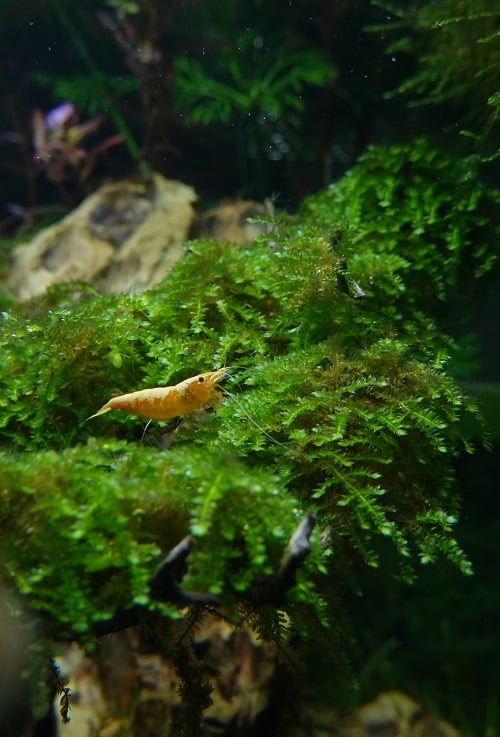
Looking to set up your first shrimp aquarium? Awesome! Even if you’ve never had an aquarium before, a shrimp tank is the perfect choice. Here at The Shrimp Farm we’ve got years of experience keeping and breeding freshwater ornamental (dwarf) shrimp, so we’re happy to explain the basics to you and share our enthusiasm for the hobby.
Keep reading for a full Shrimpin’ 101 guide to setting up a shrimp aquarium!
Once you’ve decided to go for it, it’s time to start gathering the equipment needed for a thriving tank. What are the essentials you really can’t miss?
As you progress, you’ll realize that there is a vast array of aquarium equipment out there, enough to make your head spin. For now, though, these basics are all you need to get started.
Once you’ve gathered all your materials, it’s time to get started. Find a sturdy spot to place the aquarium; it’s a hassle to move it later, so choose wisely. You're looking for a location in your home that doesn't get direct sunlight and with a stable temperature.
Once you've found the right spot for your new aquarium, just follow the steps below to get everything up and running.
The tank can look a bit cloudy at first, but don’t worry, it’ll settle within a day or so. Now sit back and relax, because it will be a few weeks before you can introduce the first shrimp into your new aquarium!
Did you know? A glass tank filled with water, substrate, rocks, and other décor can be much heavier than it looks. Your tank will need a sturdy cabinet. Floating shelves and flimsy cabinets can collapse under the weight, which is the last thing you want to come home to after a long day at work.
It’s the bane of every aquarists’ existence: the mandatory waiting period between filling up a tank and introducing the livestock. This gap is due to the fact that your aquarium has to cycle, during which time the water turns from highly toxic to shrimp to fully established and safe. This can take between 4–8 weeks.
We cannot emphasize it enough: DO NOT skip this step . An uncycled aquarium will get you off to the worst possible start by killing any shrimp you introduce. Carefully follow the instructions in our article on starting a fishless cycle . Basically, you will be dosing pure ammonia, which kickstarts a cycle that looks like this:
You’ll be tracking this cycle using your liquid water test kit, ensuring that you know what’s going on in the water. It all sounds a bit complicated at first, but it’s pretty fascinating!
Because the nitrogen cycle takes a few weeks to establish, you’ve now got plenty of time to figure out what kind of shrimp you would like to keep in your aquarium. There are loads of fascinating species and gorgeous color morphs out there, but keep in mind that there are quite a few shrimp that we wouldn’t recommend to beginners. Some are very fragile.
Our favorite choices for those just starting out include the many different varieties of Neocaridina (including the ubiquitous cherry shrimp ), Caridina japonica (the Amano shrimp ) and Palaemon sp. (the ghost shrimp ). These shrimp aren't fussy about water parameters and should be able to handle the occasional beginner slip-up.
You’ll want at least 5 shrimp to start with. With dwarf shrimp like Neos, it’s common to start with a colony of 10. Your aquarium might look a little bare at first, but if all goes well, it will soon be buzzing with baby shrimp.
You can find care information for pretty much any type of shrimp in our care guides section, but let’s quickly go over the basics here. The most important thing to keep in mind is that shrimp can be fragile. They need stable conditions more than they need perfect water values. You should never do anything drastic with your aquarium, like changing more than 30% of the water at once, changing out the entire filter cartridge, dosing chemicals to adjust the water parameters, or adjusting the heater more than 1°F a day.
You can feed your colony one or two pieces of high-quality shrimp food daily. Be sure to remove any uneaten bits after a few hours to prevent them from spoiling the water. If you always have to clean up leftovers, it's a good idea to feed less next time. Leaf litter like Indian almond leaves makes for an excellent snack for your shrimp to forage on between their normal meals.
Do a water test and a small water change (10–20%) on a weekly basis. This includes vacuuming the substrate (careful not to suck up any baby shrimp) and scrubbing algae if there is a bothersome amount. A deep aquarium cleaning can be performed once every few months.
If you keep dwarf shrimp like Neocaridina and you bought adults, you should start seeing the first pregnant females soon. Their eggs will be clearly visible between their back legs (pleopods). Congratulations! You’ll be a shrimp grandparent within 30 days. The babies need no special care, just nice clean water.
Your shrimp aquarium starter pack:
Although shrimp keeping is a fun and educational hobby, it can't all be sunshine and rainbows. Hiccups are normal; the trick is not to panic and do something drastic. Luckily, we've got guides for almost everything that could possibly go wrong with your shrimp tank.
No. Unless your tap water is of very low quality or you’re planning on keeping very sensitive shrimp species that require reverse osmosis water, you’ll be fine with just a water conditioner.
Most species don’t like things too toasty. Technically anything between 65–85 °F works, but we prefer to stick to the lower end of that range because their life cycle shortens significantly in warmer water.
Yes, just avoid combining different color varieties of the same species if you want to keep the lines pure. They can interbreed, which will eventually lead to muddled brown offspring. One combination we see frequently is some kind of dwarf shrimp, like Neocaridina davidi, along with a few Amano shrimp.
There are quite a few fish species that won’t eat shrimp , but remember to keep them in mind from the start — you'll likely have to get a bigger aquarium than if you just wanted to keep shrimp. The easiest shrimp tankmate choices are actually other inverts, especially snails.