Written by: Manya Singh
Published On: Sep 24, 2026
Most customer experience teams conflate having multiple channels with operating a true omnichannel customer service ecosystem. A customer can reach you on chat, on the phone, and by email, yet each of those conversations lives in its own silo.
The omnichannel customer service definition relies on a single, continuous conversation thread across touchpoints. Channel transitions occur without the customer losing context or repeating themselves.
Achieving an omnichannel customer experience requires moving past high-level vendor promises. This guide outlines the technical infrastructure, operational mechanics, and cross-channel metrics that determine whether continuity actually holds in production.
Delivering a seamless service across digital and voice communication channels requires an integrated technical backbone. When an enterprise treats each channel as its own system, continuity breaks at the seams.
A practical omnichannel strategy relies on three foundational components:
1. A Shared Customer Memory Layer
A centralized memory layer must persist across user sessions and channels customers use. This layer stores more than static customer relationship records:
2. Precise Channel-to-Channel Handoff Mechanics
When a user moves from web chat to phone support, a raw transcript dump is insufficient. The orchestration engine must compile and transmit a structured context payload.
3. A Single System of Record vs. Bolted-Together Tools
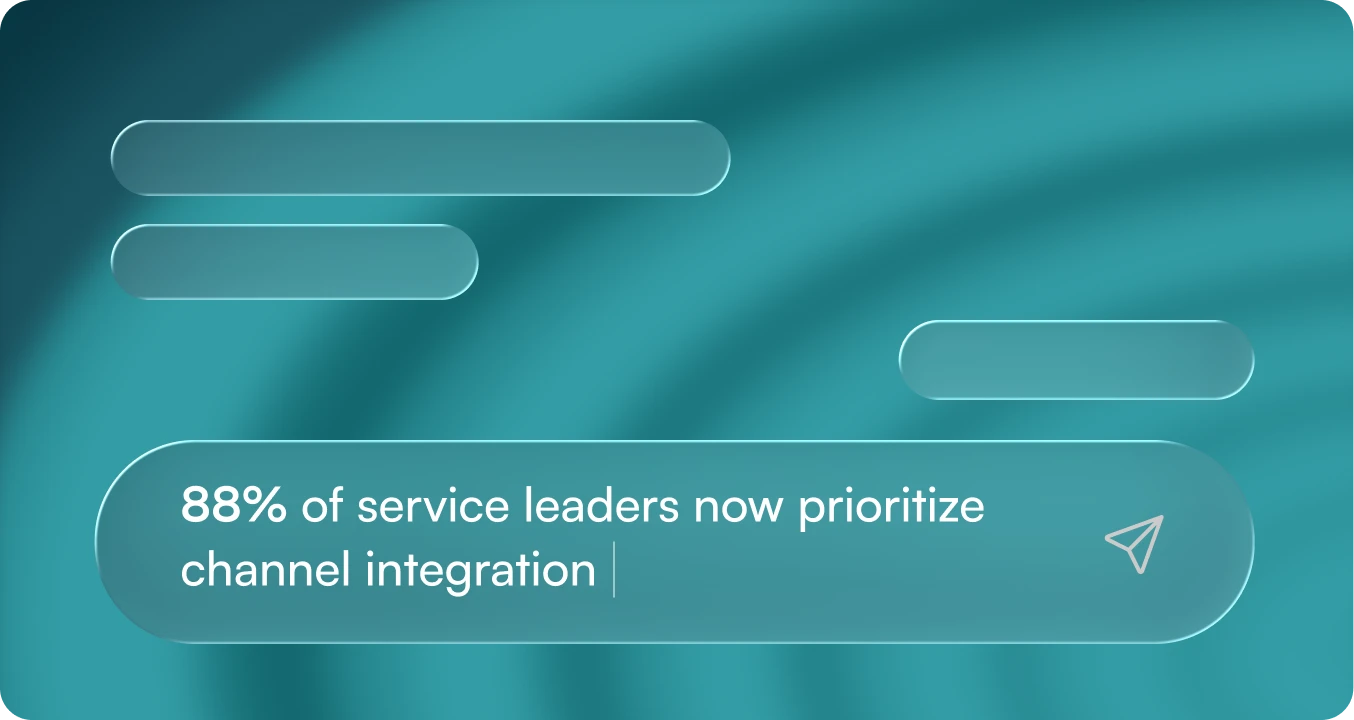
Stitching together separate vendors for multichannel customer service leads to fragmented customer information. Salesforce's State of Service Report, Seventh Edition found that 88% of service leaders are now prioritizing technology integration specifically to bring customer data together, eliminate silos, and unlock the full potential of AI, a signal that channel fragmentation isn't a minor inconvenience but the single biggest blocker standing between most enterprises and AI that actually works.
When customer service software tools are bolted together using loose webhooks, race conditions occur, status updates drop during peak concurrency, and the customer pays for the gap.
Despite heavy investments in support platforms, enterprise deployments often stall during real-world user journeys. These failures stem from architecture rather than intent.
Before purchasing new software, CX leaders should run an operational audit to identify where context drops across current touchpoints.
Select a high-volume scenario and analyze real customer behavior. Execute the journey across various channels:
During the test journey, record every instance of operational friction:
Not all support channels serve the same purpose. Design your user interface to guide users toward the most effective channel based on customer intent:
Nugget delivers true cross-channel continuity by resolving the architectural flaws that cause context drops. Instead of deploying isolated bots per channel, Nugget runs conversational AI on a single shared state layer.
Evaluating an omnichannel customer setup using single-channel metrics obscures system performance. To measure real continuity, CX teams must track the journey rather than the channel.
Recent data published in Deloitte's research highlights that omnichannel leaders post average revenue growth of 13.2%, compared to just 2.9% for laggards.
Providing omnichannel customer service also unlocks stronger customer feedback loops and boosts agent productivity by delivering timely and accurate responses.
Omnichannel customer support is an architectural commitment, not a marketing feature. Adding support for new channels without unifying underlying context simply multiplies the number of places where the customer has to start over.
Achieving true continuity requires deploying a shared context engine, establishing consistent policy guardrails, and evaluating success through journey-level metrics rather than isolated channel dashboards.
Offering customer support across chat, email, and voice without a shared context layer simply creates isolated operational silos.
True continuity requires persisting customer identity, intent trajectory, and resolution status across sessions in real time.
When transitioning a customer from automated flows to support team representatives, pass a structured context payload to eliminate forced customer repetition.
Use voice for urgent, high-empathy issues; chat for structured tasks; and email for document-heavy cases, while managing all touchpoints in one system of record.
Evaluate performance using Journey First-Contact Resolution (J-FCR) and Total Journey Resolution Time rather than isolated channel containment metrics.