From what causes ice ages and how many weâve had, to the species that thrived and the ones that died, hereâs what you need to know about the ice age, adapted from an episode of The List Show on YouTube.
The Utah Geological Survey defines an ice age as âa long interval of time ⦠when global temperatures are relatively cold and large areas of the Earth are covered by continental ice sheets and alpine glaciers.â Basically, a weirdly cold winter or five wouldnât be an ice age, but millions of years of chilly temperatures with ice sheets and glaciers would.Â
For thousands of years, there were barely any earthworms across a large swath of North America. The animals all but vanished from the northern part of the continent around 10,000 years ago, and it wasnât because they were gobbled up by some sort of prehistoric early bird: Glaciers caused their demise.Â
During Earthâs most recent glaciation period, which peaked around 20,000 years ago, glaciers crept across the northern latitudes, grinding and scouring everything in their path. Soft, squishy earthworms were no match for the heavy ice. For thousands of years, much of the continentâs soil was without earthwormsâthat is, until European colonists inadvertently introduced hordes of the creepy crawlies to the landscape.
Over its 4.5-billion year history, Earth has swung between periods of extreme heat and extreme cold. Crocodile-like reptiles once lurked within the lakes of the North Pole and palm trees swayed in Antarctic breezes.
There are a number of factors that might help plunge the planet into an ice age, and some explanations arenât particularly intuitive. You probably know that increased carbon dioxide levels in the atmosphere can warm the planet, but they might also have the opposite effect, given the right set of conditions.Â
Around 460 million years ago, the volcanic eruptions that helped create parts of the northern Appalachian Mountains dumped record-breaking amounts of CO2 into the atmosphere. Itâs believed that all that carbon created acid rain. As geochemist Lee Kump explained to the Earth science publication EOS , when acid rain ââattacks silicate rocks like granites and basalts,â a chemical reaction incorporates the CO2 into limestone, which removes the molecule from the atmosphere.â More carbon in rocks and ocean floor sediment and less in the atmosphere might have contributed to the Earthâs cooling.
That volcano example is a somewhat speedier version of whatâs sometimes called the slow carbon cycle , in which carbon moves between rocks, soil, the ocean, and the atmosphere over hundreds of millions of years.
Because rocks can sequester carbonâremove it from the atmosphere and store it in a form that doesnât contribute to the greenhouse effectâscientists are interested in what factors might slow down or accelerate the weathering processes that break down rocks and lead to this sequestration. The formation of large mountain ranges, like the Himalayas, is often at the center of these investigations. Some believe that the formation of these mountains causes increased weathering, which could then allow more carbon from the air to get stored in rocks [ PDF ].
Newer research complicates this pictureâit may be that mountain formation doesnât lead to an increase in weathering overall, but instead exposes rocky material thatâs more reactive , and therefore more efficient at weathering rocks and sequestering carbon. Anything that exposes new rocky material would therefore lead to increased carbon sequestration.
This is an area of intense interest for geologists and other climate scientists. At minimum, the slow carbon cycle could give us insights into how the planet regulates its temperature. More ambitiously, some believe that human beings could eventually harness certain rocksâ carbon sequestering powers to help combat climate change .
The planetâs orbit and the tilt of its axis arenât as constant as you might think, and variations in them can contribute to ice ages. These changes happen regularly over the course of hundreds of thousands of years, affecting the amount of sunlight that different latitudes on Earth receive, and by extension, the planetâs temperature. When the angle of Earthâs tilt decreases, summers cool down, allowing snow to accumulate. As layers of snow condense into glaciers and ice sheets, they reflect more sunlightâand therefore heatâcausing global temperatures to drop.Â
Each of the major ice ages themselves went through cycles of freezing and thawing , called glacial and interglacial periods. During an interglacial period, glaciers recede toward the poles but donât completely disappear. This ebb and flow of ice and heat is a long process that plays out over a span of tens of thousands of years, so you can probably cross off an instant planetary freeze, Ã la 2004âs The Day After Tomorrow , from your list of climate concerns.
The first of Earthâs five major ice ages was the Huronian glaciation , which kicked off about 2 billion years ago, possibly helped by a 250-million year pause in volcanic activity. That ice age was so intense that the entire planet froze over to form the first of a few â snowball Earths .â (Though many geologists think âslushball earthâ would be a more accurate label, as the planet may not have been entirely frozen.)
Itâs believed land plants caused the Karoo, or Late Paleozoic, ice age, which started around 360 million years ago. As plants covered the planet, they sucked carbon dioxide from the atmosphere and released oxygen into the air, which caused temperatures to once again plummet.Â
When people talk about the ice age, they arenât talking about any random glaciation period. Theyâre referring to the most recent glaciation during the Pleistocene epoch of the Quaternary period. ( An epoch is a timeframe within a period; a period is a longer timeframe within an era.) So when we refer to the ice age, going forward, weâre talking about a specific timeframe that lasted from about 120,000 to 11,500 years ago .
Itâs believed tectonics played a big role in triggering the Quaternary Glaciationâmore specifically, the formation of the Isthmus of Panama, the strip of land that links North and South America. The land bridge divides the Atlantic and Pacific Oceans. When it formed, it drastically changed both oceansâ currents , as the warm, tropical water could no longer flow between them. The warmer water went north, causing more precipitation in the Northern Hemisphereâs high latitudes. This precipitationâwhich, at high latitudes, fell as snowâkept piling up and freezing to form glaciers and ice sheets. All that ice reflected more light and absorbed less heat than the darker oceans it now covered, creating a positive feedback cycle that further decreased the planetâs temperature.
The ice age reached its height, a period called the Last Glacial Maximum, around 20,000 years ago. Back then , 8 percent of the Earthâs surface, and a quarter of the planetâs total land area, was buried beneath ice. Ice sheets up to a mile thick covered North Americaâincluding a whopping 97 percent of Canada âas well as large parts of Northern Europe, Asia, and Patagonia.
Other parts of Northern Europe were basically transformed into a tundra, wiping out the warm-weather plants that had previously thrived there. Steppes, which are flat, unforested grasslands, expanded across the planet and sub-Saharan Africa became more arid. Because of all the water locked in frozen ice sheets at the time, the sea level was 400 feet lower than it currently is.Â
During the Last Glacial Maximum, on average, the planetâs temperature hovered around 46°F . Thatâs 11 degrees colder than the 20th centuryâs average global temperature. And average Arctic temperatures back then were 25 degrees cooler than todayâs.
Despite the cooler temperatures, wildlife thrived. Animals we still see today , like shrews, mice, and lemmings, survived despite the changing landscape.
Megafauna reigned supreme during the ice age. We donât know for sure why prehistoric animals were so big. One theory says that bigger prey animals were less likely to be hunted. Another theory, which follows a contested principle known as Bergmannâs Rule, suggests that larger animals are more likely to be found in colder climates and higher latitudes.
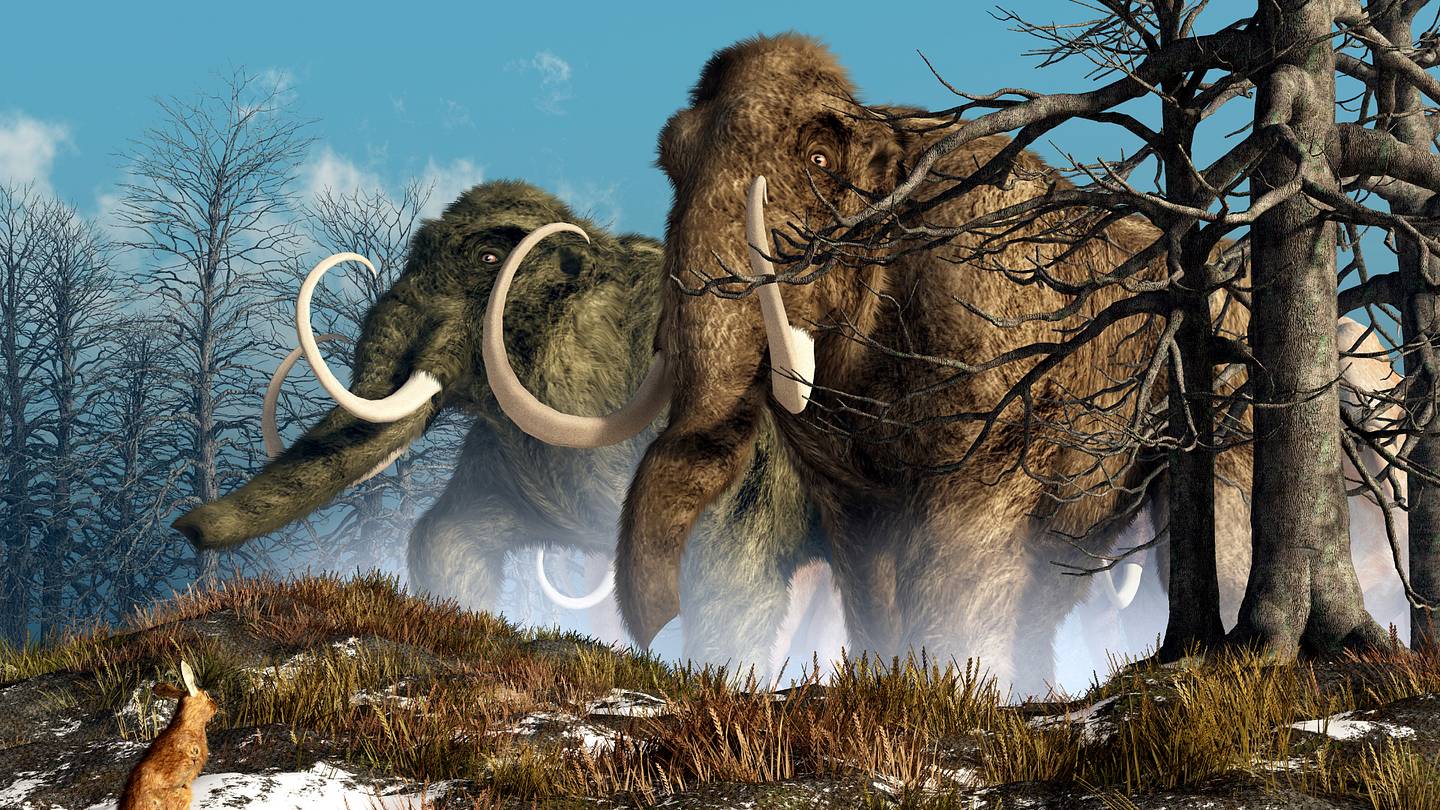
Whatever the cause, there were some big animals walking around in those cold climes. Woolly mammoths stood up to 11 feet tall at the shoulder. The largest saber-tooth cats , commonly (though incorrectly) called saber-tooth tigers , reached nearly 1000 pounds âmore than double the size of modern tigers . Bear-sized beavers roamed North America, and 12-foot-tall giant ground sloths burrowed around South America. There was also the Irish elk, one of the largest deer species ever recorded. They stood 7 feet tall at the shoulder and had antlers that spanned up to 12 feetâthatâs double the size of a moose âs antlers.Â
A lot of the iconic ice age megafauna went extinct after the ice age ended. There are multiple theories as to why. One suggests that when the last glacial period ended and the climate shifted, it caused the vegetation that certain animals depended on to change. This was bad news for the large herbivoresâand bad news for the large carnivores that depended on them.Â
Another theory suggests an intense cold snap was the cause. One far-out idea claims meteorites or comets slammed into Earth, shifted the climate, and annihilated various species. And of course, thereâs a popular theory that says a particularly powerful species of hunter was responsible for these mass extinctions: humans .
Humans thrived during the ice age. Modern Homo sapiens evolved around 300,000 years ago. It was during the last glaciation period that Homo sapiens began leaving Africa and spreading across the globe.
Anatomically modern humans were already in Europe, mixing with Neanderthals and creating detailed cave art , tens of thousands of years before the ice age hit its peak. Itâs believed that our unusually big brains âand the tools and weapons Homo sapiens had spent millennia advancingâallowed people to survive and continue expanding their range during the harsh conditions of the Last Glacial Maximum.
The last of the other human species scattered around the world went extinct during the ice age. The latest known evidence of Homo erectus dates to between 117,000 and 108,000 years ago. Neanderthals disappeared roughly 30,000 years ago, and some think the cooling climate in the years before the Last Glacial Maximum may be to blame. Though the Neanderthals had spent hundreds of thousands of years adapting to Europeâs chillier climate, the changing landscape may not have suited their hunting styles. ââ
The last glacial period ended over 10,000 years ago. Earthâs orbit changed, and the planetâs angle of tilt increased, leaving the Northern Hemisphere exposed to longer, more intense summers. Ice melted and the sea level rose. All that exposed water absorbed rather than reflected light, causing the planetâs temperatures to increase.Â
You can still see traces of the ice age today. Head to Southern Californiaâs La Brea Tar Pits, where youâll find a bubbling, tarry sludge full of ice age animal bones, including dire wolves and saber-tooth cats. Or visit Kerry, Ireland, where thereâs a single lake thatâs home to the only population of the Killarney shad, a type of fish whose ancestors split their time between the ocean and freshwater but who became trapped in an Irish lake after ice sheets altered the landscape. On Canadaâs Calvert Island, youâll find human footprints from 13,000 years ago , left behind by the people who migrated to North America during the ice age.
When ice sheets moved across the land, they left deep scars in their wake. Melting glaciers then filled those holes, creating famous bodies of water like the Great Lakes and Scotlandâs Loch Ness . Norwayâs famous fjords are valleys carved by glaciers, which later filled with sea water.
But you donât have to travel to some far-flung location to find hints of the ice age. If youâre ever hiking in the woods and find a large, scratched up rock, youâre likely looking at glacial striations caused by debris being dragged against the rock by an unrelenting chunk of ice. Or, if youâve ever seen a massive boulder seemingly dropped out of nowhere, itâs most likely a glacial erratic , which is basically just a rock left behind by a moving glacier.
The ice age ended a long time ago, but weâre actually still in an ice age : the Holocene interglacial period of the Quaternary ice age. Large portions of the Northern Hemisphere are no longer covered by ice, but we do still have some glaciers and ice sheets. Despite rapidly increasing global temperatures, our glaciers and the Antarctic and Greenland ice sheets are still hanging aroundâfor now.Â
Loading recommendations... Please wait while we load personalized content recommendations