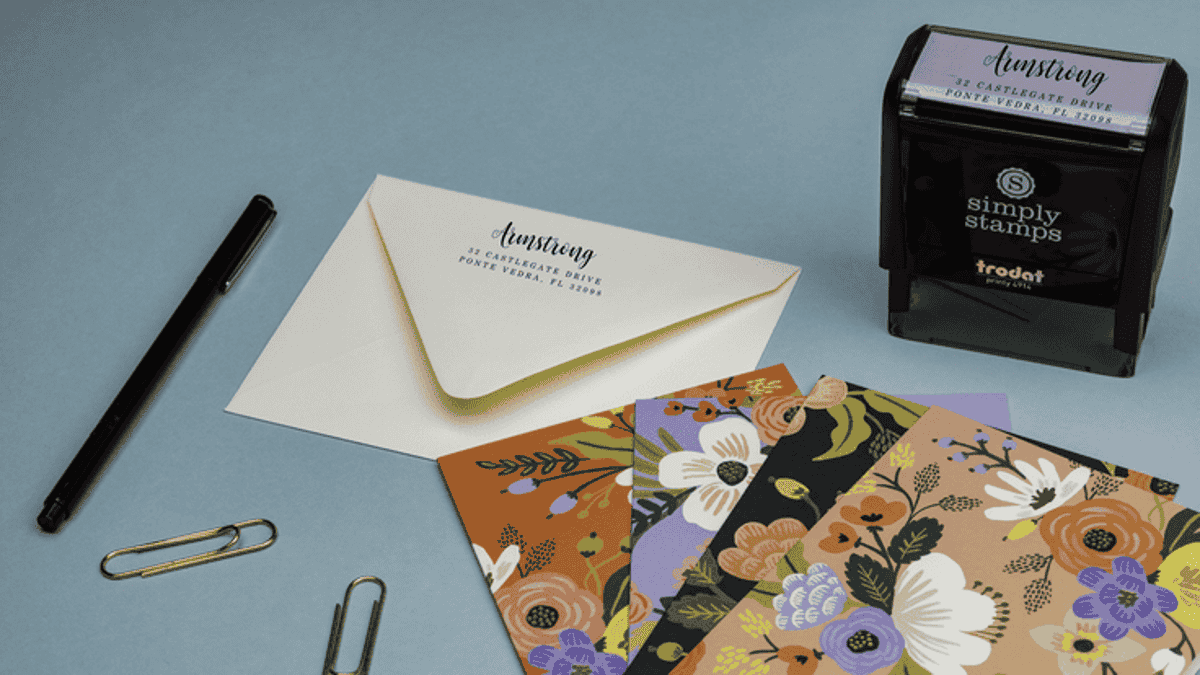
Correctly formatting the mailing address on any letter you send out can help get your mail to its recipient as quickly and efficiently as possible. If you know you've used the right address format, you won’t have to fret about whether your letter will arrive or get lost once you’ve dropped it in your mail box.
After you have your letter ready to go with the contents, return address stamp and postage stamp, take an extra moment to ensure that you have followed the requirements for writing addresses.
Little errors can slow your mail down. Bigger errors can keep it from reaching the destination. Here is a brief summary of some of the basic requirements for domestic and international address formatting, and a step-by-step guide on how to address an envelope. You can also review tips for sending letters to those who are deployed in the Military. This is not a comprehensive guide, but covers many essential areas regarding proper address formats. You will also discover links to more helpful resources if you have questions.
Ever wondered if you must have a return address on your letter to mail it? The answer is no. While this is not a requirement set by the postal service, it helps to prevent undeliverable mail from being misplaced. Undeliverable mail means that the lack of a return address or improperly formatted address will make it impossible to have the letter get back to the intended owner or sender, and may be lost. The USPS reports that 25% of all mail items have an improperly formatted address. There are a few simple practices that can ensure your mail is written and sent out correctly.
Make sure you know how to pluralize names when you write an address.
It can be easy to leave off an apartment number or put an incorrect zip code. Make sure to double check the address you write and make sure details like the state abbreviation and zip code are correct.
Many mail pieces do not include directional information like East or West, which disrupts routing and delivery. Directional information includes N, S, E, W, NE, NW, SE, and SW. For street names, directionals should be abbreviated. For city names, directionals should be spelled out. Directionals are often found in the street address line, and may be before or after the street name. The bottom line with this component is to make sure each is included. A single letter can send mail to an entirely different destination.
While the Postal Service may still be able to deliver to the poorly formatted address, it will take longer and is not guaranteed. To ensure each mail piece gets to its destination in a timely manner, and can be returned to its sender, make sure to include the return address .
The basic address format in the United States includes a minimum of 3 lines.
City, State Abbreviations, Zip
Street Address or P.O. Box
USPS.com advises that when the apartment number doesn’t fit on the street address line, apartment number should be written ABOVE the street information. The USPS prefers including the apartment number on one long street address line, but also suggests the alternative of including an apt line above the street address.
This can be confusing as many online form fields include a 2 nd address line for apartment and suite information. Many people have gotten in the habit if writing apartment numbers underneath the street address. Fortunately, mail can still be processed with the apartment line written under the street information. These guidelines are designed to assist with sorting and delivery efficiency.
There are two ways that P.O. Box information can be conveyed.
The Military P.O. Box guidelines include additional requirements.
Military addresses for those who are deployed internationally should follow a specific format. Here are the main components of a military address:
The city line begins with APO (Air/Army Post Office), FPO (Fleet Post Office), or DPO (Diplomatic Post Office). Only the abbreviation is included. Where the state would normally be listed, you will include one of the following abbreviations AE (Armed Forces), AFP (Armed Forces Pacific), or AFA (Armed Forces America).
These do not include the country destination. Instead, the fourth line is left blank.
Army/Air Post Office (APO):
Fleet Post Office (FPO):
UNIT 100100 BOX 4120
Diplomatic Post Office (DPO):
In order to properly fit a city, state and zip code on one line, official two-letter state abbreviations are commonly used in envelope addressing. When learning how to address an envelope, it's important to use the correct state postal abbreviation to ensure that your mail makes it to the right destination.
International addresses should be formatted based on recommendations from the destination country. Upper and lower case requirements, punctuation, postal codes and province rules may vary. Always be sure to check each destination’s requirements before sending.
While there are some variants in the address requirements from country to country, there are 2 consistent differences. These exist in the last line, and the 3 rd line (also known as the city line). The first thing you will notice is including the name of the destination country as the last line of the address.
Use the U.S. name of the country from the IMM. For example, write Germany, not Deutschland. Explores a full list of country names provided by the USPS here .
City, town, province, county or other designation
City, town, province, county or other designation, AND postal code
The 3rd line may contain region names for a state, province, county, district, town, territory, land, shire, department, canton, prefecture, oblast or autonomous region. In most countries the city line goes below the street address, however, in Hungary the city line goes before the street address. There may be additional exceptions.
Some countries include the postal code at the beginning of the 3rd line while others include it at the end. Still, other countries prefer the postal code to be listed on a line by itself.
Here is a summary of some of the address formats for provinces and postal codes.
This City Line Table comes from http://www.columbia.edu/~fdc/postal/
Letters with more than one recipient need to be addressed following the appropriate guidelines. Here's a helpful guide on how to address an envelope to a family unit, married couple, and groups with different last names:
For family units , you can refer to your recipients as a collective group. For example,
The Recipient Family
To send a letter to a married couple with the same last name , address the couple using their titles (“Mr.”, “Mrs.”, “Dr.”, “Rev.”, etc.) followed by their shared name.
Mr. and Mrs. Recipient’s Shared Last Name
For married or unmarried couples or groups with different last names , fully address your letter with both names written out on one single line.
Ms. Recipient 1 and Mr. Recipient 2
Attn: and C/O are used when addressing a letter to a recipient through an organization, a business or a specific person.
Stands for "attention" Most personal correspondence and letters do not require an attention attribute. “Attn:” is used when your letter is being sent to a company, a department, an organization, a business, etc. but is intended for an individual or individuals within the group.
Attn: Recipient's Name
Stands for “care of”. C/O is used when sending mail to a recipient who is in the care of another individual. This is commonly used when a person is temporarily staying at a certain address for a short amount of time.
Here is how to format an address with C/O:
C/O Name of Person/ Organization who the recipient is in the care of
Learning how to address an envelope is important for making sure your mail makes it to the correct destination, and for making sure that it can find it's way back to you if returned. Want to skip the hassle of adding your return address to each and every letter and correspondence? Address stamps are a convenient and easy way to ensure your mail has the proper return address. Here are just some of the ways that return address stamps can take the hassle and stress out of addressing your mail:
Return address stamps are not just for mail! They can also be used on small packages and shipping labels. At Simply Stamps, we specialize in creating custom return address stamps that simplify shipments for both professional and personal use.
With options ranging from custom logo address stamps to monogram address stamps , our personalized stamps are a convenient tool for all of your outgoing packages. Here are some of the top ways that custom address stamps can simplify your shipping processes:
The United States Postal Services publishes an International Mail Manual , which is updated with the newest changes. Checking this document may assist with any questions you may still have.
As a quick reminder:
Address formats are updated periodically, so always double check the postal requirements before sending to an international destination.