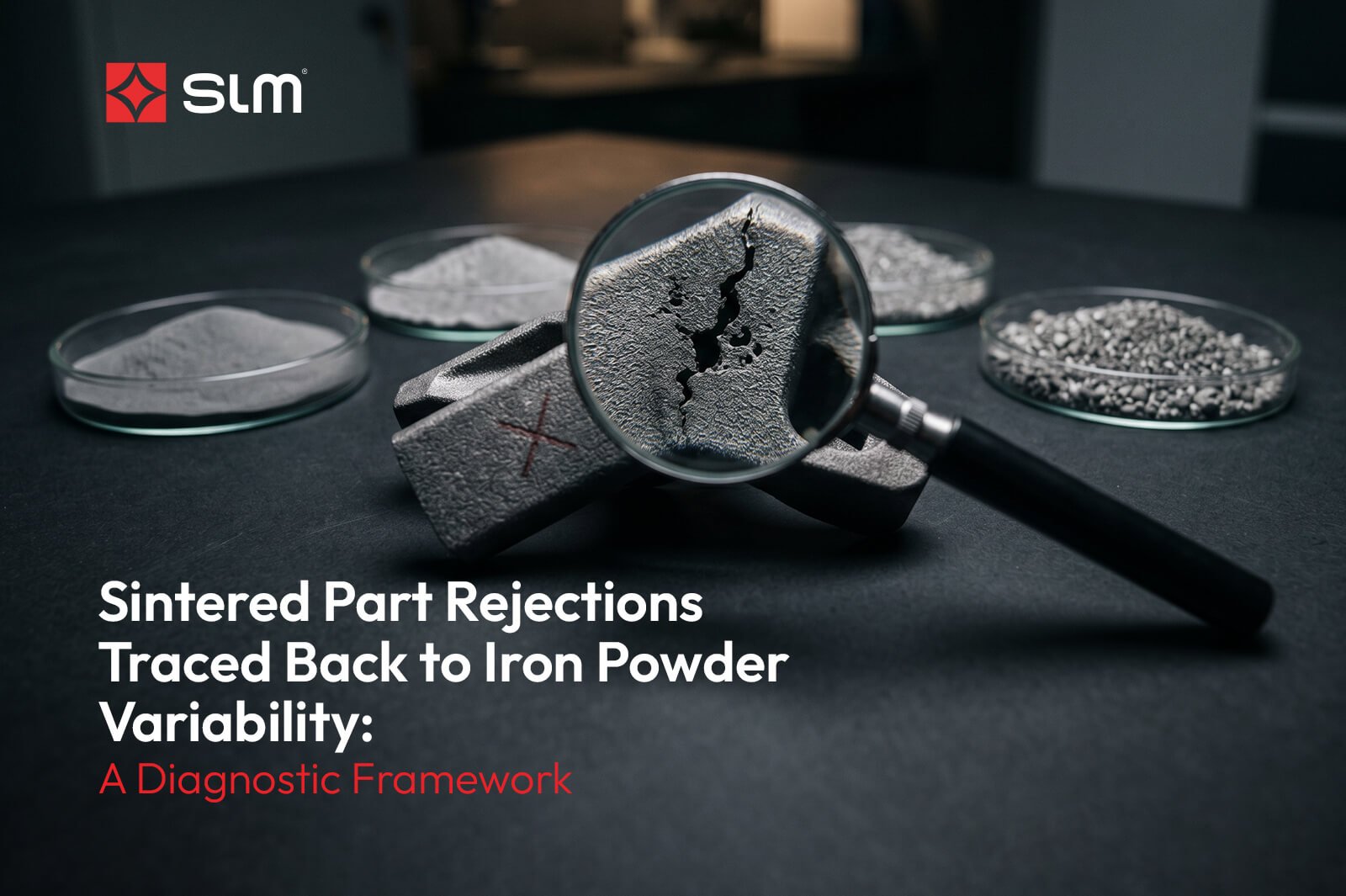
If your sintered parts are suddenly showing inconsistent density, poor strength, dimensional deviations, or unexpected cracks, the issue may not lie with your tooling or process at all. In many cases, the root cause is the iron powder itself. Variations in particle size, chemistry, apparent density, compressibility, or flow characteristics can silently affect every stage of powder metallurgy. A structured diagnostic approach helps manufacturers trace defects back to powder variability, reduce rejection rates, and restore process consistency.
Powder metallurgy is built on consistency. Every stage, from filling the die to compaction and sintering, depends on the iron powder behaving exactly as expected. Even small variations between production batches can have a significant impact on the finished component.
Manufacturers often begin troubleshooting by adjusting compaction pressure, furnace temperature, tooling, or lubrication. While these factors certainly influence part quality, they may only be treating the symptoms rather than addressing the real cause.
Iron powder is the foundation of every sintered component. If that foundation changes, the entire process changes with it.
The challenge is that powder-related issues rarely announce themselves directly. Instead, they appear as production inconsistencies that seem difficult to explain.
Some common symptoms include:
When multiple process parameters remain unchanged but these defects continue to appear, powder consistency deserves closer investigation.
A structured diagnosis begins with understanding the most critical powder properties.
Particle size influences packing efficiency, flowability, compressibility, and sintering behaviour.
A wider distribution may improve packing density, while excessive fines can reduce flow and create filling inconsistencies. Coarser particles may reduce green strength or require process adjustments.
Consistent particle size distribution ensures predictable behaviour throughout production.
Apparent density affects how much powder fills the die cavity before compaction.
Variations in apparent density can lead to inconsistent fill weights, causing density differences from one component to another. These differences often translate into dimensional variation and uneven mechanical performance after sintering.
Monitoring apparent density helps maintain repeatable production.
Good flow ensures complete and uniform die filling.
Poor flow can create uneven powder distribution, resulting in density gradients, incomplete filling, and defects that become visible only after sintering.
Flowability becomes especially critical for complex geometries and high-volume production.
Compressibility determines how effectively the powder densifies under pressure.
Lower compressibility may require higher pressing forces while excessive variability can create differences in green density across production batches.
Consistent compressibility supports stable mechanical properties and dimensional accuracy.
Even minor changes in oxygen content, carbon levels, impurities, or alloying elements can influence sintering behaviour.
Chemical variability affects:
Reliable suppliers maintain tight control over chemical composition to minimise these variations.
Rather than adjusting every process parameter one by one, manufacturers can follow a systematic approach.
Determine whether defects occur:
Patterns often reveal whether the issue originates from material or process conditions.
Compare recent powder batches against previous successful lots.
Review parameters such as:
Small differences that appear acceptable on paper may become significant in demanding applications.
Verify that critical production parameters have remained stable.
If these variables remain unchanged while quality declines, the investigation should return to the raw material.
Test a previously successful powder batch under identical production conditions.
If part quality immediately improves, the evidence strongly points toward powder variability rather than equipment or processing issues.
Controlled comparisons eliminate unnecessary guesswork.
Successful manufacturers do more than inspect incoming material.
They track powder properties alongside production metrics such as:
Over time, these correlations make future problems much easier to diagnose.
Choosing the right iron powder is only part of the equation. Producing consistent powder from one batch to the next requires robust manufacturing controls, quality assurance, and process discipline.
An experienced supplier understands that manufacturers depend on repeatability rather than occasional performance.
Reliable production includes:
The more consistent the incoming powder, the more stable the downstream manufacturing process becomes.
Reducing rejection rates isn’t simply about identifying one faulty batch. It’s about building a production system that detects variability before defects reach finished parts.
Manufacturers can strengthen quality by:
Preventive quality control is almost always less expensive than reacting to production failures after they occur.
Sintered part rejections are often blamed on tooling, furnaces, or compaction settings. While these factors certainly matter, the investigation should always begin with the material itself.
Iron powder variability can quietly influence every stage of powder metallurgy, from die filling to final part performance. By following a structured diagnostic framework, manufacturers can identify root causes faster, minimise production losses, and improve overall process stability.
Consistent iron powder isn’t just a raw material, it is the starting point for reliable, repeatable, high-quality sintered components.
Variations in particle size, density, flowability, compressibility, or chemical composition can lead to inconsistent compaction, dimensional changes, reduced strength, porosity, and higher rejection rates.
Unexpected increases in rejection rates despite stable production settings are often one of the earliest indicators of inconsistent iron powder.
Only to a limited extent. Process adjustments may temporarily reduce defects, but consistent powder quality is essential for long-term production stability.
Key properties include particle size distribution, apparent density, flow rate, compressibility, chemical composition, oxygen content, and moisture levels.
Implement incoming powder inspection, monitor batch-to-batch consistency, maintain stable processing conditions, analyse production data, and partner with suppliers who deliver consistent material quality.