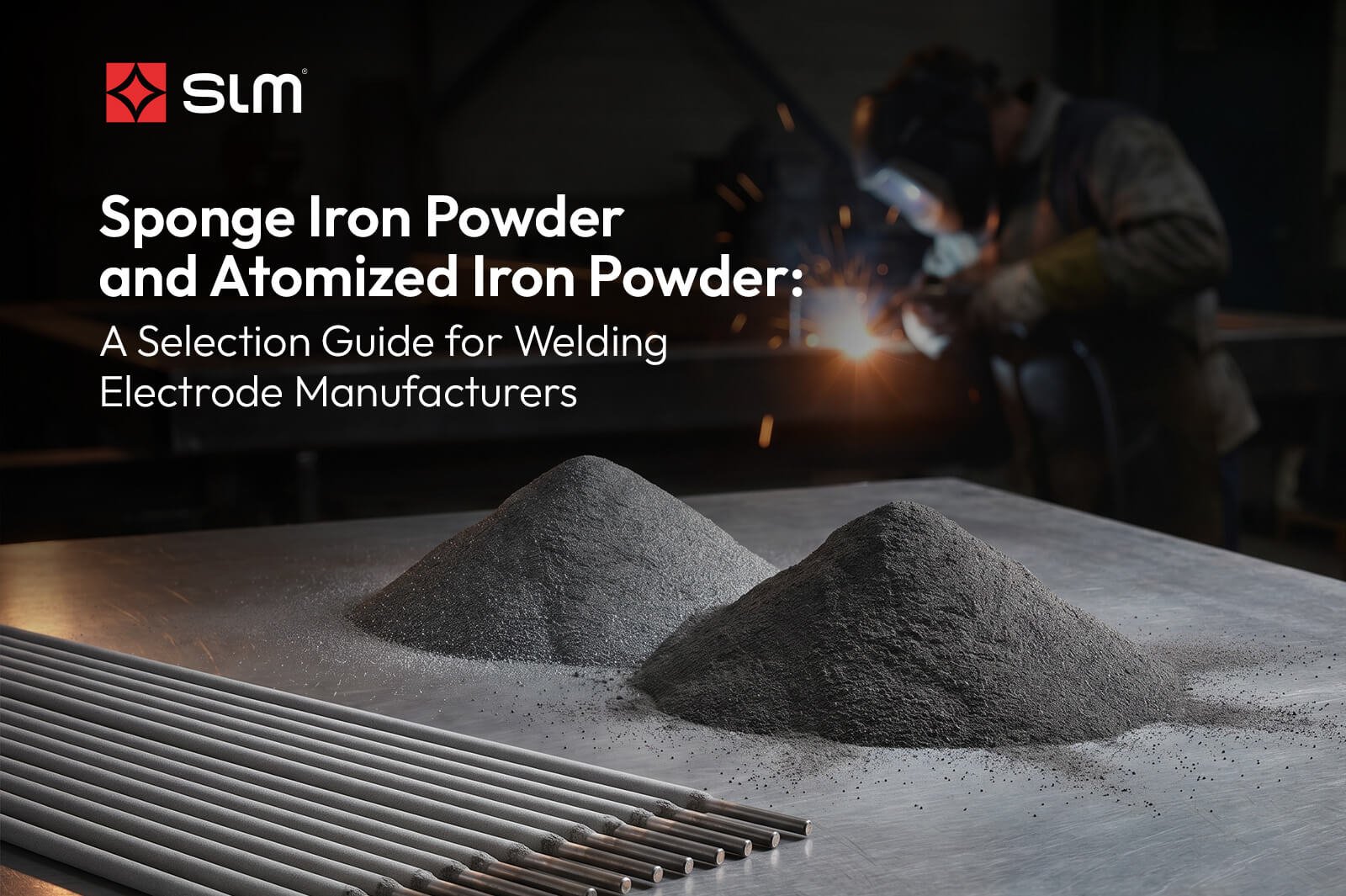
Choosing the right iron powder for a welding electrode formulation is rarely just a material decision. It shows up later in productivity, weld quality, deposition efficiency, and how satisfied the end customer is.
Most electrode manufacturers end up comparing two options at some point: sponge iron powder and atomised iron powder . They serve similar purposes on paper, but the manufacturing process, particle structure, density, and surface area behind each one are quite different.
Which one performs better depends on the electrode you’re producing, your production line, and the welding result you’re aiming for. Here’s how the two actually compare.
Iron powder is a core ingredient in many electrode formulations, added mainly to lift metal deposition rates, improve welding efficiency, stabilise the arc, and bring production costs down.
Get it right and it shows up as:
Not every iron powder behaves the same way, though. Knowing what separates sponge iron powder from atomised iron powder matters before either one goes into a formulation.
Sponge iron powder comes from reducing high-purity iron ore without ever melting it. During the reduction process, oxygen is stripped away, leaving a porous iron structure that is then crushed, milled, sieved, and classified into the particle sizes required for a given application.
Because the metal never melts, the particles stay irregular and porous rather than smoothing out.
That porosity and surface area is exactly why sponge iron powder tends to win out wherever compaction and coating adherence matter most.
Atomised iron powder takes the opposite route. Molten iron gets broken into fine droplets with high-pressure water or gas jets, and those droplets solidify almost instantly into powder.
The result is denser, smoother-surfaced particles than anything sponge iron powder produces.
Wherever a process needs predictable density and controlled flow, this is usually the powder doing the work.
There’s no single right answer here. It comes down to what a specific electrode formulation actually needs.
Sponge iron powder makes sense when you need:
Its porous structure interlocks mechanically with the rest of the coating mix, which is why so many flux-coated electrodes lean on it.
Atomised iron powder is the better fit when you need:
Dense, uniform particles behave predictably on the line, especially where feeding and mixing are automated.
Rutile, basic, and low-hydrogen electrode formulations each pull toward a different powder choice. There’s no powder that’s right for all three.
2. Deposition Efficiency
Iron powder lifts deposition efficiency across the board, but how much depends on particle morphology, since that’s what governs how the powder actually contributes to weld metal formation.
3. Manufacturing Process
Production equipment matters too. A line built around automated feeding and consistent flow tends to favour atomised powder. A process prioritising adhesion and compaction usually leans sponge.
4. Cost Considerations
Raw material price is just one line item. The fuller picture includes:
A pricier powder sometimes ends up cheaper overall, once you factor in fewer rejects and less waste.
High-purity powder shows up as:
That consistency is also why it’s worth being selective about iron powder manufacturers in India . Batch-to-batch reliability is what actually protects quality standards over time.
Consistency tends to matter more than the price tag in electrode manufacturing. A small drift in particle size, density, moisture, or chemistry can quietly cause:
That’s the real argument for sticking with trusted iron powder suppliers in India: stable production, not just a lower invoice.
Picking between sponge and atomised is only half the decision. The supplier behind either one matters just as much.
The right supplier ends up functioning as a manufacturing partner, not just another vendor on the purchase order.
SLM Metal has built its iron powder around consistency, purity, and performance, the three things manufacturers actually need from a supplier rather than a vendor.
Manufacturing capability, tight quality control, and years of experience across industrial applications back that up, which is what lets SLM Metal support welding electrode manufacturers through demanding production requirements.
Sponge or atomised, working with a trusted supplier is what actually delivers process stability, product quality, and manufacturing efficiency over the long run.
Sponge and atomised iron powder both have a real case to make. Which one wins out depends on the electrode formulation, the production process, and what you’re optimising for.
Sponge iron powder pulls ahead on surface area, porosity, and coating adhesion, which covers a lot of conventional welding electrodes. Atomised iron powder pulls ahead on flowability, density, and consistency, which matters more in precision manufacturing setups.
Price shouldn’t be the only line manufacturers look at. Powder characteristics, production efficiency, and supplier reliability belong in that decision too, and that’s where working with established iron powder manufacturers in India and trusted iron powder suppliers in India pays off: steadier quality, fewer production headaches, and electrodes that perform.
1. What is the main difference between sponge iron powder and atomised iron powder? Sponge iron powder comes from reduced iron ore and keeps a porous, irregular structure. Atomised iron powder comes from molten iron broken into droplets, which gives it denser particles and better flow.
2. Which iron powder is better for welding electrodes? Depends what you’re optimising for. Sponge wins on coating adhesion and surface area; atomised wins where you need high density and consistent flow.
3. Why is iron powder added to welding electrodes? Mainly for deposition efficiency. It also helps arc stability, productivity, and overall weld quality.
4. How do I choose reliable iron powder manufacturers in India? Look at quality control track record, particle size consistency, purity levels, technical support, and whether supply has actually been reliable over time.
5. Does particle size affect welding electrode performance? Yes, more than people expect. It affects coating uniformity, deposition efficiency, flowability, and weld quality, so getting it right matters for consistent results batch after batch.