How you take Synthroid matters. Explore the tabs below to find everything from factors your doctor will consider when choosing your starting dose, to what you can expect long term. As always, be sure to follow up with your doctor on any questions you may have at your next appointment.
There's no one dose that's right for all people with hypothyroidism. That's why Synthroid comes in a variety of dosing strengths to match each person's exact needs.
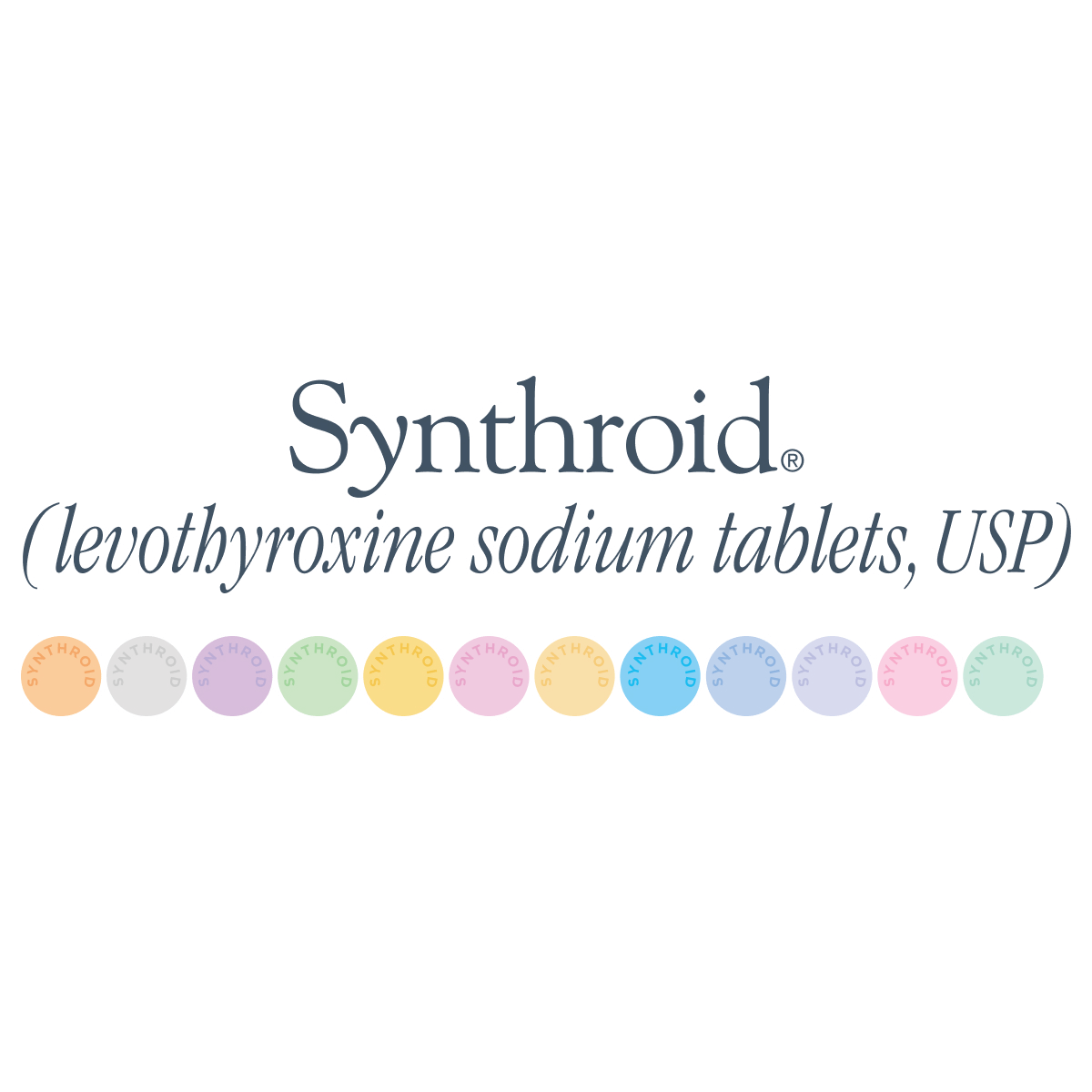
Synthroid comes in 12 dosing options to help your doctor find the dose that's right for you. Your doctor will determine your starting dose based on your weight, age, cause of hypothyroidism, and other health conditions, as well as other medications you’re taking.
Tablets shown not actual size and may not represent exact color.
Finding the right dose
Hear the steps Wendy took to make sure she found the right doctor—and the right dose.
WENDY, DIAGNOSED WITH HYPOTHYROIDISM
My process of finding the right dose included several different doctors actually. They just were having a very difficult time dialing in appropriate levels. Hypothyroidism can actually cause a great deal of complications in pregnancy, so it was important to have it correct. I went through about three endocrinologists. I think it’s utterly critical you find an endocrinologist that you have a rapport with, you have a connection with. Gratefully, my endocrinologist has had my thyroid medication dialed in and under control. I absolutely love him.
YOUR DOCTOR WILL CAREFULLY MONITOR YOUR THYROID LEVELS REGULARLY. INDIVIDUAL RESULTS MAY VARY.
If I were to meet somebody just starting on this journey, my advice to them is find a doctor they have an excellent rapport with and don’t settle for less. I have a very happy life while living with hypothyroidism. I trust Synthroid to keep my thyroid level exactly where it needs to be.
SYNTHROID IS NOT FOR EVERYONE. TALK TO YOUR DOCTOR TO DETERMINE WHICH MEDICATION IS RIGHT FOR YOU.
SYNTHROID is not right for everyone. Talk to your doctor to determine which medication is right for you.
TO SEE WENDY’S FULL STORY, VISIT THE “SYNTHROID STORIES” SECTION OF SYNTHROID.COM
What to expect when starting Synthroid
When you first start taking Synthroid, your doctor will usually test your TSH levels every 6 to 8 weeks. Because your thyroid hormone needs are very precise, your doctor may need to make small adjustments to find the dose that’s right for you.
It may take several weeks before you notice Synthroid is working and for your thyroid hormone levels to adjust to the correct range.
The way you take Synthroid can affect how much medicine your body is getting. That's why it's critical to take Synthroid as your doctor prescribes, and to take it the same way, every day.
Remember these quick tips on how to take Synthroid:
Take Synthroid once a day, every day, at the same time before breakfast.
Only take Synthroid with water and on an empty stomach.
Wait 30 minutes to 1 hour before eating or drinking anything other than water.
Keep this cheat sheet handy for fast facts about Synthroid and how to take it the right way.
It may take time to find the proper dose of Synthroid that restores your thyroid hormone levels. What do you think, is this a myth or a fact?
Sorry, that's incorrect. This is a fact.
It may take time to find the proper dose of Synthroid that restores your thyroid hormone levels.
It may take up to several weeks for you and your doctor to find the dose of Synthroid that works best for you. Then, after finding the right dose, it’s up to you to take your Synthroid the right way, every day, so that it can work properly. You can review how to take Synthroid here.
See more myths vs facts
Correct! This is a fact.
Establish your dosing routine to help you remember to take Synthroid the same way, every day.
Here are a few helpful suggestions:
Keep Synthroid beside something you see or use when you wake up in the morning. It could be by your phone, toothbrush, or keys.
If you walk your dog every morning, place a sticky note near the leash. If you read the morning news on your smartphone or tablet, place a sticky note on it.
Use a weekly pillbox to help you plan timing for your medication and avoid dosing errors.
Turn your medicine bottle or weekly pillbox upside down after you take Synthroid. Before going to sleep, turn your bottle right side up so you know to take Synthroid in the morning.
You can also sign up to get daily reminders via text or email to take your Synthroid.
Looking to take advantage of these helpful reminder tools?
Foods that interfere with Synthroid
Foods containing soy and cottonseed meal can make Synthroid less effective. Walnuts, grapefruit juice, and dietary fiber can also make Synthroid less effective. If you eat any of these on a regular basis, check with your doctor. They may need to adjust your dose of Synthroid.
Supplements that interfere with Synthroid
Some supplements and medications can also interfere with the way Synthroid works. To avoid this, you should take Synthroid 4 hours before or after taking:
You should always take Synthroid at the same time every day. Ideally, it's preferable to take Synthroid 30-60 minutes before you eat breakfast in the morning to ensure the synthetic thyroid hormone is digested and absorbed into your body without interference from food or supplements.
Even if you’re traveling to another time zone, it's important to maintain your dosing schedule by taking Synthroid at the same time every day.
If a dose is missed in the morning, try to take it as soon as possible. If it’s been over a day since your last dose, skip the missed dose and take your next normal dose as scheduled. Never take more than your prescribed dose.
Many people who think they're taking Synthroid might actually be taking a generic.
Did you know: 1 out of every 3 people who think they’re taking Synthroid aren’t
Although your doctor may have prescribed Synthroid in some cases it can be switched to a generic brand at the pharmacy without you even realizing it.
That’s because some generics come in the same shapes, colors, and doses as Synthroid.
The Food and Drug Administration has determined that certain levothyroxine products are interchangeable and can be substituted at the pharmacy.
You worked closely with your doctor to find the dose of Synthroid that’s right for you, so if your doctor prefers for you to stay on Synthroid, here are ways to make sure you get brand name Synthroid.
Enroll in the Synthroid Delivers Program
To make it even simpler to make sure you always get Synthroid, enroll in the Synthroid Delivers Program and have Synthroid delivered right to your door for only $25 a month for a 90-day prescription.*
*Other pricing available for 30 days ($29.50) and 60 days ($54). See full pricing information . Terms, conditions, and eligibility restrictions apply.
Ask your doctor to note their preference on your prescription
Without specific instructions for the pharmacy, such as DAW or “Dispense As Written,” you may get switched to another treatment without your knowledge, depending on your state’s pharmacy laws.
Inform your pharmacist
Always let your pharmacist or mail-order pharmacy know that you and your doctor prefer brand-name Synthroid.
Before leaving the pharmacy (or as soon as your prescription arrives in the mail), check the pill to ensure it says “SYNTHROID.” If it doesn’t, let your pharmacist know what you and your doctor prefer.
Making sure it’s Synthroid
Find out how Wendy works with her doctor and her pharmacy to make sure she’s getting brand-name Synthroid, as her doctor prescribed.
I had a couple of occasions where I asked for Synthroid, I expected Synthroid, and evidently, that’s not the way it always happens.
At the doctor’s office, we have decided together that he will make notations with my pharmacy, to be Synthroid-specific. It’s nice to know now that I’m going to pick up my prescription and it will be Synthroid. After nearly 15 years, I have put my confidence in Synthroid. It is the right medication for me.
THE FOOD AND DRUG ADMINISTRATION HAS DETERMINED THAT CERTAIN LEVOTHYROXINE PRODUCTS ARE INTERCHANGEABLE.
My doctor explained to me that it’s very important to take my Synthroid first thing in the morning on an empty stomach and to delay having any caffeine or food for at least 30 minutes. This is not an interruption. I just have one tiny little pill and off I go.
TAKE SYNTHROID AS A SINGLE DOSE, PREFERABLY ON AN EMPTY STOMACH, ONE-HALF TO ONE HOUR BEFORE BREAKFAST.
When your doctor prescribes Synthroid, that might not always be what you'll get at the pharmacy. What do you think, is this a myth or a fact?
1 in 3 people who think they are taking Synthroid aren’t. The FDA has determined that certain levothyroxine products are interchangeable and can be switched at the pharmacy. So if your doctor didn’t note their preference for brand-name Synthroid on the prescription, your pharmacy may switch you to a generic. To ensure you get what your doctor prescribed, check out these tips .
Hypothyroidism is a lifelong condition that requires lifelong treatment. By continuing to take Synthroid as your doctor prescribed and getting your levels checked regularly, you can help keep your thyroid hormone levels where they should be.
Taking the initiative
Elisa talks about how she takes an active role in her hypothyroidism treatment with Synthroid.
There is more to managing your hypothyroidism than just taking a pill. It’s not just, you take the pill and that’s it. There’s other facets to this. But it’s manageable and it, it can be done.
My role in managing my hypothyroidism is just that. It’s mine.
Living with hypothyroidism
And I have to take the responsibility to do that and the initiative to do it. And part of that is making sure that I go to the doctor, my endocrinologist, and being as open as I can be. And when I’m having down days, telling him about it, and when I feel like I’m managing it well or I’m where I need to be within my levels, I also tell him so that everybody’s on the same page.
Your doctor will carefully monitor your thyroid levels regularly.
When I’m feeling off, I definitely—the first thing I do is I call my doctor’s office because he will help me rule out whether or not it’s a thyroid issue or if I need to go see another doctor.
PARTNERING WITH YOUR DOCTOR
Part of your commitment in managing your hypothyroidism is partnering with your doctor. And so, I would tell someone that has hypothyroidism that’s trying to find their doctor, they need to figure out what they’re wanting from the doctor beyond just a diagnosis. There’s another element there, which is the compassion and personal-to-personal relationship that you have with them.
Because I loved my doctor so much, that any time I had an appointment, I would drive six hours to see him. I didn’t care because it’s not just about the medication. He gave me the initiative to do something about it and give me control and educate me. By him taking that time to get to know me, and I got to know him, when it got to the point of being on medication, I was on the same page that he was at, and I knew exactly what he was talking about as far as where I needed to be.
Part of what keeps me motivated in managing my hypothyroidism is knowing where I came from and not forgetting that. I’ve really learned to step up and take responsibility for it and talk to people. I don’t get to change that I have hypothyroidism, but I do get to choose how I’m going to manage it.
Keeping your thyroid hormone levels in balance takes commitment–that's more than just taking a pill. It means:
Keep reading to see how you can take an active role in managing your hypothyroidism, so you can help keep your thyroid hormone levels where they need to be.
Once you are on a stable dose of Synthroid, it’s important to have your thyroid hormone levels tested every 6 months to a year, or sooner if you’re experiencing symptoms.
A TSH test is used to check the level of thyroid-stimulating hormone (TSH) in the blood, and it helps your doctor determine if you’re receiving the right dose of medicine. And while a TSH test can tell your doctor a lot, it’s just one part of the picture. What your body tells you is also important.
Your dose may need to be adjusted over time
Throughout your lifetime, your doctor may have to adjust your dose of Synthroid. That’s because the amount of thyroid hormone your body needs may change. Some of the reasons for this may include major life events such as pregnancy, menopause, or aging.
It’s essential to tell your doctor if you’re pregnant or planning on becoming pregnant. The body goes through many changes during pregnancy that may affect your thyroid hormone levels. It’s estimated that 1% to 2% of people develop hypothyroidism during pregnancy despite no prior diagnosis.
Throughout pregnancy, your doctor will need to monitor your thyroid hormone levels, and, if needed, restore your hormone levels with a consistent and precise regimen of Synthroid.
Menopause may require you to take estrogen therapy. This is because during menopause your body makes less estrogen. This may require a dose adjustment to your hypothyroidism medicine.
As you get older, your body may become more susceptible to developing hypothyroidism. Your doctor should test your thyroid hormone regularly during this time.
If you receive a diagnosis for hypothyroidism later in life, your doctor may need to start you on Synthroid. It’s possible they’ll need to slowly start you on medication with smaller doses. Sharing if you have any history of heart disease, stroke, or dementia may help inform your doctor’s dosing decisions.
Always keep track of your symptoms even when on Synthroid. Use a journal to record symptoms you experience and be sure to share them with your doctor.
You need to continue taking Synthroid even after you feel better. What do you think, is this a myth or a fact?
Hypothyroidism is usually a lifelong condition. While feeling better after starting Synthroid might be a sign that your thyroid levels are restored to normal, you'll need to keep taking Synthroid to maintain these levels. Be sure to always follow your doctor's guidance on taking Synthroid.
Have open and honest conversations with your doctor so they can understand how your treatment is going.
SYNTHROID® (levothyroxine sodium) tablets, for oral use is a prescription, man-made thyroid hormone that is used to treat a condition called hypothyroidism in adults and children, including infants. It is meant to replace a hormone that is usually made by your thyroid gland. Generally, thyroid replacement treatment is to be taken for life. SYNTHROID should not be used to treat noncancerous growths or enlargement of the thyroid in patients with normal iodine levels, or in cases of temporary hypothyroidism caused by inflammation of the thyroid gland (thyroiditis).
This is the most important safety information you should know about SYNTHROID. For more information, talk with your doctor.
You are encouraged to report negative side effects of prescription drugs to the FDA. Visit www.fda.gov/medwatch or call 1-800-FDA-1088 .
If you are having difficulty paying for your medicine, AbbVie may be able to help. Visit AbbVie.com/myAbbVieAssist to learn more.
You are about to enter a site that is for US Healthcare Professionals only. By selecting “Yes” below, you certify that you are a healthcare professional and that you wish to proceed to the Healthcare Professionals Only section of this site. Products or treatments described on this site are available in the US but may not be available in all other countries.
I am a licensed healthcare professional and wish to proceed to the Healthcare Professionals Only section of this site.
You are leaving an AbbVie website and connecting to a site that is not under the control of AbbVie. AbbVie is not responsible for the contents of any such site or any further links from such site. AbbVie is providing these links to you only as a convenience, and the inclusion of any link does not imply the endorsement of the linked site by AbbVie. You should also be aware that the linked site may be governed by its own set of terms and conditions and privacy policy for which AbbVie has no responsibility.
Conversely, the presence of this link does not imply the linked site's endorsement of Synthroid.com or AbbVie.
Do you wish to leave this site?
Terms and Conditions apply. This benefit covers SYNTHROID ® (levothyroxine sodium). Eligibility: Available only to patients with commercial insurance coverage for SYNTHROID who meet eligibility criteria. The form of co-pay assistance, enrollment requirements, and processes may vary, please call 1-866-627-4980 for additional information. Co-pay assistance program is not available to patients receiving reimbursement under any federal, state, or government-funded insurance programs (for example, Medicare [including Part D], Medicare Advantage, Medigap, Medicaid, TRICARE, Department of Defense, or Veterans Affairs programs) or where prohibited by law or by the patient’s health insurance provider. If you live or receive treatment in certain states, you may not be eligible. If at any time a patient begins receiving drug coverage under any such federal, state, or government-funded healthcare program, patient will no longer be able to use the SYNTHROID Co-pay Savings Card and patient must call 1-866-627-4980 to stop participation. Co-pay assistance provided under this program is offered to and intended for the sole benefit of eligible patients and may not be transferred to or utilized for the benefit of third parties, including, without limitation, third-party insurance plans and/or pharmacy benefit managers and their agents. Patients may not seek reimbursement for value received from the SYNTHROID Co-pay Savings Program from any third-party payers, including insurance plans, flexible spending plans or health savings accounts. Co-pay support made available under this program may not be used with any other coupon, discount, prescription savings card, free trial, or other offer (including any program offered by a third-party insurance plan or pharmacy benefit manager, or an agent of either, that adjusts patient cost-sharing obligations). This is not health insurance. Offer subject to change or discontinuation without notice. Restrictions, including monthly maximums, may apply. Subject to all other terms and conditions, the maximum monthly benefit that may be available solely for the patient’s benefit under the co-pay assistance program is $15.00 per month during the calendar year for patients receiving SYNTHROID every month or $25.00 per month during the calendar year for patients receiving SYNTHROID every 3 months. Patients without health insurance may pay a fixed cash price of $39.95 for a 1-month prescription or $99.90 for a 3-month prescription. The actual application and use of the benefit available under the co-pay assistance program may vary on a monthly, quarterly, and/or annual basis, depending on each individual patient’s plan of insurance and other prescription drug costs. By utilizing this co-pay assistance program, you hereby accept and agree to abide by these terms and conditions. Any individual or entity who enrolls or assists in the enrollment of a patient in the co-pay assistance program represents that the patient meets the eligibility criteria and other requirements described herein. Further, you agree that you currently meet the eligibility criteria and other requirements described herein every time you use the co-pay assistance program. To learn about AbbVie’s privacy practices and your privacy choices, visit https://abbv.ie/corpprivacy .
You are leaving the AbbVie website and connecting to a site that is not under the control of AbbVie. AbbVie is not responsible for the content of any such site or any further links from such site. AbbVie is providing these links to you only as a convenience and the inclusion of any link does not imply the endorsement of the linked site by AbbVie. You should also be aware that the linked site may be governed by its own set of terms and conditions and privacy policy for which AbbVie has no responsibility.
Conversely, the presence of this link does not imply the linked site’s endorsement of AbbVie. Do you wish to leave this site?
SYNTHROID® (levothyroxine sodium) tablets, for oral use is a prescription, man-made thyroid hormone that is used to treat a condition called hypothyroidism in adults and children, including infants. It is meant to
Thyroid hormones, including SYNTHROID, should not be used either alone or in combination with other drugs for the treatment of obesity or weight loss. In patients with normal thyroid levels, doses of SYNTHROID used daily for hormone replacement are not helpful for