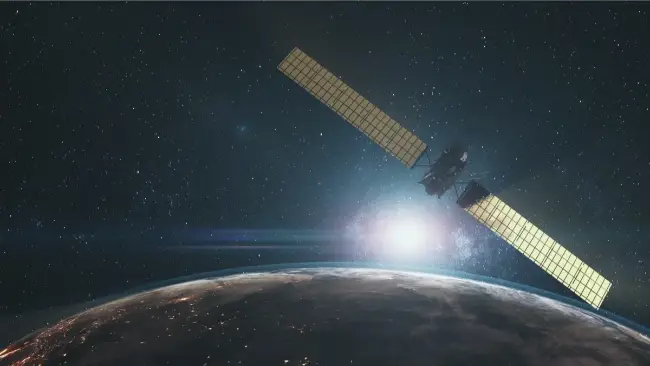
In 2023 the half a trillion dollar global race back to the moon and beyond looked to be just getting started. There appears to be nothing final about this frontier. From military applications, to satellites for communication and advanced imaging, to asteroid mining and In-orbit weightless manufacturing this $550 Billion portfolio of missions has already gone where no industry has gone before. The wager is that space technologies will drastically transform the global supply chains in the next decade. Are we looking at moon rocks being traded on the COMEX, or a “gold rush” for market share in satellite bandwidth? Even garbage collection to clean up more than 60 years of accumulated and hazardous orbiting space junk could be worth additional billions.
This past year, off-world economic activity grew by 25%. A blend of innovative technologies from enhanced satellite networks enabling global real-time monitoring and upgraded communication to advanced propulsion systems has put the cost of efficient and integrated space travel within reach. Space-based construction and 3D printing, make weightless manufacturing possible on a scale impossible to achieve under Earth's gravity. A surge in space mining investment, seeks to exploit and acquire the vast resources of asteroids and other celestial bodies without degrading earth’s ecosystem. Transcending the physical and environmental limitations we currently face on Earth, may be more prosaic than the Hollywood storylines of time travel, intergalactic colonization and reaching for the stars, but the real life 21st century space industry looks to dwarf box office numbers with real revenue and profitability.
In only five years the census of operational satellites in Earth’s orbit doubled to 3000. Enhancing and upgrading this new economic resource is becoming as critical as sustaining agriculture or public health. Communication and data networks rely on space based infrastructure to function. The new and even more significant disruptor lies in the domain of in-orbit manufacturing and 3D printing. In 2022 a proof-of-concept pilot successfully demonstrated a vastly improved modality for the manufacture of fiber optics in space, at half the cost of terrestrial production.
Asteroid mining was first conceived in a sci-fi story published in 1898 called “Edison’s Conquest of Mars.” Refined by Hollywood dreamers, space mining is edging closer to conventional reality and actual paychecks for space miners. There have been significant discoveries of near-Earth asteroids, with NASA's Center for Near-Earth Object Studies cataloging over 28,000, but the composition of these objects remains to be determined. Companies used to the risks of seeking mineral wealth from planet earth believe they have a built-in expertise to apply their knowledge in space. They are already investing heavily in extraction technologies. It’s both a return to the wildcat days of the 20th century oil booms and a paradigm shift in the natural resource sector that promises to diminish the pressure on Earth's limited reserves and potentially benefit the environment.
Studies conducted in the microgravity environment of the International Space Station have shown potential for pharmaceutical companies to enhance drug development, improve our understanding of diseases and molecular structure. MIcrogravity research initiatives have already contributed to growing better-quality protein crystals, a key step in drug design.
In the energy sector, space-based solar power production has achieved investment grade potential. Companies are looking to engineer ways to generate and transmit solar energy 24/7 without atmospheric interference. A breakthrough could revolutionize our approach to renewable energy.
1. United States of America
The growing space sector is not just a testament to human ingenuity; it is a 21st century driver of economic complexity, and a new path for achieving future economic and environmental sustainability on earth. From satellite networks enhancing global communication to mining asteroids for resources, these developments are laying the groundwork for a more connected, sustainable, and resource-efficient world. But this new economic domain comes with a unique fragility. Space prosperity and its terrestrial benefits will depend on maintaining political stability and unprecedented cooperation among nations. It is said that in war the first casualty is the truth. In our time that first casualty may be the hard won benefits of the space economy. Our human capacity for conflict may turn this final frontier into a tragic finality and failure of the global community to take our next big leap in economic development.