In June, we examined the global food crisis, influenced by El Niño and the Great US Drought. The Fifth National Climate Assessment (NCA5), a comprehensive report , predicted how climate change could impact U.S. financial markets and global supply chains, particularly food security. NCA5 highlights the vulnerability of food supply chains to climate change, emphasizing risks from production to distribution.The NCA5's warnings are borne out in our latest global trade data. The disturbing “how” of “heatwave economics” enables us to understand the impact on the global economy.
Climate change's impact on U.S. agriculture:
Brazil, a key food exporter, is facing abundant challenges. In 2022, drought conditions caused an 8% drop in its agricultural GDP, with soy and corn production plummeting by 47 million metric tons across two harvests. Arabica coffee, particularly in Espírito Santo, saw a 10.8% yield decline in its high demand conilon variety due to climate events. Both robusta and conilon varieties are experiencing yield reductions. By 2050, the frequency of extreme temperature days over 34°C during crucial flowering periods is expected to surge, which would bring unavoidable disaster to Brazil's coffee production.
There is no person or economy left on the planet untouched by climate change. Droughts across Canada, South America, Australia, China, and the Mediterranean have significantly affected agriculture. South America's droughts have disrupted agriculture and water supplies, notably reducing Argentina's wheat yields and causing water shortages in Bolivia. Similarly, North America grappled with droughts affecting agriculture and escalating food prices. Europe saw a decline in olive oil production and record-low wine outputs. In Ukraine, drought conditions hampered winter crop sowing even more than the ongoing war with Russia. Asia experienced damage to crucial crops like hazelnuts and rice, while severe droughts in Africa have brought widespread water scarcity and millions of “thirst refugees.”
Import-dependent countries are at risk of facing shortages and increased prices for essential food items. There is an urgent need for international collaboration, to develop climate-resilient agricultural practices and strengthen supply chain strategies. Mitigating food insecurity risks and maintaining a stable, sustainable global food system in a changing climate will demand a historic level of cooperation to match these historic temperature rises.
Addressing climate change in agriculture requires a shift towards resilient practices, including:
R&G Miller and Sons Organic Dairy Farm in Wisconsin is an innovation leader. The farm has implemented diversified crop rotations, integrated cover crops for soil health, and utilized water conservation methods to reduce vulnerability to climate extremes, thereby improving productivity and sustainability.
Investing in enhanced storage, efficient transportation, and renewable energy is crucial. The global community must prioritize funding and technology transfer, particularly in vulnerable regions.
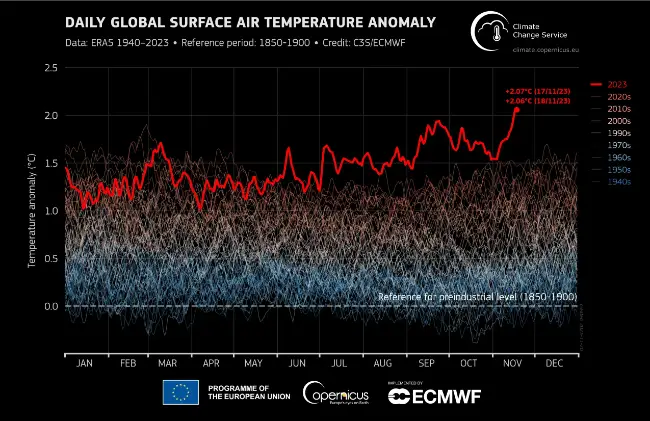
The recent 2-degree temperature breach, surpassing scientific forecasts, happened two weeks before the UN COP28 in Dubai. This conference will now have to assess if it is even feasible to pursue the Paris Agreement's objective of capping global warming at 2 degrees, ideally at 1.5 degrees.
The impact of climate change on food exports is a call for action. These are not simply numbers. The future, is written in these trends. The cornerstone of civilization is global food security and sustainability. Collaborative efforts involving governments, private sectors, and local communities are crucial. Policymakers must champion policies that foster sustainable practices, encourage innovation, and provide safety nets for affected communities. As consumers, our choices can drive demand for sustainable products, supporting a shift towards a more resilient food system. The challenge is immense but so is the urgency to drive coordinated action and forge a path to a more resilient and food-secure future.