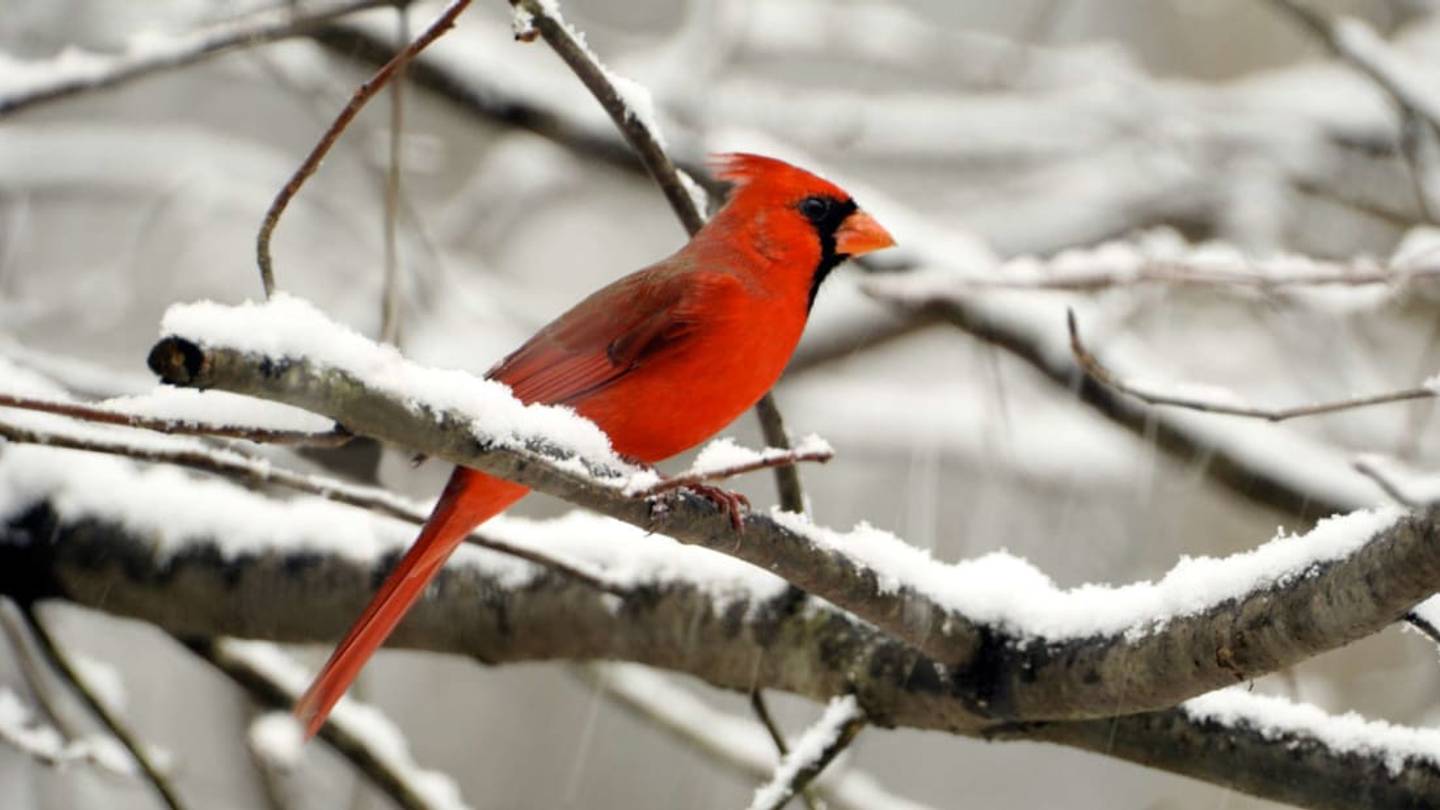
When Pennsylvania-based birder Jamie Hill heard that a friend of a friend had sighted a northern cardinal that was part red and part white, he thought it might be leucistic âin other words, it had lost some of its pigmentation. Either that, or the bird was a hybrid.
But there was a third (albeit less probable) theory that Hill considered, too: That the mysterious visitor was half male and half female, or what is called a bilateral gynandromorph . The woman who had spotted the bird texted Hill a photo of it, which all but confirmed that it was, in fact, a bilateral gynandromorph. The birdâs left side featured the olive-brown and ivory feathers of a female cardinal, while its right side was the brilliant red of a male.
Hill and a friend traveled to Warren County in northwestern Pennsylvania and staked out a spot near the womanâs bird feeders (with her permission) to try to capture photos of the rare specimen. They stayed for an hour, during which the cardinal appeared for a short visit to the feeders and a stopover in the surrounding trees. Hill snapped about 50 photos and shared the most striking ones in a Facebook post , where he described the âonce-in-a-lifetime, one-in-a-million bird encounter.â
Understanding what causes gynandromorphism in birds requires a basic grasp of bird chromosomes. Basically, a female bird contains one Z and one W sex chromosome, while a male hosts two Z chromosomes. A femaleâs egg cell usually contains a copy of either one Z or one W chromosome, but it occasionally forms two nuclei: one with a Z, and one with a W. According to National Geographic , it then essentially gets âdouble fertilizedâ by the maleâs Z chromosome. One nucleus will grow to be female (ZW), while the other will be male (ZZ). Theoretically, the Warren County cardinal has one ovary and one testis.
Birds donât have a monopoly on bilateral gynandromorphismâbutterflies, lobsters, and plenty of other animals have been observed with the condition, too. But it is rare, and itâs a lot harder to spot in species with males and females that look similar.
For Hill, a 48-year bird-watching veteran, spotting the northern cardinal was understandably thrilling. It wasnât, however, the most exciting experience imaginable. âI have been searching for the long-thought-extinct ivory-billed woodpecker for almost two decades,â he told BBC, âand photographing this rare version of one of our most common backyard birds, this gynandromorph northern cardinal, was almost as exciting as I think I would get if I actually found the woodpecker.â
Loading recommendations... Please wait while we load personalized content recommendations