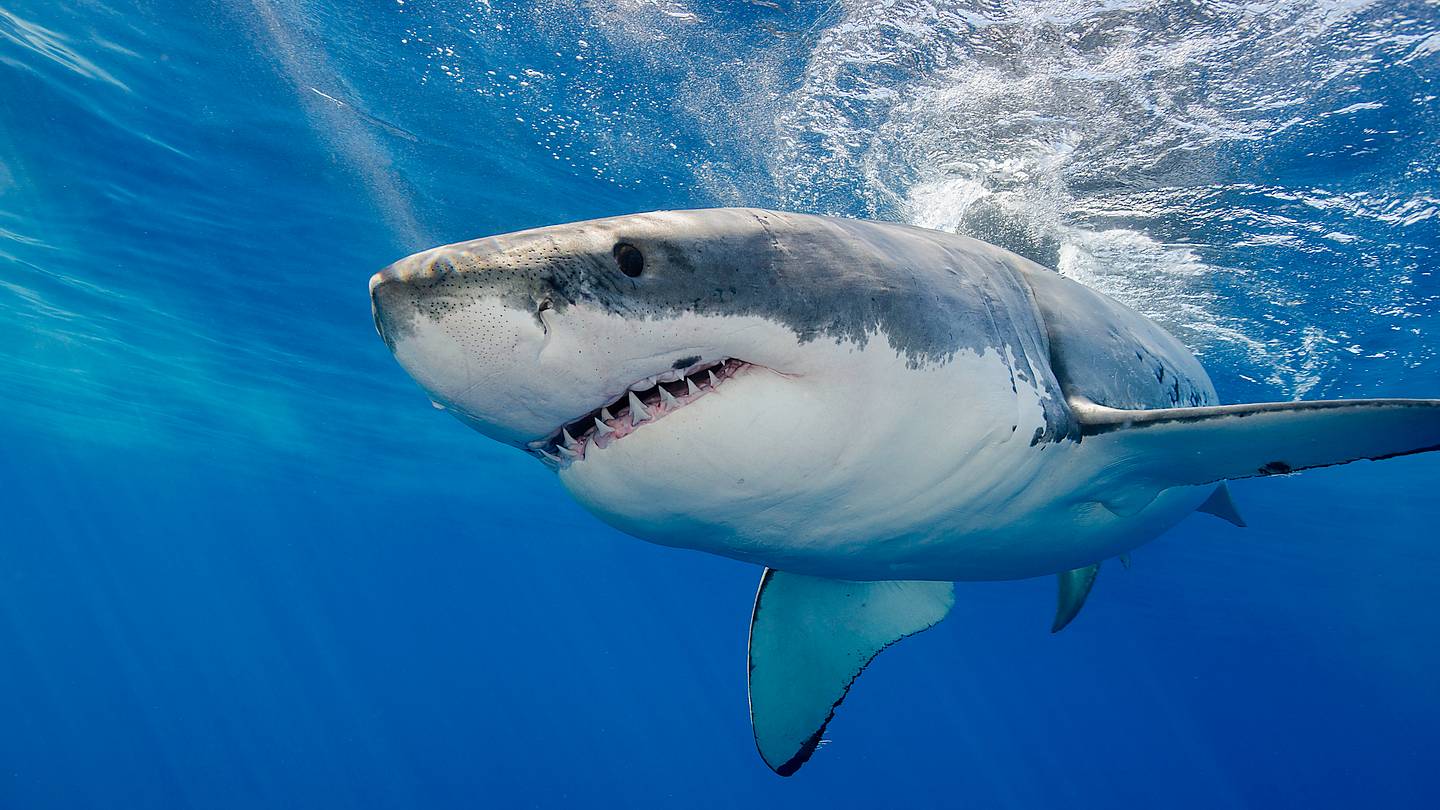
Whether youâre a Jaws fanatic or just want to live every week like itâs Shark Week , youâll want to read up on these fascinating facts about sharks, adapted from an episode of The List Show on YouTube.
They range in size from 8 inches to 40 feet long.
The cookie cutter shark uses its suction-cup-like lips to attach itself to prey. Once itâs firmly stuck on there, the shark spins its body, using its bottom row of serrated teeth to take out a cone-shaped chunk of flesh. Typically, cookie cutters feed on sea creatures much bigger than them, but theyâve also taken bites out of a couple of humans ⦠and theyâve been known to leave their mark on submarines, too.
The novel wasnât always going to be called Jaws. Alternate titles included The Stillness in the Water , The Silence of the Deep , Leviathan Rising , and The Jaws of Death .
He used his pen to tackle misconceptions about the fish. In 2006, he said, âI could never write that book today. Sharks donât target human beings and they certainly donât hold grudges.â Fun fact: Benchley makes a cameo in Steven Spielberg âs 1975 movie adaptation of his novel. He plays a TV news reporter.
In 2018, there were 66 confirmed unprovoked attacks. In 2022, there were 57 confirmed, unprovoked bites , five of which were fatalâdown from nine fatal attacks in 2021 and 10 in 2020.
According to the International Shark Attack File (as reported by the Florida Museum of Natural History), the risk of dying from a shark attack is 1 in 4,332,817. Youâre more likely to be killed by fireworks , a train crash, or MRSAâthat antibiotic-resistant bacteriaâthan you are by sharks. Worldwide, the risk is even lower.
Thanks to their fossilized teeth, we know that theyâve been swimming the seas for at least 400 million years.
Researchers in 2016 used radiocarbon dating on the eyes of 28 Greenland sharks and determined that one female might have been around 400 years old.
The sharkâs meat is toxic when fresh, so it has to go through a fermentation process that involves burying the sharkâs body in sand under rocks for six to 12 weeks. The meat is then cut up and hung to dry. The finished product has a strong scent of ammonia. Anthony Bourdain called it âthe single worst, most disgusting and terrible tasting thingâ heâd ever eaten.
Great whites have a 40 to 55 percent accuracy rate in catching their seal prey, according to research. The hunting process also often involves the sharks coming fully out of the water, which is called breaching.
They can swim at 35 miles per hour for short bursts.
Great white shark attacks on humans are much less vicious than the way sharks attack prey like seals and sea lionsâone study reported that in 76 percent of attacks on surfers, the force would not have stunned a pinniped. In most cases theyâre probably just curiousâthough still potentially deadly. One expert told Discovery that if you do see a shark, the safest thing to do is to remain calm and try to slowly and calmly get back to safety.
Since the 1970s, aquarium workers who have tried to keep the sharks in captivity have been having basically the same tragic experience: finding a captive great white shark sick, then dead, within a week. While in enclosures, the sharks canât swim at the high speeds or over the distances theyâre supposed to, so they bump into the glass and get hurt or just stop swimming and die. Younger sharks have tended to do better: The Monterey Bay Aquarium was able to keep a young great white for 198 days, but released her after she started going after other sharks.
Another shark you probably wonât see in captivity these days is the tiger shark ânot to be confused with the sand tiger shark , which is a completely different species found in aquariums around the world.
After 13 to 16 months of pregnancy, a female might give birth to between 10 and 82 little shark babies. The average is around 30.
One study, which began in 1995 and concluded in 2012, found this to be the case with lemon sharks in the Bahamas.
In research that lasted for four months, a biologist and his team recorded 264 male and 132 female mako sharks in the Easter Island area. They found that there was a clear divide between where males resided versus females. They were baffled as to why. One of them suggested that it might have to do with the fact that males often bite their intended mate, so maybe the females were trying to avoid that whole situation. Fun fact: Biting is often a part of shark copulation, because the males have to hang on to something.
In 2002, software programmer Jason Holmberg went scuba diving on vacation and encountered the endangered whale shark . He wanted to make the spotted sharks less mysterious, so he teamed up with an astrophysicist and a marine biologist. They were able to adapt an algorithm that had been created for the Hubble Space Telescope program and use it to start identifying sharks. The algorithm was initially for star mapping, so it made sense as an algorithm for shark spot mapping. Theyâve since created a database with 32,000 pictures of whale sharks. The database has helped them track the animalsâ locations, which means they can learn more about whale shark life history.
Sharks are able to sense electric fields in water, which allows them to determine if theyâre in the vicinity of prey. One theory is that hammerhead sharks have more of those sensory organs in their heads, so they can find prey better. Their eyes being so far apart helps tooâthey have better binocular vision.
In addition to using electric fields to sense prey, sharks also use them to sense predators. Even shark embryos have that ability. In a study published in 2013, a group studying brownbanded bamboo shark embryos found that when the embryos were in the electric field of a predator, their gills would stop moving.
Nurse sharks and whitetip reef sharks have been observed gathering in groups of two to 40, usually in a safe place like a crevice, often just napping.
It quickly loses parts of its jaw and tail. So itâs not unusual for people who spot a decomposing basking shark on the shore to believe that theyâve found a sea monster. This happened in 1970 in Massachusetts.
During the 1930s, a tiger shark at Coogee Aquarium in Australia vomited a human arm, evidence that became part of a murder trial. Thanks to a tattoo on the arm, the person it belonged to, James Smith, was identified. It turned out that he was missingâand the shark hadnât bitten the arm off, it was cut off with a knife. There was a suspect, Patrick Brady, and a man willing to testify that Brady was responsible. But that witness was shot before the trial. Bradyâs lawyer claimed that for a homicide, there needed to be a body and all they had was an arm. Brady went free. The shark unfortunately died.
The deep-sea-dwelling goblin shark has a jaw that shoots outward to grab prey in what scientists have dubbed âslingshot feeding,â so itâs no wonder they often get compared to monsters. The goblin shark can deploy its jaw at 10.1 feet per secondâroughly twice the speed that New York City pedestrians walk.
Japanese fishermen named the sharks tengu-zame . Tengu is a demon with a long nose that sometimes steals children. And zame means âshark.â Thatâs how we got our English translation: goblin shark.
The bonnethead shark has long been observed to eat seagrassâwhich can account for up to 62.1 percent of its gut content mass. Until recently it was unclear if they were digesting it. But in 2018 it was confirmed through stable isotope analysis that they actually were, making them the first known omnivorous shark.
These sharks have bellies and fins that glow, so itâs thought that when thereâs a predator swimming beneath them, the predator doesnât know the difference between the shark and sunlight filtering into the ocean.
Bull sharks are unusual in that they can tolerate fresh water. Most sharks have to be in salt water because thatâs what their bodies can handleâput them in fresh water and theyâll lose too much salt. But bull sharks are better able to retain salt in their bodies, so they can travel in fresh and brackish water. In fact, in 1937, one was caught in Alton, Illinois, 1000 miles up the Mississippi River from the Gulf of Mexico, where you wouldnât typically expect to encounter a shark.
But there are theories that the measly great white shark, at less than half that size, may have caused them to go extinct. It was previously believed that megalodons went extinct around 2.6 million years ago, but when a group of paleontologists and geologists went back through the fossils and data, they pegged it at 3.6 million years agoâwhich just so happened to be the time that great white sharks were emerging . They were probably able to go head-to-head with younger megalodons and out-compete them for food.
And you might want to be on the lookout for them. In 2018, a couple found a fossilized megalodon tooth on a beach in North Carolina. In 2023, a 9-year-old girl unearthed a megalodon tooth bigger than her hand on the shore of Chesapeake Bay in Maryland.
Thomas Jefferson loved fossils and even kept some on display at the entrance of Monticello. Today, his megalodon tooth is at the Academy of Natural Sciences in Philadelphia. Of course, he signed it.
Before Pinkfongâs version of â Baby Shark â became one of the most viewed YouTube videos of all time, it was a common song for kids to sing at camps. But when Johnny Only turned it into the bop that we all get stuck in our heads today, he did change some things. In the original lyrics, the sharks attack people and even kill them. Peter Benchley would not approve.
A version of this story was originally published in 2020 and has been updated for 2023.
Loading recommendations... Please wait while we load personalized content recommendations