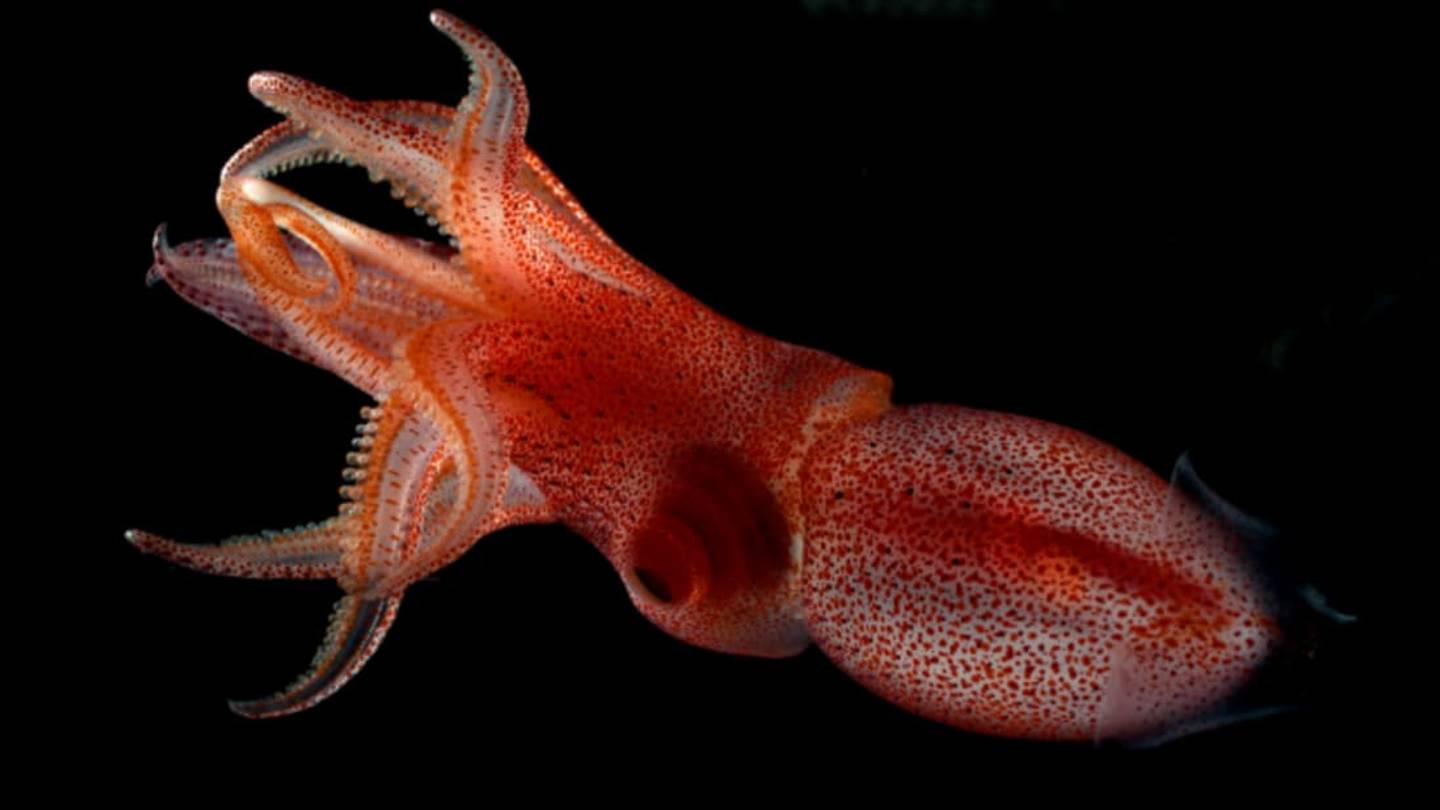
Our oceans are an endless cornucopia of weirdness. Today, weâd like to introduce you to a cockeyed deep-sea cephalopod called the strawberry squid. Researchers writing in the journal Philosophical Transactions of the Royal Society B say each of the squidâs unusual eyes serves a separate purpose in the black depths of the sea.
Histioteuthis heteropsis (literally âdifferent eyesâ) is pink, studded with bioluminescent spots, and quite content to cruise through the â twilight zone â some 650â3300 feet beneath the surface of the ocean. It has one enormous yellow eye and one normal blue eyeâas normal as squid eyes get, anyway.
Biologist Kate Thomas of Duke University, lead author on the paper, says she was impressed by the strawberry squidâs strangeness. âYou canât look at one and not wonder whatâs going on with them,â she says in the video above.
So she decided to find out. She pulled up 30 years' worth of undersea video recorded by remotely operated vehicles at the Monterey Bay Aquarium Research Institute and scrolled through, watching the squidsâ behavior and looking for clues. She analyzed 152 different H. heteropsis sightings and another nine sightings of its cousin, Stigmatoteuthis dofleini .
The onscreen sightings revealed yet another strawberry squid eccentricity: They like to float along upside down, with their heads pointed toward the ocean floor. But this posture, while whimsical, appears to be practical. The head-down orientation aims the squidâs large eye toward the surfaceâwhich is where any light might originate. The little blue eye, better suited for spotting bioluminescence , can keep looking downward into the darkness.
Senior author Sönke Johnsen, Thomas's advisor, said the squid's blue eye could only have one job. âThere is no way it is able to pick out shapes against the ambient light," he said in a statement. "And once it is looking for bioluminescence, it doesnât really need to be particularly big, so it can actually shrivel up a little bit over generations. But the eye looking up actually does benefit from getting a bit bigger.â
Itâs an ingenious solution to a low-light situation. âEyes are really expensive to make and maintain,â Thomas added. âYou want eyes just big enough to do what you need to do, but you donât want to have any bigger eyes because then you are just wasting resources.â
Loading recommendations... Please wait while we load personalized content recommendations