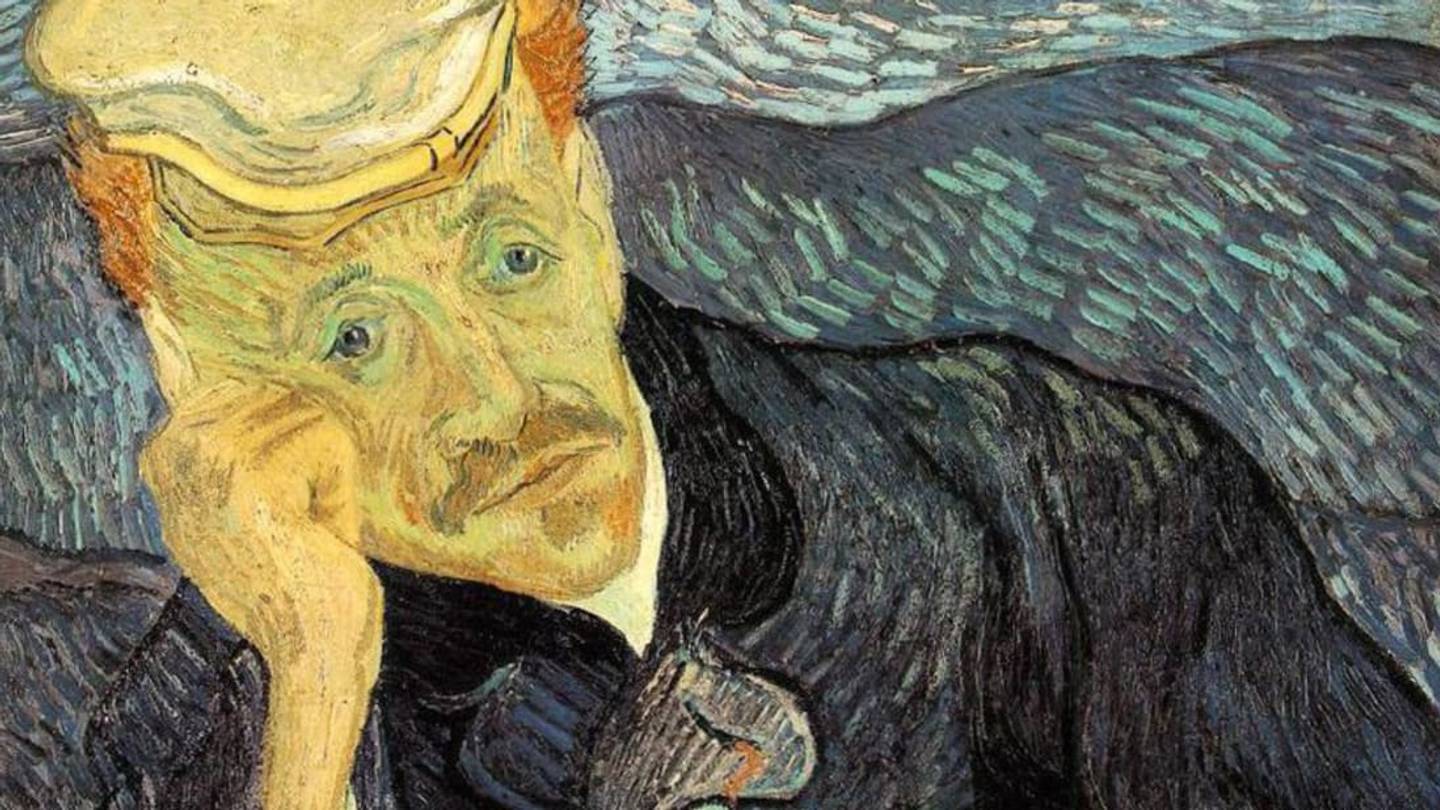
Over the years, Portrait of Dr. Gachet has become one of Vincent van Gogh's most recognizable works. But beneath the brushstrokes, there may be a mystery of jealousy, fraud, and the death of a legend.
Both are called Portrait of Dr. Gachet and feature the same costume, melancholy expression, and head on hand pose. (However, they do include slightly different props.) Their canvasses are virtually the same size (26.4 inches by 22.4 inches) and they were both painted in 1890, the final year of van Gogh's life.
Around the same time that he completing the two paintings, van Gogh also made his only attempt at an etching. There are 61 known prints from this etching, of which 14 are believed to be by van Gogh. The others are said to have been created after his death. The original copper plate is now in the collection of the Musee dâOrsay.
He was also a caretaker. An admirer of the Impressionist movement, Paul-Ferdinand Gachet was an amateur painter who palled around with Paul Cezanne, Camille Pissarro, Claude Monet, and Auguste Renoir. By trade he was a physician who championed the power of homeopathic cures and had an interest in palm reading. After van Gogh left the mental asylum where he'd painted Starry Night , his brother Theo put van Gogh under Gachet's care. The painter moved to Auvers-sur-Oise in a northwestern suburb of Paris, where Gachet looked after him in what turned out to be van Gogh's final months.
In letters to his brother, Vincent alternately wrote of the doctor , "I have found in him a complete friend, even something like a new brother," and "I think that we must not count on Dr. Gachet at all. First of all, he is sicker than I am ⦠Now when one blind man leads another blind man, don't they both fall into the ditch?"
Based on his great reputation and his familiarity with artists, Gachet was expected to save van Gogh from inner demons. But both men lost that battle on July 27, 1890, when the artist ended his life with a revolver shot to the chest that killed him two days later. Some have blamed the poor psychiatric care of Gachet for van Gogh's brutal end. Others blame the doctor's subpar care for the artist after his injury had been revealed. But it's worth noting that when the gendarmes showed up to interrogate the fatally wounded artist, van Gogh famously declared , "My body is mine and I am free to do what I want with it. Do not accuse anybody, it is I that wished to commit suicide."
Ambroise Detrez , Norbert Goeneutte , and Ãmile Bernard also painted Gachet's portraits. Charles Leandre did a caricature and Paul Cezanne painted The House of Doctor Gachet in Auvers .
Imagining the portraits he planned to paint as he healed under the doctor's care, van Gogh wrote in a letter , "It would be more in harmony with what Eugène Delacroix attempted and brought off in his Tasso in Prison , and many other pictures, representing a real man. Ah! portraiture, portraiture with the thought, the soul of the model in it, that is what I think must come." He asked his brother to send a lithograph of the piece for reference.
Though today regarded as one of the most iconic painters to ever live, van Gogh only ever sold two pieces in his lifetime. He'd hoped that painting a prominent figure of the French village might bring him money and more work .
In a letter to Theo he gushed , "I've done the portrait of M. Gachet with a melancholy expression, which might well seem like a grimace to those who see it... Sad but gentle, yet clear and intelligent, that is how many portraits ought to be done... There are modern heads that may be looked at for a long time, and that may perhaps be looked back on with longing a hundred years later."
In his last 70 days on Earth, van Gogh is believed to have created 70 paintings, including both Portraits of Dr. Gachet , The Church at Auvers , and The Cornfield . But the exact number has been called into question.
In the late 1990s, debate began to rage among art critics and historian on whether some of the paintings from van Gogh's last days were actually painted by Gachet. The authenticity of both Portraits of Dr. Gachet has been called into question, with some suggesting they are in fact self-portraits of a close admirer of the master's style.
It took only three minutes for Christie's to sell the original Portrait of Dr. Gachet , which actually boasts van Gogh's signature. Selling for $82.5 million , it set a new record for highest price paid for a painting. It's generally believed to be authentically van Gogh's, as he once wrote of such a portrait, describing the doctor's dour face as mirroring " the desolate expression of our time ."
When 74-year-old Japanese businessman Ryoei Saito won the Portrait of Dr. Gachet at auction, he said of its record-breaking price tag, "It's my principle to get what I want, no matter how much money it costs." But his fervor later drew outcry when he claimed he'd take the piece to the grave and be cremated with it. In the wake of international uproar, Saito confessed his cremation comment was just a bad joke.
Much of Gachet's fine collection of Impressionist art was donated to the Musee d'Orsay . The second Portrait of Dr. Gachet remains on display there today, shrouded in controversy. Chief curator of the French National Museum Service explained the doubt over this piece, saying , "At the root of the uncertainty is the fact that van Gogh does not mention this second version - which is unsigned and appears to be a hastier, less well-finished work - in any of his numerous letters to his brother."
By exhibiting their Portrait of Dr. Gachet side by side with authenticated works of Gachet's, the Musee d'Orsay hoped to put the question to rest. The museum even commissioned infrared scans and chemical analysis, yet all of this did little to convince skeptics.
Loading recommendations... Please wait while we load personalized content recommendations