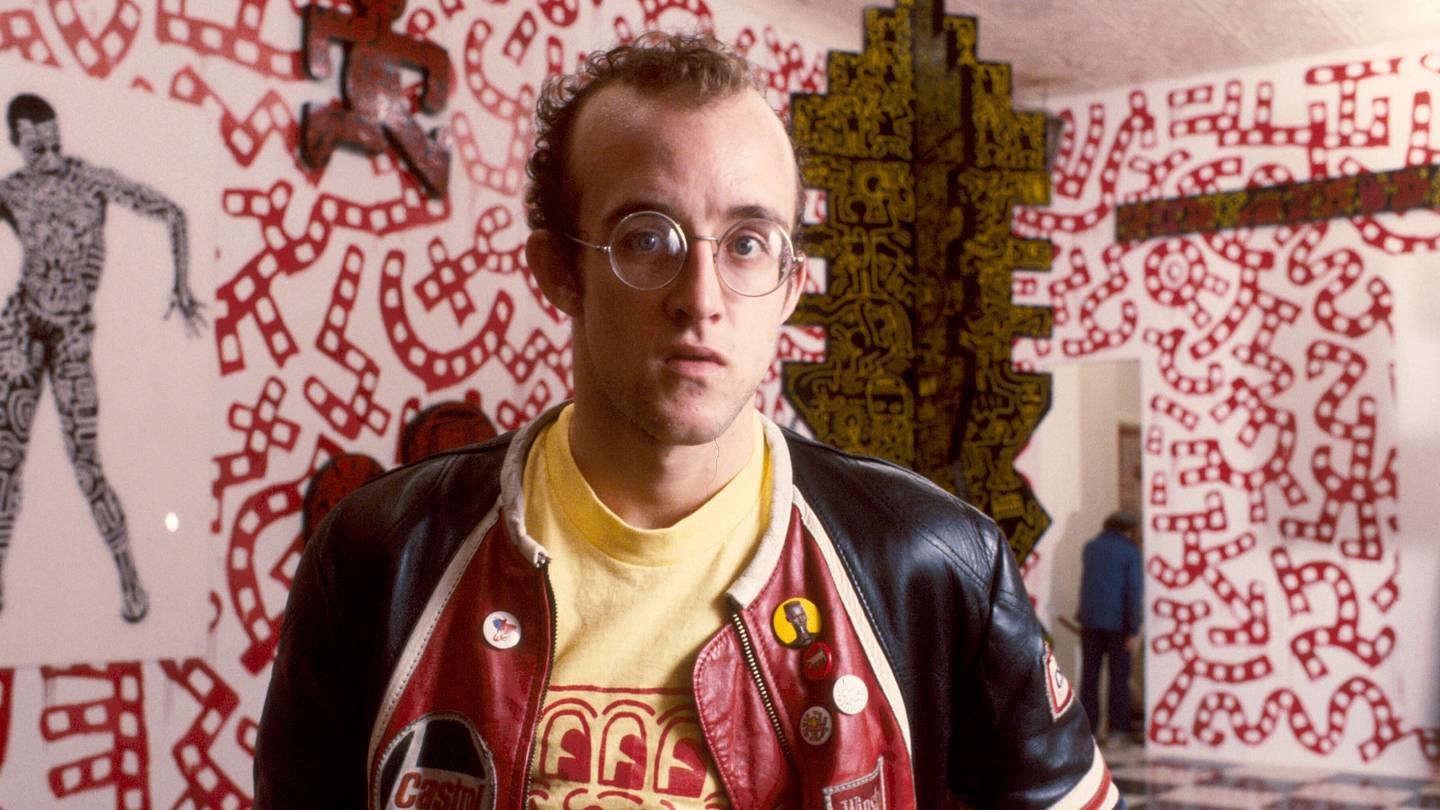
Born on May 4, 1958 in Reading, Pennsylvania, Keith Haring was best known for his contributions to the New York City art scene in the 1980s. His graffiti-inspired artwork depicted simplified people, dogs, babies, hearts, and flying saucers. He often painted bold lines and bright colors to convey feelings of movement and radiance, and although he died in 1990 at just 31 years old, his artwork and legacy live on. Here are some things you might not have known about the artist.
Long before the Kardashians, all the children in Keith Haringâs family shared a first initial of k . His parents, Allen and Joan Haring, named their four kids Keith, Kay, Karen, and Kristen. The oldest child and only son, Keith loved watching and drawing cartoons like Mickey Mouse, Dr. Seuss, and Peanuts. As a young adult, he moved to New York City to pursue his love of art. Kristen Haring later recalled how her older brother would call home from New York to tell his family about his celebrity dinner companions like Grace Jones .
Beginning in his early twenties, Haring drew art in New Yorkâs subways. The walls of the subway stations had panelsâempty spaces for advertisingâposted with black paper that Haring drew on with white chalk. His subway drawings were simple, and he did dozens of drawings per day in front of people who would watch him and ask him what the drawings meant.
Although people generally felt positively towards Haringâs subway drawingsâand despite the fact that he drew quickly to avoid getting caught in the actâthe NYPD still ticketed and arrested him multiple times for vandalism. âMore than once, Iâve been taken to a station handcuffed by a cop who realized, much to his dismay, that the other cops in the precinct are my fans and were anxious to meet me and shake my hand,â Haring said . By 1984, Haringâs artwork was so popular that people would steal his chalk drawings from subway stations and sell them.
In 1978, Haring attended the Nova Convention, which celebrated the work of William S. Burroughs, author of The Naked Lunch . Afterward, Haring read The Third Eye , which focused on what Burroughs and his co-author Brion Gysin called âcut-ups,â or âa way of rearranging or collaging language by breaking text down into small phrases or words and reorganizing them at random, creating new prose imbued with dynamic spontaneity,â according to Wright Auctions, which they also believed could apply to images. â[I]t was this pursuit that Haring became committed to. He found that he could use the âcut-upâ technique to expand the conversations within his own compositions and would juxtapose images of sexuality and religion, life and death, activism and conformity to echo the struggles and complexities of modern life.â
Harring and Burroughs finally met in 1983 and collaborated first two works: The Apocalypse portfolio in 1988 and The Valley in 1989.
Haring became very involved in the 1980s downtown New York art scene, befriending visual artists and performers such as Andy Warhol and Madonna . In a series of paintings called Andy Mouse , Haring depicted Warhol with sunglasses and Mickey Mouse ears. Haring tried his hand at fashion designing when he made a jacket and skirt for Madonna to wear for her performancesâwhich she says sheâd ânever give up.â She told Rolling Stone that sheâd been introduced to Haring through a roommate, and then âwe started hanging out at [legendary New York nightclubs] Danceteria and Mudd Club and the Roxy. ⦠Weâd dance, weâd watch break-dancing crews there and on the street.â
In the 1980s, Haring drew public works murals around New York City, including his âCrack is Wackâ mural at East 128th Street and Harlem River Drive. Although heâs best known as a New York artist, he didnât stay solely in the city. He traveled all around the world to paint public murals in cities such as Paris, Berlin, Pisa, Sydney, Melbourne, and Rio de Janeiro. In these cities, he painted at childrenâs hospitals, charities, churches , and orphanages.
In 1986, Haring opened the Pop Shop , a retail store in New Yorkâs Soho neighborhood, to sell merchandise. The store offered shirts, posters, magnets, and buttons with his artwork on them. Aiming to make his art accessible to a larger audience, Haring opened another Pop Shop in Tokyo in 1987. Critics accused the artist of engaging in crass commercialism, but Haring asserted that he was doing the opposite of selling out. âMy work was starting to become more expensive and more popular within the art market,â Haring said. âThose prices meant that only people who could afford big art prices could have access to the work. The Pop Shop makes it accessible.â
Haring and Jones were introduced by Warhol; in her memoirs, Jones wrote fondly of the time they spent together, whether they were at The Garage, a gay club in SoHo, or Fire Island. When she had an appearance, she would call Haring to help craft her look together: âHe would paint my naked body like it was a canvas, and always differently. Keith always said that as soon as he saw me, he knew my body would be the ultimate body to paint,â Jones wrote . âI remember once when he painted me for a photograph, I went where I was going next with the paint still on. If I could, I would go out wearing nothing but his paint. Covered with Haring, light and joy, his swoops and strokes, his handwritingâI would be dressed perfectly.â He also painted Jones for her music video âIâm Not Perfect (But Iâm Perfect for You).â
In 1988, Haring was diagnosed with AIDS after many of his friends and partners had been dying of AIDS for years. He worked to raise AIDS awareness through his artwork, such as with his piece Silence=Death . âThe hardest thing is just knowing that thereâs so much more stuff to do,â he told Rolling Stone in 1989. âIâm a complete workaholic. Iâm so scared that one day Iâll wake up and I won't be able to do it.â He died of complications from AIDS six months later, at just 31 years old.
In 1989, a year after his AIDS diagnosis, Haring started the Keith Haring Foundation. Besides being passionate about AIDS awareness and prevention, Haring loved working with children to create collaborative murals. During his life, Haring led art workshops for kids in museums and schools around the world. The Keith Haring Foundation gives funding to childrenâs charities, AIDS research, and AIDS education, and it manages and licenses his artwork. Haringâs Pop Shop in New York stayed open for 15 years after his death before closing in 2005. (The Pop Shop in Tokyo closed in 1988.)
In one 1989 journal entry, Haring wrote that âI keep thinking the main reason I am writing is fear of death.â He went on to muse about his career (âwhen I die, there is nobody to take my place ... my movement consists of only one personâ), the impermanence of life (âLife is very fragile and always elusive. As soon as we think we âunderstand,â there is another mystery. I donât understand anything. That is, I think, the key to understand everythingâ) and success:
âPeople keep asking me how success has changed me. I always say that success has changed peopleâs responses and behavior toward me and that has affected me, but it has not really changed me. I feel the same on the inside as I did 10 years ago. I was as happy then as I am now.â
In a foreword to Haringâs journals, Shepard Fairy âwho created OBEY Giant and the Obama â Hope â posterâwrote that the artist had a âprofound impactâ on him. âHaring demonstrated that one could create art on the street that differed from the more pervasive lettering-based graffiti,â Fairey wrote. âHe also showed me that the same artists could not only affect people on the streets, they could also put their art on T-shirts and record covers, as well as have their work respected, displayed, and sold as fine art. Inspired by Keith Haringâs achievements, I pursued my art career with the optimism that my goals could be attained.â
Discover More Facts About Artists:
A version of this story was originally published in 2018 and has been updated for 2024.