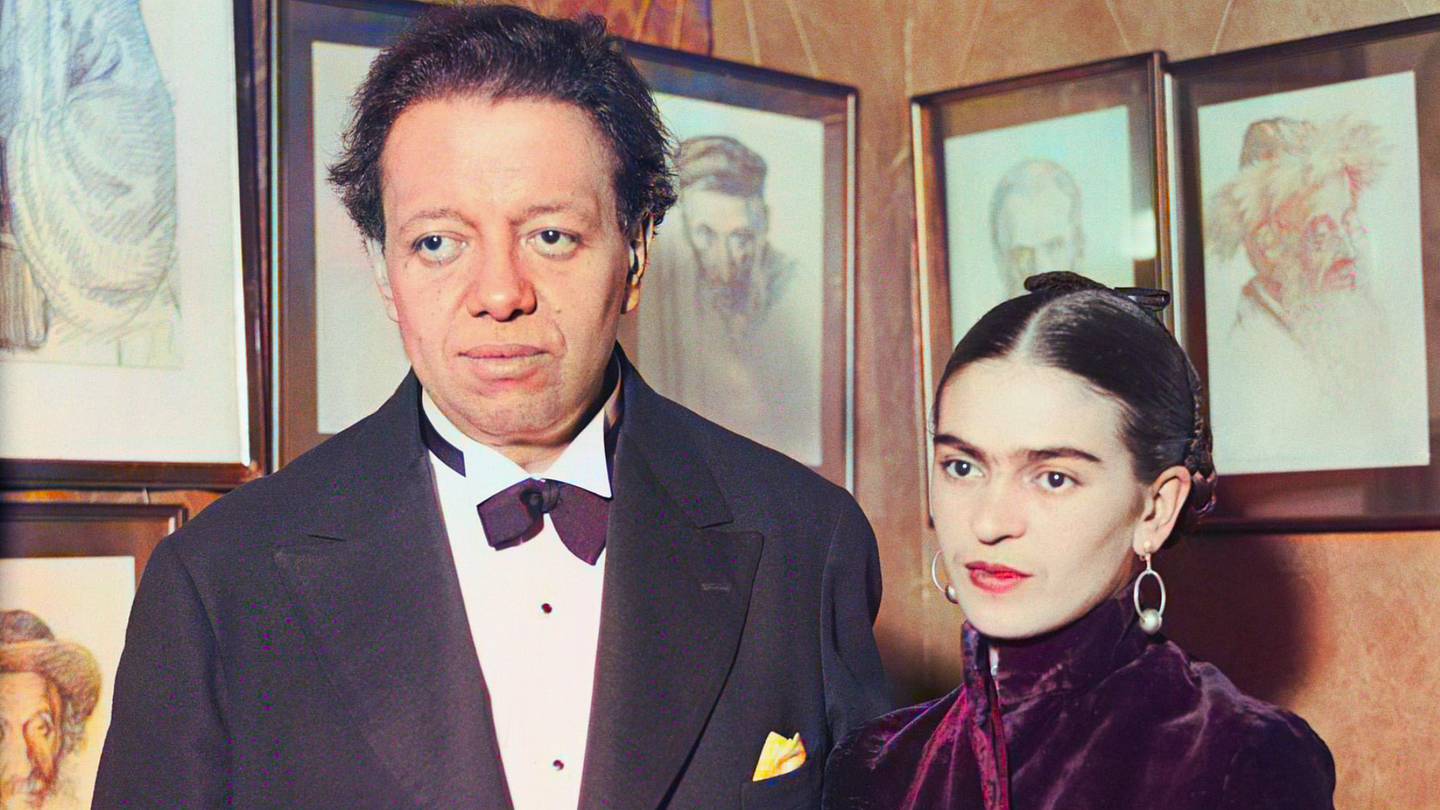
The great Mexican artist Frida Kahlo once claimed to have suffered âtwo serious accidentsâ in her life. One was the notorious and near-fatal streetcar accident she was involved in 1925 at the age of 18, which left her impaled on an iron handrail and left with a dislocated shoulder and multiple fractures in her spine, legs, ribs, and pelvis. The other, she said, was her marriage to Diego Rivera.
An acclaimed artist in his own right, Rivera married Kahlo married in 1929 after a short and tempestuous love affair. Their marriage was just as turbulent, and eventually briefly ended in divorce in 1939âbefore the couple shortly after reconciled, and remarried in 1940, remaining together until Kahloâs death.
The story of their unlikely relationship and fraught marriage has since become the stuff of creative and romantic legend, and today remains just as talked about as their groundbreaking and legendary work.
It was back in 1922, when Rivera was painting a mural at the prestigious National Preparatory School in Mexico City, that a young girlâone of barely 30 female students at the schoolâ swept into the auditorium where he was working and exclaimed, âEn garde, Diego!â Kahlo was just 15 at the time.
âShe was dressed like any other high school student,â Rivera later recalled, âbut her manner immediately set her apart. She had unusual dignity and self-assurance, and there was a strange fire in her eyes.âÂ
At the time of that fateful first meeting, Rivera was married to the model and writer Lupe MarÃn (having already wed and divorced the Russian artist Angelina Beloff while working and studying in Europe). In fact, Lupe was even in the auditorium at the time of Kahloâs arrival into both her and her new husbandâs lives.
After Kahlo first introduced herself, she asked if she could sit and watch Rivera work, telling him that she wished to be an artist herself. After a moment or two, Lupe flew into a jealous rage , yet despite her youth Kahlo was unperturbed and merely held her ground as Lupe confronted her. Eventually, even she had to admit that she was impressed by the young girlâs backbone, saying admiringly, âLook at that girl! Small as she is, she does not fear a tall, strong woman like me. I really like her.â Â
It would be some years before Kahlo and Riveraâs paths would cross again after that first meeting at the preparatory school, with Kahlo later tracking Rivera down while he was working on one of a number of grand murals at Mexicoâs Ministry of Education.
While high up a scaffold working on a fresco, Rivera recalled hearing a womanâs voice call up, âDiego, please come down from there! I have something important to discuss with you!â He looked over the side of the scaffold to see Kahlo, now in her late teens. The two began talking, and Kahlo asked Rivera to cast a critical eye over three of her paintings, which she had brought to the ministry and stowed out of sight beneath a staircase.
Clearly still driven by the same fiery ambition as in their earlier meeting, Kahlo made it clear what she wanted out of the meeting, stating, âI have not come to you looking for compliments. I want the criticism of a serious man. Iâm neither an art lover nor an amateur. Iâm simply a girl who must work for her living.â Rivera was apparently smitten.
The next time Rivera and Kahlo met, Kahlo again invited him to come to her home to look over the rest of her paintings. A few days later, their tempestuous romance began. The couple pursued one another relentlessly, but despite Rivera being almost twice Kahloâs age, neither one ever saw and issue with their relationship, nor, in Riveraâs words, âfelt the least bit awkwardâ about it. Because of the difference between the two of them, in fact, Kahloâs mother merely jokingly labelled them âthe elephant and the dove.âÂ
Because Rivera was still married to Lupe MarÃn at the start of his and Kahloâs romance, the early days of their time together was an affair carried out in secret. Riveraâs pattern of infidelity was already well established by this point, and would continue throughout the coupleâs time together. Kahlo, for her part, would eventually follow suit and embark on a series of love affairs of her own.
Kahlo and Rivera wed in 1929. By that time, Rivera was one of the most famous artists in Mexico, accepting lucrative commissions across the country. Kahlo, meanwhile, was still struggling to establish herselfâand that was far from the only difference that marked out their early years together.Â
While Rivera had been riding high on his fame and renown over the past decade, for instance, Kahlo had been enduring the long and painful recovery from her streetcar accident, and had had to learn how to walk again.
The contrast between the two became all the more nuanced in the early 1930s when, having been expelled from the Mexican Communist party for accepting government commissions just three weeks after their marriage, Rivera relocated the newlywed couple to America. There, Kahlo was desperately unhappy and homesick for Mexico, while Rivera continued to be awarded major contracts, and worked on artworks across the country, in Chicago, San Francisco, and New York.
When Kahlo later insisted they return to Mexico City, however, the tables were turned, and it was Rivera who then felt ill at ease in their home.Â
On their return to Mexico in 1933, Kahlo and Rivera moved into an extraordinary dual-part house in Mexico City, consisting of two art studiosâone blue, the other pinkâconnected by a bridge. The house was an inadvertent representation of the coupleâs marriage, with the two joined together as one, yet essentially living independent lives from one another.
Despite their home becoming a hub of the artistic community in the city, however, Rivera remained unhappy in Mexico and before long had embarked on a tempestuous affair with Kahloâs sister, Cristina. In retaliation, Kahlo moved out of the coupleâs house, and embarked on an affair of her own with fellow artist Isamu Noguchi. A string of affairs with (both men and women) followed, before the coupleâs marriage finally collapsed in 1939.
By the time of their divorce, Kahloâs career and reputation was at long last beginning to take off, and she spent time traveling the world, painting some of what would go on to become her most celebrated work. Not long after her return to Mexico, however, the Soviet revolutionary Leon Trotskyâwhom both Kahlo and Rivera had petitioned the Mexican government to grant asylumâwas brutally murdered in Mexico City.
Kahlo, who had offered Trotsky her childhood home, La Casa Azul, as a refuge, was briefly implicated in the murder. As a result, she was for a short time arrested and questioned along with Cristina. Her health began to fail during this time, and on her release Kahlo travelled to San Francisco for surgery.Â
Rivera, meanwhile, had been known to have previously clashed with Trotsky as his political stance had changed, and not wishing to follow suit and be implicated in the murder, fled to the United States in the aftermath of his death, where he promptly picked up a commission in San Francisco. With fate seemingly intervening to bring them both back together, Kahlo and Rivera were reconciled in San Francisco, and remarried in a quiet civil ceremony in 1940.Â
After their reconciliation, both Rivera and Kahlo continued to work on their respective careers, but Kahloâs health continued to deteriorate. Further medical treatment in the U.S. proved less successful than before, and she was eventually confined to a wheelchair, had to have her leg amputated, and became increasingly reliant on painkillers, and eventually alcohol.
When Rivera began a new love affair, Kahlo became suicidal. Despite it all, however, the couple seemingly remained devoted to one another in their own extraordinary and unlikely way, with Kahlo later writing that despite enduring âcenturies of tortureâ and âwanting to kill myself,â it was the thought of Rivera missing her that stopped her from going through with it.Â
15 years after they had remarried, 26 years after they had first married, and 32 years after they had first met, Frida Kahlo died on July 29, 1955, following years of ill health. By this time she was all but confined to her childhood home, La Casa Azul, in the Coyoacán neighborhood of Mexico City, and it was thereâwhere she and Rivera had also both for many years livedâthat she died in the upper floor bedroom at the age of just 47. Her death mask now lies on the upstairs bed.Â
Kahloâs death has long been the subject of debate, with the official cause of death being listed as a pulmonary embolism, yet many people suggesting that she took an overdose of painkillers.
Either way, Rivera was left devastated , despite maintaining his infidelities until the end. âToo late,â he later admitted, âI realized the most wonderful part of my life had been my love for Frida.â
Shortly after Kahloâs death, Rivera donated La Casa Azul and all of her surviving paintings and sketches to the nation of Mexico, and established a trust, the Fideicomiso de los Museos Diego Rivera y Frida Kahlo, to maintain both the house and the permanent exhibition of Kahloâs work that it contains. Today, the Frida Kahlo Museum in Mexico City remains one of the cityâs most popular attractions.Â
The 2027 Mental Floss Amazing Facts Calendar is now on sale! Order yours today .