In the 1962 film Dr. No , Sean Conneryâs James Bond and his companion Honey Ryder end up in the lavish lair of the titular antagonist. As Dr. Julius No escorts them to dinner, the camera lingers on a gilt-framed painting of a decorated military leader. So does Bond, whose slow double takeâwith the help of an atmospheric music cueâclearly implicates their host as an owner of a piece of stolen art (and, therefore, an obvious villain).
You donât need to recognize the artwork itself to grasp that message, but many moviegoers would have. Itâs an imitation of Francisco Goyaâs The Duke of Wellington âand when Dr. No hit UK theaters in October 1962, the original had been missing from Londonâs National Gallery for more than a year.
The real-life burglar, as the public would come to know him, was about as far from a suave Bond villain as you could get: Kempton Bunton, a 61-year-old Newcastle retiree, was described by The New York Times as a âburly, phlegmatic former truck driver.â
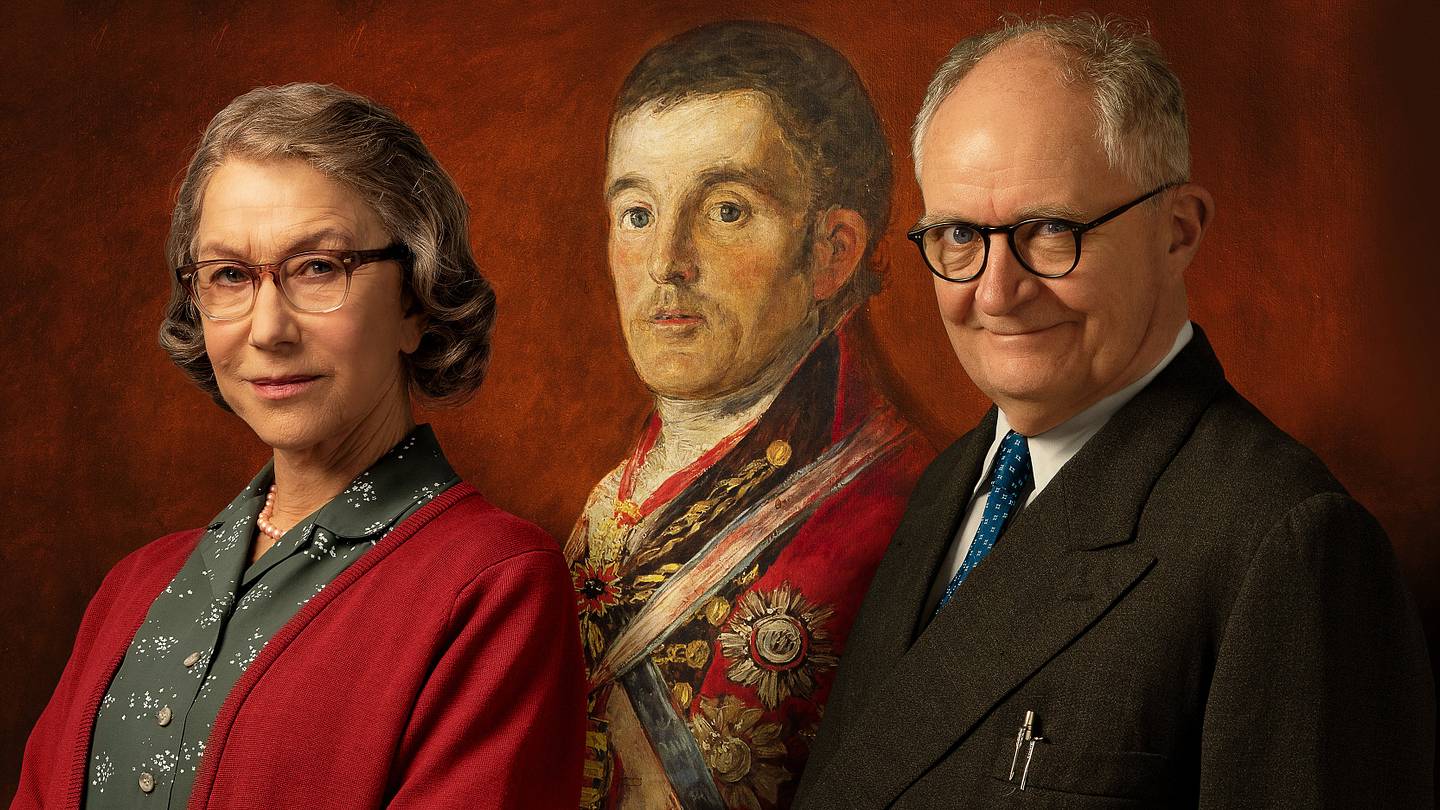
Buntonâs suspiciously well-executed and surprisingly moralistic heist is the subject of The Duke , a charming dramedy starring Jim Broadbent as the thief and Helen Mirren as his wife, Dorothy. Read on for the spoiler-filled history behind the movie.
After besting Napoleon during an 1812 battle in Spain, British commander Arthur Wellesley, 1st Duke of Wellington, alighted in Madrid and posed for two paintings and a sketch by Goya. The Duke of Wellington , depicting Wellesley from the torso up, was passed down privately until John Osborne, 11th Duke of Leeds, auctioned it off in 1961.Â
The roughly 20-inch-by-25-inch portrait was snapped up by American collector Charles Wrightsman for £140,000, the equivalent of about £3.3 million (or $4.3 million) today. But the prospect of the painting leaving the country upset enough patriots that the Wolfson Foundation launched a campaign to buy it back. Wrightsman agreed to sell it at cost, and the government donated £40,000 to the cause.
With The Duke of Wellington back in British hands by early August, it soon went on display in the National Gallery and stayed there for all of 18 days. Then, sometime between 7:40 p.m. and 10:05 p.m. on August 21, 1961 it disappeared . Though museum guards noticed its absence that night, they assumed it had been relocated for some planned reason and failed to raise any alarm until the following morning.
As officials beefed up museum security and investigators sniffed out leads over the next several days, the thief mailed a letter to Reutersâ London news headquarters revealing his motives.
âThe act is an attempt to pick the pockets of those who love art more than charity,â read the letter, which was published in papers on August 31. âThe picture is not, and will not be for saleâit is for ransomâ£140,000âto be given to charity.â As long as a fund was âquickly made upâ and police confirmed âa free pardon for the culprits,â The Duke would be safely returned.
But a fund was not quickly made up, the Duke was not returned, and for the next three-and-a-half years, the only significant updates in the case came from the criminal himselfâin the form of similar missives that showed up sporadically at newspaper offices in London. The initial few reiterated the original terms: the price of the painting donated to charity and a promise not to press charges.
Finally, in a fifth letter dated March 15, 1965, the anonymous Robin Hood appeared to be flagging. âLiberty was risked in what I mistakingly [sic] thought was a magnificent gestureâall to no purpose so far, and I feel the time has come to make a final effort,â he wrote. This time, he asked that the portrait âbe put on private exhibition at a five-shilling view fee for a monthâ and then reinstalled at the National Gallery with a donation box. All proceeds from both operations would go to the charity of his choice.
Scotland Yard didnât bite, but the Daily Mirror did . On the front page of its March 18 issue, the tabloid vowed to do its darnedest to fulfill the burglarâs bargain should he surrender The Duke . After a bit more back-and-forthâthe burglar asking for guarantees, the Mirror providing noneâand several weeks of silence, the Mirror received an envelope containing a ticket from the baggage checkroom of a Birmingham train station. It was given to the authorities, who, on May 22, retrieved an assiduously wrapped parcel from the checkroom.
It was The Duke of Wellington , frameless but unharmed.
Within a week, the portrait was back on display at the National Gallery, the ransomerâs charitable terms unmet. Investigators still pursued him but, yet again, all they really had to do was wait. On July 19, Kempton Bunton entered a London police station and turned himself in.Â
He decided to confess after spilling the beans to someone he worried would unmask him in return for the policeâs promised reward money. According to Alan Hirschâs book The Duke of Wellington, Kidnapped! , Bunton revealed in his unpublished memoirs that the person in question was his son Kennethâs girlfriend, Pamela Smith. Bunton came clean to her after she stumbled upon a draft of one of his ransom letters, and though she vowed to keep the secret, he wasnât convinced.
Bunton's motive for the crime itself could hardly have been clearer. At the time of the theft, the bespectacled father of five was primarily living on unemployment after a pieced-together career of odd jobs. He didnât think working-class retirees should have to pay for the BBC license required to own a TV, and he was spearheading a solitary crusade to do away with it for that demographic. Bunton had tinkered with his own TV so that it didnât receive BBC service at all, which he felt entitled him to skip the fee. Law enforcement disagreed: He served several small stints in jail for his repeated refusal to pay up. The ransom, then, was meant to go toward securing free TV licenses for old-age pensioners.
As for how he managed to pilfer the portrait, Bunton claimed he had scaled a wall, climbed a ladder left out by laborers, and sneaked into the museum through an unlocked bathroom window. Plenty were skeptical that the heavyset 57-year-old actually carried out the heist himself. But with a full confession in hand and no other suspect in sight, authorities charged Bunton.Â
The trial kicked off on November 4, 1965 and lasted 12 days, during which the defendant maintained a ânot guiltyâ plea. The defense, laid out by celebrated barrister Jeremy Hutchinson âwhoâd recently gained fame for upholding Penguin Booksâ right to publish the allegedly âobsceneâ D.H. Lawrence novel Lady Chatterleyâs Lover âwas that Bunton hadnât technically stolen the painting. Instead, heâd simply borrowed it for a while, with every intention of giving it back.
Buntonâs noble cause endeared him to the public, and his buttoned-up gruffness in court provided some entertainment value, too. âHe favored blunt answers, occasionally spiced with apparently inadvertent humor, which brought stifled smiles to faces,â The New York Times reported on November 12.
In the end, Hutchinsonâs argument did the trick. The jury found Bunton guilty of stealing only the frameâwhich has still never been recoveredâbut not The Duke of Wellington . After spending three months in prison for the former offense, he was free.
Though Bunton died in 1976, his story was far from over. For decades, people continued to wonder whether a more physically capable culprit had actually filched The Duke . And in 2012, declassified files appeared to prove those suspicions correct.
In July 1969, when Buntonâs son John was picked up by police for an unrelated incident, he feared that his fingerprints would be matched to those collected during The Duke of Wellington investigation. So he jumped the gun and confessed to the robbery. According to John, heâd presented the painting to his father in the hopes that he could use it as leverage for his TV license initiative. Bunton took his son up on the offer, and then forbade him from taking the fall for the crime.Â
As it turned out, Johnâs fingerprints werenât a matchâand without any other evidence linking him to the heist, it was really just his word against his late fatherâs. Realizing it wouldnât serve them to prosecute on such shaky ground, officials declined to press charges.
During a father-son ferry trip years later, John shared the whole yarn with his then-14-year-old son Chris Bunton. âMy dad likes his beer, so heâd had a few beers and when he told me the story I thought heâd had one too many, to be honest,â he told RadioTimes.com .
But Chris never forgot about his curious family history, and after revisiting it as an adult, he decided it belonged on the silver screen; he even took the first crack at writing a screenplay about it himself. Screenwriters Richard Bean and Clive Coleman eventually stepped in for a thorough edit, amplifying the comedy and smoothing out plot points as needed. In the film, for example, Bunton brings the portrait back to the National Gallery in person, rather than depositing it at a railway station. Chrisâs mother is also a supporting character, though his parents didnât meet until the early 1970s.Â
That said, the filmmakers focused on historical accuracy, too, drawing heavily from court transcripts and Kempton Buntonâs own memoirs. Nothing was completely fabricated; Bunton really did quit a bakery job because someone was being racist toward a co-worker, and his daughter Marion did pass away at a young age. In fact, the photo of Marion seen in the film is the very same one that hung on the Buntonsâ wall.
Overall, the movie captures the deeply human side of a story that has long been characterized as larger than life. And although Buntonâs ransom attempt never succeeded in bringing free BBC to the homes of Englandâs elderly, his dream did eventually come to fruition. In 2000, the broadcaster began issuing gratis licenses to any citizen over age 75. In 2020, the policy was updated to cover only those over age 75 who received pensions.
As for how the film fits into the family legacy, Chris considers it closure. âItâs not something my family [is] proud of, and I think now that itâs been turned into something positive, itâs something we can hopefully be proud of in the future,â he told the BBC .
Loading recommendations... Please wait while we load personalized content recommendations