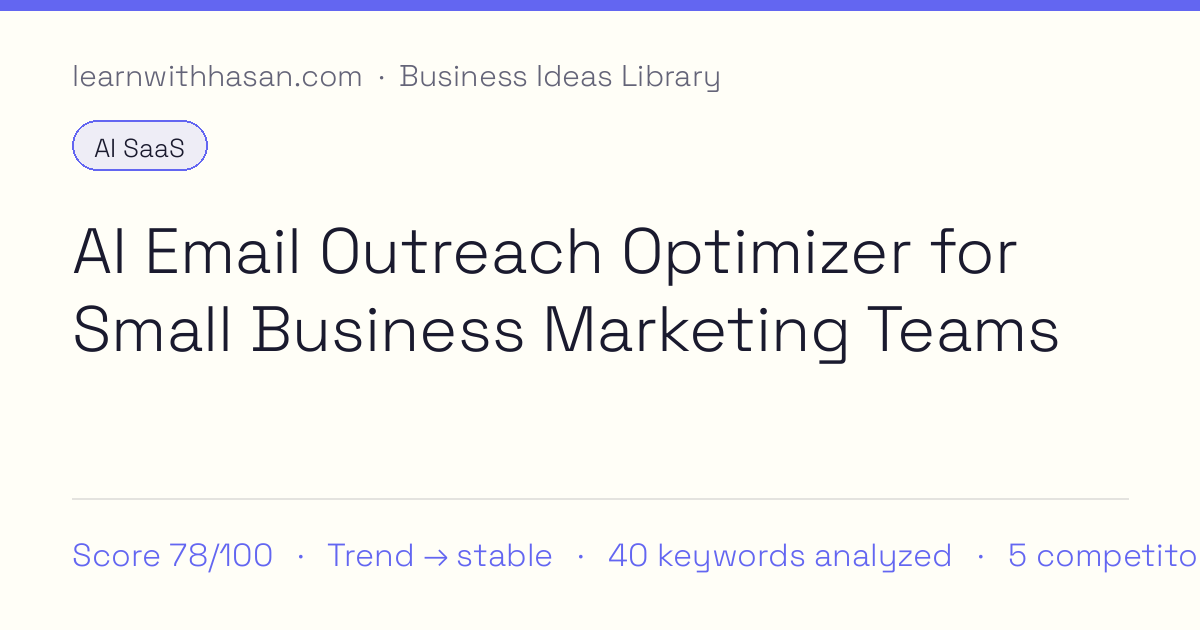
One of the 12 free reports — open in full, no account needed.
Strong demand, room to enter
The revenue model is the strongest signal here — 13.5 of a possible 15 points. Differentiation costs the most, returning 7.5 of 15.
The advisory stack is entirely common, off-the-shelf solo-builder tooling: Next.js + Supabase (auth/DB), Stripe billing, OpenAI for personalization/send-time, and Resend for delivery with open/click tracking, all deployable on Vercel serverless. No hardware, regulatory approval, or scarce data is needed. It docks a few points because email deliverability, inbox warming, and reliable open/click tracking at volume are genuinely hard parts that competitors invest heavily in, making a truly production-grade MVP more than a trivial weekend build.
Willingness to pay is strongly evidenced by high commercial-intent CPCs and paid incumbents. Buyer keywords like 'email marketing tools/tool' at $21.13 CPC and 'email marketing automation' at $14.78 signal advertisers paying dearly for these clicks — a proxy for lucrative paid demand. Established subscription competitors (Mailchimp, ActiveCampaign at $12.35 CPC, Constant Contact at $7.01) confirm a mature paying market. The stated tiered subscription model matches how every incumbent monetizes, so paid demand is obvious and proven.
The AI-outreach space is crowded with direct competitors doing nearly the same thing — Instantly, Lemlist, Saleshandy, and Klenty all offer AI personalization, deliverability, and engagement analytics for small businesses and agencies, with Saleshandy already sizable (40,500 visits/mo, 13,118 keywords). The proposed core features overlap heavily with these players, so there's no obvious moat. However, a niche wedge exists: send-time optimization is a thinner sub-area occupied mainly by Seventh Sense (only 560 visits/mo, 202 keywords), and no listed competitor squarely targets non-sales SMB marketing teams, leaving a defensible angle.
Market demand and competition are computed deterministically from the evidence below. Feasibility, revenue and differentiation are AI-scored against that same evidence, then re-checked by an independent adversarial audit before anything publishes.
Google Trends, indexed 0–100 against this term's own peak · 12-month average 47 · stable
1,164,090 searches a month across all 40 analysed keywords — the 15 biggest are shown. CPC is what advertisers pay for a click, which is the closest thing to a price signal a keyword carries.
Provides an AI-driven email outreach platform for small businesses and agencies that automates campaign sending, personalization, and deliverability across large contact volumes.
Offers a sales outreach platform with AI-personalized email copy, images, and multichannel sequences plus engagement analytics for small teams and agencies.
Runs AI-generated cold email sequences with automated personalization, deliverability tools, and reply/engagement tracking for small business and agency outreach.
Automates multichannel cold outreach campaigns with AI-assisted personalization and performance analytics aimed at sales teams and agencies.
Uses AI to optimize individual email send times and frequency for HubSpot and Marketo users to raise open and click-through rates.
A solo builder would use Next.js with Supabase for the database and auth, integrate Stripe for subscription billing, connect to OpenAI for email personalization and send-time optimization, and use Resend for reliable email delivery with open/click tracking. Deploy the frontend to Vercel for one-click deploys and the backend as serverless functions.
Every idea in the library gets this same treatment — the score breakdown, the keyword evidence, the graded competitors and the build stack. The Solo Builder Complete bundle opens all of them.
Strong demand, room to enter. Search demand is the strongest signal here — 31.5 of a possible 35 points.
Strong demand, room to enter. The revenue model is the strongest signal here — 13.5 of a possible 15 points.