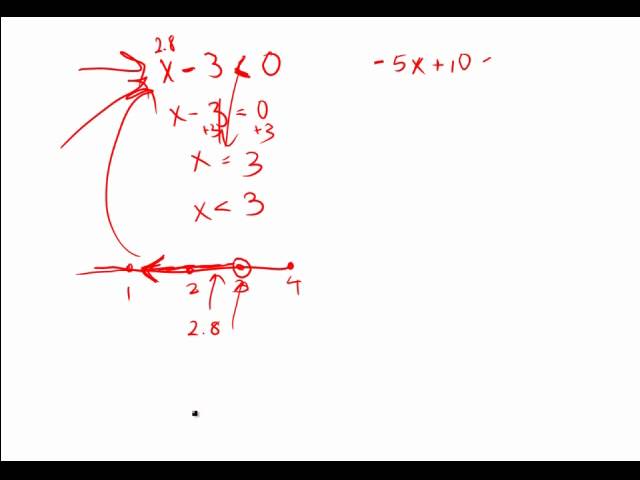
The inequality sign is far more intimidating than it need be. In many cases, just think of the inequality sign as an equal sign. Which case that is will be described below – along with the instance in which you have to switch the sign. But with a little bit of practice, inequality should be the least of your worries on the GRE.
Note how the sign is tapered on the left side. The smaller side of the inequality corresponds to the smaller value. In this case, x – 3 is less than zero.
The first step is to change the inequality sign into an equal sign.
Now place the inequality sign in the same place it was: x < 3.
See, that wasn’t too bad. Now let’s introduce a new sign: the less than equal sign.
Again, replace sign with an equal sign and solve:
To interpret this mathematically speaking, we need a number line. In this little video I will show you how the number line relates to inequalities.
But things aren’t always that straightforward. If the variable in an inequality is multiplied by a negative number (e.g. -2x), then we have to change the sign.
Again repeat steps, but because we are dividing by a -2, at the very end we must flip the sign, so > becomes <.
It’s always a good idea to test your answer. So let’s plug in a value less than -2, say -4, and see if it satisfies the original equation:
Because 9 > 5, we clearly pointed the sign in the right direction.
If this was a little basic for you, I will have an advanced inequality post coming soon.
The inequalities you see on the GRE will be pretty basic. As long as you understand the above, you should be ready for the test.
To find out where inequalities sit in the “big picture” of GRE Quant, and what other Quant concepts you should study, check out our post entitled:
What Kind of Math is on the GRE? Breakdown of Quant Concepts by Frequency
Chris graduated from UCLA with a BA in Psychology and has 20 years of experience in the test prep industry. He’s been quoted as a subject expert in many publications, including US News , GMAC , and Business Because .